
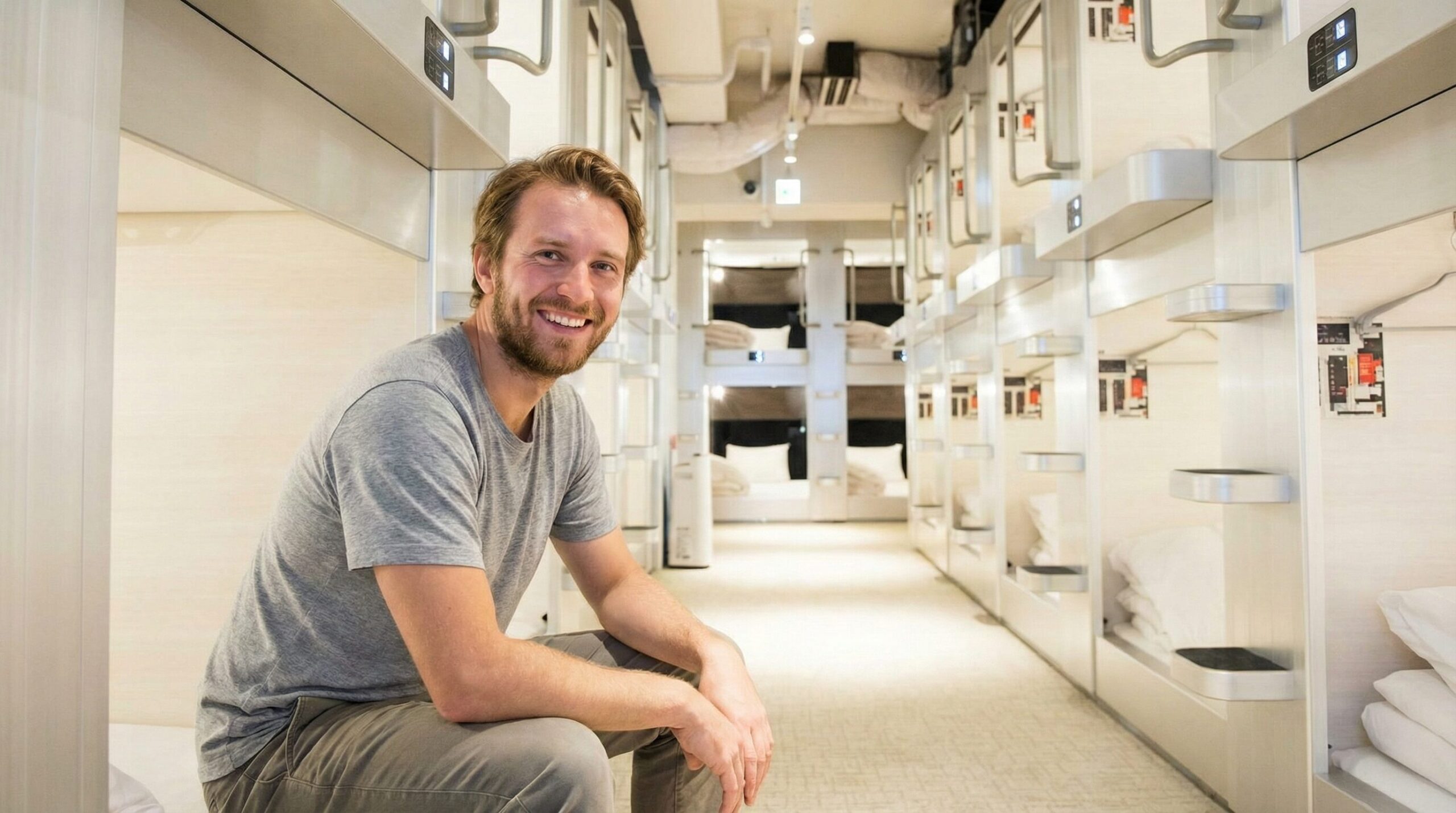
Tokyo is a city of verticality. When you run out of land, you build up. And when you run out of room, you shrink the space. For the uninitiated Western traveler, the concept of the “Capsule Hotel” often evokes images of dystopia—rows of honeycomb cells, cramped quarters, and a lack of humanity.
But to view the capsule hotel merely as a “cheap place to crash” is to miss one of the most fascinating cultural experiences Japan has to offer. Born in the economic boom of the 1970s by the legendary architect Kisho Kurokawa, the capsule hotel is not a coffin; it is a cockpit. It is a masterclass in minimalism and efficiency.
It strips the hotel experience down to its absolute atomic necessities: a bed, a bath, and silence. For the budget traveler in 2026, Tokyo’s hotel prices can be formidable. But the capsule offers a loophole. It allows you to stay in the most expensive districts—Shinjuku, Shibuya, Akihabara—for a fraction of the cost of a business hotel.
This guide to the Best Capsule Hotels in Tokyo for Budget Travelers is not just about saving money. It is about embracing a uniquely Japanese way of existing: finding total privacy within a shared space.
The Capsule Ecosystem: How It Actually Works
Before we list the hotels, we must debunk the fear. Many travelers avoid capsules because they don’t understand the “system.” A capsule hotel is more like a spa that you sleep in than a hostel.
The Anatomy of a Stay
Unlike a standard hotel where you walk into your room with your shoes on, the capsule hotel operates on a strict sequence of zones.
- The Genkan (Entrance): You remove your shoes immediately. You place them in a shoe locker and exchange the key for a wristband. This wristband is your identity, your wallet, and your key for the duration of your stay.
- The Locker Room: You do not take your suitcase into the capsule. The sleeping floor is a sanctuary of silence. You leave your luggage, clothes, and worldly possessions in a narrow metal locker. You change into the provided “kanban” (loungewear or gown).
- The Bath (Sentō): Most high-quality capsule hotels feature a large communal bath and sauna. This is the heart of the experience. Washing the city grit off your body before entering the sleeping zone is a ritual.
- The Pod: You enter the sleeping room. It is dark, smelling faintly of fresh linen. You crawl into your pod. Inside, you have light controls, a charging port, and often a TV. You pull the roll screen or blind (it doesn’t lock—by law), and you are alone.
The Code of Silence
The most striking feature of a capsule floor is the silence. Despite having 50 people in one room, it is often quieter than a library. The sound of rustling plastic bags is the enemy. The Japanese cultural value of meiwaku (not causing trouble for others) is in full effect here. It is a communal agreement to maintain peace.
Top Recommendations: The Best Capsule Hotels in Tokyo for Budget Travelers
We have selected these locations not just for their price, but for their cleanliness, safety, and distinct “personality.”
Nine Hours (9h): The Sci-Fi Minimalist
Locations: Narita Airport, Otemachi, Hamamatsucho, Ningyocho Vibe: Clinical, Futuristic, Photogenic
If Apple designed a hotel, it would be Nine Hours. This chain has stripped away everything extraneous. There are no TVs in the pods. There are no manga libraries. There is only black and white design and curves.
- The Concept: 1 hour to shower + 7 hours to sleep + 1 hour to rest = 9h. It is designed for pure transit efficiency.
- The Pod: The “Sleep Pod” looks like a spaceship airlock. The interior is a smooth, seamless white plastic that feels surprisingly spacious because the curves eliminate corners.
- Why it’s a Winner: For design lovers, it is a dream. The Otemachi location is particularly good for runners, as it connects directly to the Imperial Palace jogging route.
- Budget Note: Prices fluctuate, but booking early can secure a pod for under 4,000 JPY.
Anshin Oyado: The “Salaryman” Luxury Resort
Locations: Shinjuku, Akihabara, Shimbashi (Primarily Men-only chain; strictly check availability for women) Vibe: Bali Resort meets Manga Cafe
While Nine Hours is minimal, Anshin Oyado is maximal. It targets the exhausted Japanese businessman, and as a result, the amenities are incredible.
- The “All-Inclusive” Value: This is arguably the best value for money in Tokyo. The price often includes:
- Unlimited soft drinks and alcohol (evening happy hours).
- All-you-can-eat morning curry and rice.
- A massive library of manga.
- High-end massage chairs.
- Every toiletry imaginable (razors, Gatsby wipes, hair gel).
- The Bath: The artificial hot springs here are legitimate. After a day of walking 20,000 steps in Tokyo, soaking in their jet bath is a lifesaver.
- The Crowd: You will be sleeping alongside real Tokyo workers. It is an authentic cultural immersion.
Smart Stay SHIZUKU: The Sauna Sanctuary
Locations: Ueno, Oimachi Vibe: Zen, Wooden, Relaxing
“Shizuku” means “droplet,” and the focus here is on purity and relaxation.
- The Design: Unlike the plastic of Nine Hours, Shizuku uses wood tones and warm lighting to create a calming atmosphere.
- The Sauna: This place is famous among “Saunners” (sauna enthusiasts). Their facilities are top-tier, offering high temperatures and proper cold plunges.
- Location: The Ueno location is perfect for travelers visiting the museums and Ueno Park. The Oimachi location is a hidden gem with easy access to Shibuya via the Rinkai line.
The Millennials: The “Smart Pod” Hybrid
Locations: Shibuya Vibe: Social, Digital Nomad, Hip
If you are claustrophobic or want a social vibe, The Millennials bridges the gap between a hostel and a capsule.
- The “Smart Pod”: These aren’t stacked bunks. They are single-level units with high ceilings. The bed is an electric sofa-bed; you can set an alarm that wakes you up by slowly raising the bed to a seated position (lights turn on gently). It is a silent, gentle wake-up call.
- The Common Area: Unlike most capsule hotels where you hide in your pod, The Millennials features a massive coworking space and kitchen. It attracts international travelers and creatives.
- Budget Note: It is slightly more expensive (6,000–8,000 JPY), but for the location (right in Shibuya) and the workspace, it is a bargain compared to a hotel.
First Cabin: The “Business Class” Experience
Locations: Akasaka, Ichigaya, Haneda Airport Vibe: Airline Lounge, upscale, Spacious
Technically, these are “cabins,” not capsules. First Cabin mimics the first-class section of an airplane.
- The Height: You can stand up in your cabin. This is the game-changer. There is no crawling involved. You have a sliding accordion door (which closes magnetically but cannot be locked due to Japanese law) and a small table.
- The Classes: They offer “First Class” (wider bed, table space) and “Business Class” (standard capsule width but high ceiling).
- Why choose it: If you have large luggage you want to keep close (First Class cabins have space for a bag), or if the idea of a stacked bunk terrifies you, this is your safety zone.
Practical Tips for the Capsule Traveler
Surviving and thriving in a pod requires a specific set of skills.
The “Consecutive Stay” Rule
This is the most confusing rule for beginners. In traditional capsule hotels, you must check out every morning (usually by 10 AM) and check back in at 3 PM, even if you booked for a week.
- Why? They need to deep clean the pods and change the sheets daily.
- The Locker: You can usually keep your big luggage in the locker or front desk, but you cannot stay in the pod during the day. (Note: Modern places like The Millennials or Nine Hours often allow you to stay, but always check).
Luggage Logistics
Capsule lockers are thin. They fit a backpack or a suit jacket. They do not fit a massive 80L suitcase.
- The Solution: Most hotels have a designated “Luggage Area” near the front desk where large bags are chained up or stored. You will need to unpack your pajamas and toiletries in the lobby before heading to the locker room. Pack a small “pod bag” or tote inside your suitcase for this purpose.
The Alarm Clock Dilemma
Do not use a sound alarm. If your phone starts ringing at 6:00 AM, you will be the most hated person on the floor.
- The Solution: Use your phone’s vibration alarm and place it under your pillow. Or, wear a smartwatch with a haptic wake-up feature. The silence of the room amplifies all sounds.
Gender Separation
Most capsule hotels are strictly gender-separated by floor or by elevator.
- Couples: You will not sleep together. You will likely say goodbye in the lobby and meet again at breakfast. See it as a chance for a solo retreat within your couples’ trip.
- Women-Only Floors: Safety is taken very seriously. Keycards restrict access to female floors, and many chains (like Nine Hours) have entirely separate elevators for men and women.
Conclusion
The Best Capsule Hotels in Tokyo for Budget Travelers offer more than just a low price tag. They offer a story.
There is something profoundly meditative about the capsule experience. After a day of sensory overload in Tokyo—the neon lights of Akihabara, the scramble of Shibuya, the density of the Yamanote Line—crawling into your white, silent pod feels like entering a decompression chamber.
It is a reminder that you don’t need much to be content. A clean set of pajamas, a hot bath, and a quiet corner of the world are often enough.
So, for one night at least, skip the Western hotel chain. Leave your shoes at the door, put on the kanban, and sleep inside the future. It is one of the most “authentic” Tokyo nights you can have.