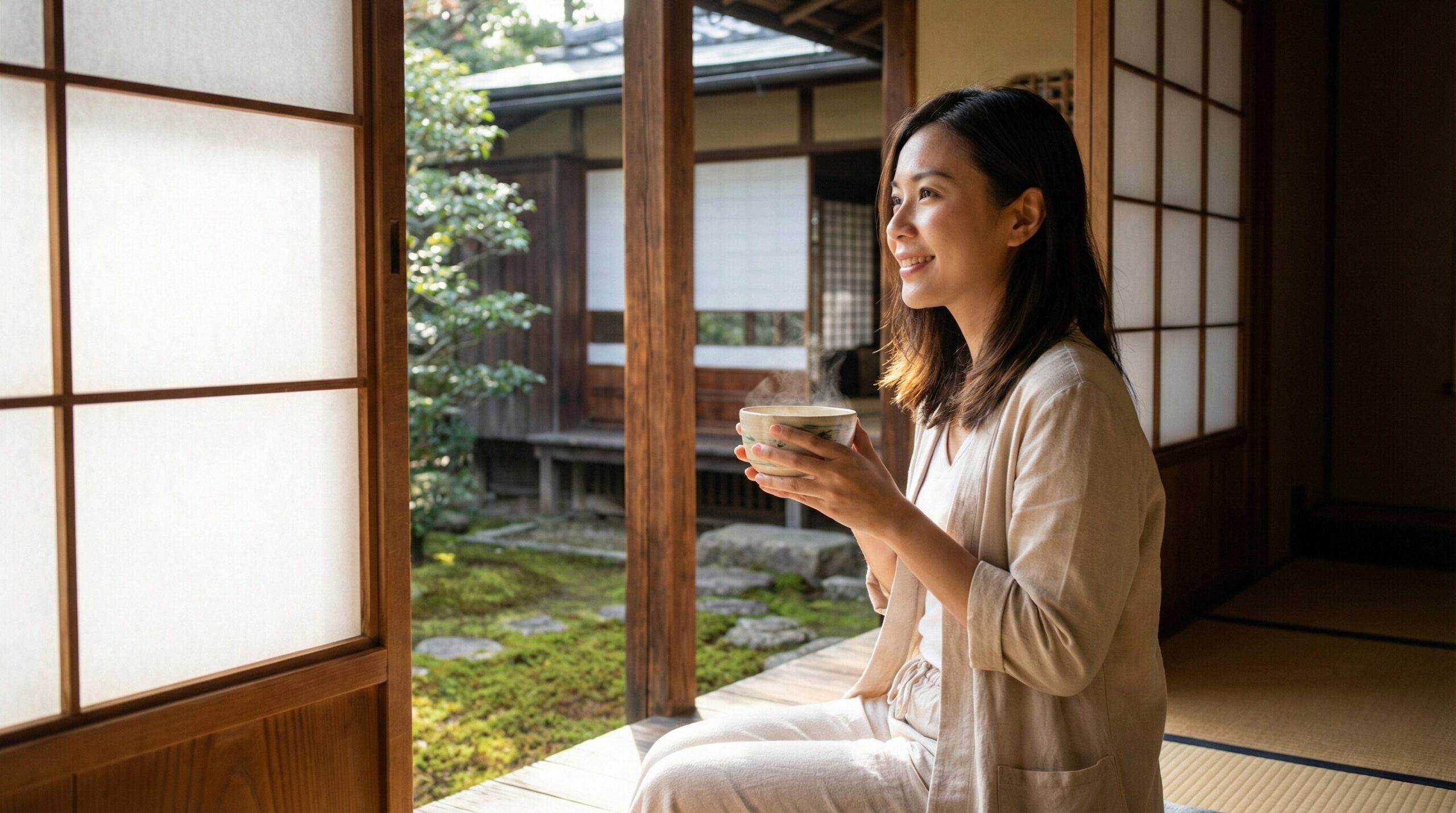
There is a version of Kyoto that exists on Instagram: the vibrant orange of Fushimi Inari’s gates, the golden reflection of Kinkaku-ji, and the bustling streets of Ninenzaka packed with rental kimonos and matcha soft-serve. But there is another Kyoto.
It is found in the hush of a bamboo grove after the tourists have left, or in the scent of wet moss after a morning rain. This is the Kyoto of shadows and silence, where time seems to pool in the corners of old rooms. Nowhere is this spirit more palpable than in the city’s traditional tea houses (chashitsu).
For the traveler seeking “Beyond Nippon,” a tea house is not just a place to drink green tea. It is a sanctuary. It is a lesson in Ichigo Ichie (一期一会)—the concept that this moment, this meeting, will never happen again in exactly the same way. While the famous tea houses of Gion offering geisha performances are spectacular, they often feel performative. To touch the real heart of Kyoto, you must venture off the beaten path. You must find the places where the locals go to listen to the sound of the kettle boiling—a sound the Japanese poetic imagination likens to wind in the pines.
Here is your guide to Kyoto’s lesser-known tea houses, where the tea is bitter, the sweets are seasonal, and the silence is profound.
- The Culture of Silence: Understanding the “Way of Tea”
- Saryo Hosen: The Garden of Serenity (Shimogamo)
- Koto-in: The Samurai’s Zen (Daitoku-ji)
- Shoren-in Monzeki: The Emperor’s View (Higashiyama)
- Bikouen: The Authentic Merchant’s Tea (Nishi Honganji Area)
- Okochi Sanso Tea House: The Reward at the End of the Grove (Arashiyama)
- Understanding the Menu: A Quick Guide
- Practical Tips for the Tea Traveler
- Conclusion
The Culture of Silence: Understanding the “Way of Tea”
Before we step through the sliding doors, it is vital to understand what we are entering. The Japanese Tea Ceremony (Sado or Chado) is often misunderstood by the West as a rigid set of rules. While the etiquette is complex, the core philosophy is simple: respect.
Respect for the guest, respect for the seasons, and respect for the utensils. In a traditional tea house, the hanging scroll (kakejiku) in the alcove is chosen specifically for the day’s weather or the guest’s journey. The flower arrangement (chabana) is minimal—often a single bud—to symbolize the fleeting nature of life.
When you visit the places listed below, you are not just a customer; you are a participant in this centuries-old dialogue. You don’t need to be a master of etiquette. You simply need to be present. Put away your phone, breathe in the tatami scent, and let the atmosphere wash over you.
Saryo Hosen: The Garden of Serenity (Shimogamo)
Located in the quiet residential district of Shimogamo in northern Kyoto, Saryo Hosen feels worlds away from the frantic energy of Kyoto Station. This is not a place you stumble upon; you go here with intention.
The Atmosphere
The tea house is a traditional sukiya-style building with a verified pristine Japanese garden. Unlike many cafes where the garden is a backdrop, here it is the main event. The seating is on tatami mats, with low tables positioned to frame the garden view perfectly. There is no background music—only the sound of the shishi-odoshi (bamboo deer scarer) clacking periodically in the garden.
The Specialty: Warabi-mochi
Saryo Hosen is revered by Kyoto locals for one specific dish: Warabi-mochi. Most warabi-mochi sold in convenience stores is made from potato starch. Real warabi-mochi, made from the root of the bracken fern, is dark, incredibly elastic, and rare.
At Saryo Hosen, it is made fresh to order. It arrives glistening and translucent, with a deep amber hue characteristic of pure bracken starch. You eat it with kuromitsu (black sugar syrup). The texture is a revelation—it is neither jelly nor gum; it melts yet resists, a texture the Japanese call mochi-mochi.
Why Go?
To experience the “luxury of doing nothing.” It is a place to watch the moss grow.
- Location: 25 Shimogamo Nishitakagicho, Sakyo Ward
- Nearest Station: Demachiyanagi Station (then a 15 min walk or short taxi)
- Best Time: Weekday mornings right after opening (10:00 AM).
Koto-in: The Samurai’s Zen (Daitoku-ji)
Daitoku-ji is a sprawling Zen temple complex in northern Kyoto that serves as the headquarters for the Rinzai school. While the main temple is impressive, the magic lies in its sub-temples (tatchu). Among them, Koto-in is a masterpiece of solitude.
The Approach
The journey begins before you even taste the tea. You walk down a long, narrow stone path shaded by a canopy of bamboo and maple trees. The light here is always green and diffused. It acts as a decompressed chamber, stripping away the noise of the city before you reach the gate.
The Tea Experience
Koto-in was established by Hosokawa Tadaoki, a samurai lord and a master of tea. The main guest hall here overlooks a garden famous for its simplicity—just moss, maples, and a single stone lantern. Unlike the polished gold of other temples, everything here is rustic and dark.
You are served a bowl of matcha and a simple seasonal sweet on the veranda (engawa). Sitting here, legs dangling or folded, staring into the deep shade of the maples, you understand why samurai sought refuge here between battles.
(Note: Koto-in occasionally closes for preservation work. Always check the Daitoku-ji website or ask your hotel concierge before heading north. If closed, the nearby Ryogen-in or Zuiho-in are worthy alternatives within the same complex.)
- Location: 73-1 Murasakino Daitokujicho, Kita Ward
- Access: City Bus to Daitokuji-mae.
- Vibe: Deep Zen, masculine elegance, shadows.
Shoren-in Monzeki: The Emperor’s View (Higashiyama)
While tourists swarm the massive Chion-in temple next door, Shoren-in remains a quiet pocket of grace. As a Monzeki temple, its head priests were historically members of the Imperial family, and the architecture reflects this aristocratic elegance.
The Experience
Here, you don’t just sit in a cafe; you sit in the formal guest rooms of the temple. The tea service is usually held in the Kacho-den drawing room, which opens entirely to the garden. The view is breathtaking. Giant camphor trees, centuries old, frame a garden that seems to rush up the hillside.
The matcha is served with a sweet bun labeled with the temple’s crest. What makes Shoren-in special is the accessibility of its beauty. You can sit on the tatami for as long as you like. The sheer scale of the open room allows the breeze to flow through, carrying the scent of incense and old wood. It is one of the few places in Higashiyama where you can find genuine space to breathe.
- Location: 69-1 Awataguchi Sanjobocho, Higashiyama Ward
- Access: 5 min walk from Higashiyama Station (Tozai Line).
- Tip: Visit in late October or November for the autumn foliage illuminations, though daytime is better for quiet contemplation.
Bikouen: The Authentic Merchant’s Tea (Nishi Honganji Area)
For those who want to buy tea as well as drink it, Bikouen offers a connection to history without the pretension. Established in 1872, this shop has long been the purveyor of tea to the Nishi Honganji temple and the Yabunouchi school of tea ceremony—the oldest surviving tea school.
The “Real” Matcha
Many cafes in Kyoto serve “cooking grade” matcha sweetened with sugar. Bikouen serves the real thing. Their cafe space is unpretentious, but the quality of the tea is top-tier.
Here, you can try Koicha (thick tea). In a standard tea ceremony, thin tea (usucha) is common. Koicha is a thick, dark green paste, almost like paint, made from the very highest quality leaves. It is an intense explosion of umami—savory, grassy, and sweet, with no bitterness. It is a flavor profile that challenges the Western palate but rewards the adventurous.
Why Go?
This is a place for tea geeks. The staff are incredibly knowledgeable (and patient with foreigners). It’s less about the garden view and more about the liquid in the bowl.
- Location: 580 Yakuen-cho, Shimogyo Ward (Zip: 600-8347)
- Access: 10 min walk from Kyoto Station (near Nishi Honganji).
- Best for: Buying souvenirs that real tea lovers will appreciate.
Okochi Sanso Tea House: The Reward at the End of the Grove (Arashiyama)
Arashiyama’s Bamboo Grove is arguably the most crowded spot in Kyoto. But if you walk all the way to the back, past where the Instagram crowds stop to turn around, you find the entrance to Okochi Sanso Villa.
The Villa
This was the private estate of Denjiro Okochi, a famous samurai film star of the 1920s. He spent 30 years and his fortune building this garden. It is a masterpiece of borrowed scenery, using the mountains of Arashiyama as a backdrop.
The Tea House
The entrance fee (usually around 1,000 yen) is steeper than most temples, which keeps the casual crowds away. Crucially, the ticket includes a matcha and sweet in the villa’s tea house.
Hidden in the bamboo, the tea house offers a view of the garden that feels private and exclusive. After fighting through the crowds of the bamboo grove, sitting here with a hot bowl of bitter tea and a sweet monaka (wafer cake) feels like reaching an oasis. It is the perfect strategic stop to recover your energy.
- Location: 8 Tabuchiyama-cho, Saga Ogurayama, Ukyo Ward
- Strategy: Go to the Bamboo Grove at 7:30 AM. Walk to the end. Enter Okochi Sanso right when it opens at 9:00 AM. You will have the garden to yourself.
Understanding the Menu: A Quick Guide
When you visit these places, the menu might be simple, but the nuances are deep.
- Matcha (抹茶): Powdered green tea. Usually served as Usucha (thin tea). Frothy and bitter-sweet.
- Sencha (煎茶): Steeped leaf tea. The standard high-quality green tea of Japan. Look for a balance of sweetness and astringency.
- Gyokuro (玉露): “Jade Dew.” The highest grade of shaded leaf tea. It is brewed at a low temperature (50-60°C) and tastes like savory broth. A delicacy.
- Wagashi (和菓子): Traditional sweets.
- Namagashi: Fresh, soft confections, often shaped like seasonal flowers.
- Higashi: Dry, sugary sweets pressed into shapes.
- Zenzai: Sweet red bean soup with mochi. A winter favorite.
Practical Tips for the Tea Traveler
Socks Matter
In almost all traditional tea houses, you will be asked to take off your shoes. Walking on tatami requires socks. In formal tea ceremonies, white socks are mandatory, but for these casual visits, any clean socks are acceptable. Never go barefoot. It is considered disrespectful to the host and the mats.
The “Sweet First” Rule
You will usually be served the sweet (wagashi) before the tea. Eat the sweet first. The sweetness is designed to coat your tongue, balancing the bitterness of the matcha that follows. If you eat them together or eat the sweet after, you miss the intended harmony of flavors.
Don’t Fear the Bowl
If you are served a bowl with a beautiful design, you might see others turning the bowl before drinking. This is to avoid drinking from the “front” or the “face” of the bowl (the most beautiful part), so that others can admire it.
Simple version: Pick up the bowl with your right hand, place it on your left palm. Turn it clockwise twice gently. Drink. Wipe the rim with your fingers (wipe fingers on a paper). Turn it back counter-clockwise. Admire the bowl. If you forget this, don’t panic. Intent matters more than form.
Silence is Golden
These are quiet spaces. Conversations should be kept to a low murmur. The soundscape—water boiling, birds chirping, wind—is part of the menu.
Conclusion
Kyoto is a city that requires patience. It doesn’t give up its secrets to those who rush from the Golden Pavilion to the Fushimi Inari shrines in a single morning. To find the “Real Japan,” you must stop moving. You must sit down.
In these lesser-known tea houses, you find the antidote to modern travel burnout. You find a connection to the generations of people who have sat on these same tatami mats, looking at the same gardens, finding peace in the same bitter green foam.
So, on your next trip, skip the line at the trendy cafe. Walk a little further. Find the wooden gate with the small fabric noren curtain fluttering in the wind. Slide the door open. “Irasshaimase.” Welcome to the silence.
Travel Deeper. Explore the Real Japan.