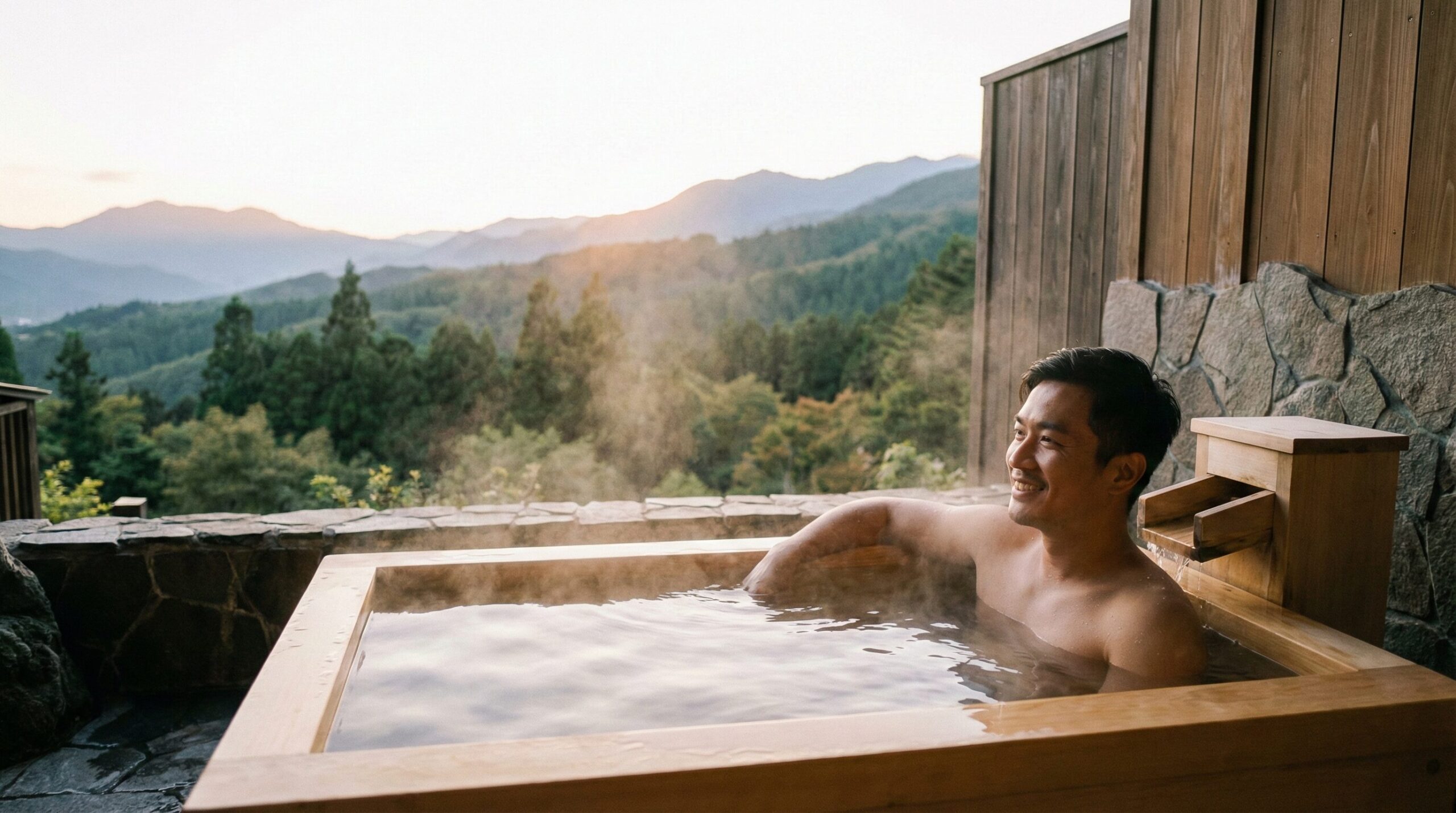
There is a moment that defines the perfect trip to Japan. It isn’t standing in the scramble crossing of Shibuya, nor is it snapping a photo of the Golden Pavilion. It is the moment you slide open the paper screen of your room, step out onto a wooden terrace, and find steam rising into the cool mountain air from your own private hot spring.
For the traveler seeking to go Beyond Nippon, the public dai-yokujo (large bath) is an incredible cultural experience. But the Rotenburo Tsuki Kyaku-shitsu (guest room with a private open-air bath) is something else entirely. It is a sanctuary.
It is the ability to soak at 2:00 AM under a full moon, with a glass of local sake floating on a cypress tray, listening to nothing but the wind in the maple trees. This is the ultimate expression of Omotenashi (Japanese hospitality)—an experience of total privacy and profound connection with nature.
However, finding these gems can be difficult. The term “luxury” is often overused, and booking sites can be confusing. This guide curates the Top Ryokan with Private Outdoor Baths, focusing not just on the hardware, but on the soul of the inn—the authentic food, the history, and the view that awaits you.
- Understanding the Terminology: What Are You Booking?
- The Northern Retreat: Chikusenso (Miyagi Prefecture)
- The Hidden Village: Takefue (Kumamoto, Kyushu)
- The Icon of Elegance: Gora Kadan (Hakone)
- The Cliffside Wonder: Bousui (Izu Peninsula)
- The Samurai Estate: Wanosato (Gifu Prefecture)
- Practical Guide: How to Book & Behave
- Conclusion: The Luxury of Time
Understanding the Terminology: What Are You Booking?
Before we list the destinations, it is vital to understand the vocabulary. A mistake here can lead to disappointment.
- Rotenburo (露天風呂): An open-air bath.
- Kashikiri-buro (貸切風呂): This is a private rental bath. It is not in your room. It is a separate bath in the facility that you reserve for 45–60 minutes.
- Rotenburo Tsuki Kyaku-shitsu (露天風呂付客室): This is the gold standard. A guest room attached with a private open-air bath. This is what you want.
Why choose a private bath?
- Tattoo Friendly: Public onsens often ban tattoos. In your private room, there are no rules.
- Couples & Families: Traditional public baths are gender-separated. A private bath allows couples to share the experience (konyoku).
- Meditative Silence: There is no chatter from other guests. Just you and the water.
The Northern Retreat: Chikusenso (Miyagi Prefecture)
We begin in Tohoku, the rugged northern region known for its “Real Japan” authenticity. Nestled in the Zao mountain range, Chikusenso Mt. Zao Onsen Resort & Spa blends traditional aesthetics with modern luxury.
The Experience
Chikusenso feels less like a hotel and more like a feudal lord’s mountain villa. The lobby features a massive bronze bell, setting a tone of Zen solemnity.
The Room: Book the “Executive Suite with Open-Air Bath.” The bath is usually made of cypress or stone, located on a terrace overlooking the virgin forest of the Zao National Park.
The Water: The spring water is drawn from the historic Togatta Onsen, known as “Bijin no Yu” (Spring of Beauty). It is gentle on the skin and famous for its healing properties.
The Vibe: In winter, you are soaking surrounded by walls of snow. In autumn, the forest is on fire with red and gold leaves. It is pure silence.
- Location: Zao, Miyagi Prefecture.
- Access: 1 hour by shuttle bus from Sendai Station (which is 90 mins from Tokyo by Shinkansen).
- Best Season: Winter (January–February) for the “snow viewing” bath.
The Hidden Village: Takefue (Kumamoto, Kyushu)
If you want to disappear from the world, go to Takefue. Located near the famous Kurokawa Onsen but hidden deep within a 5,000-tsubo bamboo forest, this is arguably the most atmospheric ryokan in Japan.
The Experience
“Takefue” literally means “Bamboo Flute.” The entire property is immersed in a dense bamboo grove.
The Room: There are only 12 rooms, each utterly unique. The “Sayo” room is legendary. Its private bath is not a tub; it is a pool. It is large enough to swim in, fed by 100% free-flowing hot spring water, and surrounded by bamboo stalks lit up at night.
The Details: The level of detail is insane. In the fridge, the sodas and juices are free. In the bath, you might find a floating wooden boat carrying sake. The dinner is Kaiseki served in your room, often featuring Kumamoto’s specialty: Basashi (horse sashimi) and Aka-ushi Beef.
- Location: Minami-Oguni, Kumamoto.
- Access: 2 hours by bus from Fukuoka Airport. It is remote, but they offer a private limousine pickup from the bus stop.
- Warning: It is incredibly popular. You must book 6–12 months in advance.
The Icon of Elegance: Gora Kadan (Hakone)
For those who want history and prestige near Tokyo, Gora Kadan is the benchmark. Located in the grounds of a former imperial family summer villa, it is a member of Relais & Châteaux.
The Experience
This is where traditional Ryokan architecture meets modern design. The long, glass-enclosed hallway overlooking the garden is iconic.
The Room: The rooms here are vast. The private outdoor baths are often made of smooth rocks, fed by mineral-rich volcanic water from the Owakudani valley. The steam rising from your bath blends with the mists of the Hakone mountains.
The Service: The Nakai-san (room attendant) here is the epitome of professionalism. They anticipate your needs before you know them.
The Food: The Kaiseki dinner is visually stunning, reflecting the micro-seasons of Hakone.
- Location: Gora, Hakone.
- Access: A comfortable 90-minute “Romancecar” train ride from Shinjuku, Tokyo.
- Vibe: Sophisticated, polished, and foreigner-friendly without losing authenticity.
The Cliffside Wonder: Bousui (Izu Peninsula)
While mountains are classic, there is something primal about the ocean. Bousui, located on the east coast of the Izu Peninsula, offers a bath experience where the horizon line disappears.
The Experience
Bousui sits literally on the water’s edge.
The Room: Ask for a room with a “Moon Gazing Bath.” These are wooden tubs located on terraces that hang over the Sagami Bay. The sound of the waves crashing against the rocks below is your soundtrack.
The Sunrise: You leave your curtains open here. You wake up to the sun rising directly out of the Pacific Ocean, casting a red road of light across the water leading straight to your bath.
The Food: Being a fishing town, the sashimi here is unbelievably fresh. Look for Kinmedai (Golden Eye Snapper), a local delicacy simmered in a sweet soy glaze.
- Location: Hokkawa Onsen, Shizuoka.
- Access: 2.5 hours from Tokyo by the “Odoriko” express train.
- Unique Feature: They have a private “Gazebo” on the beach that you can rent for spa treatments.
The Samurai Estate: Wanosato (Gifu Prefecture)
For those heading to Takayama or the Japanese Alps, Wanosato offers a rustic, time-slip experience.
The Experience
The main building is a 160-year-old Gassho-zukuri (thatched-roof farmhouse) relocated to this secluded river valley. The smell of the Irori (sunken hearth) fire greets you upon arrival.
The Room: The rooms are scattered along the riverbank. The private baths are often rock-lined and look directly out onto the clear, rushing stream and the mossy forest beyond.
The Atmosphere: This is “Wabi-Sabi” (beauty in imperfection) at its finest. It is dark, woody, and warm.
The Food: They serve Hida Beef, one of Japan’s top wagyu brands, grilled over a magnolia leaf with miso (Hoba Miso).
- Location: Takayama, Gifu.
- Access: A shuttle bus from Takayama Station.
- Why Go: To experience the Japan of folklore.
Practical Guide: How to Book & Behave
Booking a high-end Ryokan can be intimidating. Here is how to navigate it.
The Booking Window
These rooms are limited (often only 3–5 per ryokan).
- Book Early: 5 to 6 months in advance is standard for weekends.
- Plan C: If your dream ryokan is full, ask to be put on the “Waiting List” (Kyanseru-machi). Cancellations happen.
The Price Tag
Be prepared. A room with a private outdoor bath is the most expensive category.
- Cost: Expect to pay ¥50,000 to ¥100,000+ ($350–$700 USD) per person, per night.
- Inclusions: Remember, this price usually includes a multi-course Kaiseki dinner and a lavish breakfast. It is a “half-board” rate.
Etiquette in Your Private Bath
- Wash First: Even in your private room, the rule stands. Shower and scrub your body outside the tub before you get in. The bath water is for soaking, not washing.
- Temperature: Ryokan staff usually set the temperature between 40°C and 42°C (104°F–107°F). If it is too hot, there is usually a “cold water” tap (Ume-mizu) near the tub. Use it sparingly; diluting the spring water too much is considered a waste.
- Alcohol: While drinking in public baths is frowned upon, in your private bath, it is your castle. Many ryokans provide floating sake sets (ukibune). Just be careful not to overheat.
Dietary Restrictions
Ryokans take immense pride in their menus. If you have allergies or are vegetarian, you must inform them at the time of booking. Telling them at check-in is often too late, as ingredients are procured days in advance.
Conclusion: The Luxury of Time
In the West, luxury is often defined by gold taps, marble floors, and obsequious service. In Japan, specifically in a Ryokan with a Private Outdoor Bath, luxury is defined by nature and time.
It is the luxury of watching a snowflake melt on your arm before it hits the hot water. It is the luxury of a dinner that lasts two hours, serving you the mountains and the sea on ceramic plates. It is the luxury of doing absolutely nothing, and feeling entirely full.
As you plan your journey Beyond Nippon, allocate the budget for just one night in a place like this. Skip the souvenir shopping, stay in business hotels for the rest of the trip if you must, but do not compromise on the Ryokan.
Because long after you forget the crowded streets of Tokyo, you will remember the feeling of that water, that silence, and that moon.
Travel Deeper. Explore the Real Japan.