
There is a saying in Japan: Kyoto no kidaore, Osaka no kuidaore. (Kyoto people ruin themselves on clothes; Osaka people ruin themselves on food.)
If you want to understand the soul of Osaka, you don’t go to a temple. You go to a market. And there is no market that embodies the boisterous, delicious, slightly chaotic spirit of this city quite like Kuromon Ichiba.
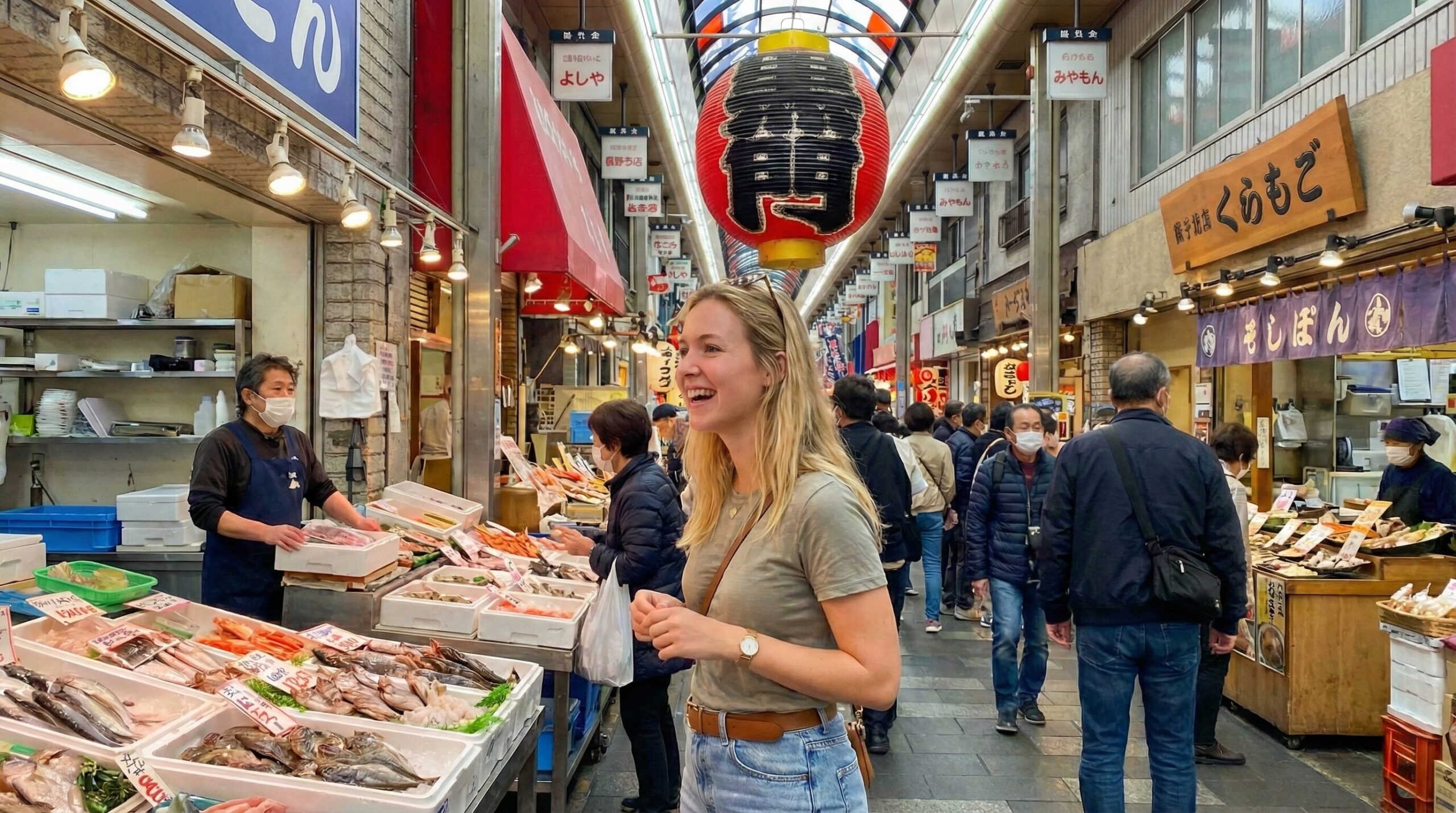
Known locally as “Osaka’s Kitchen,” Kuromon Market has been serving the city’s chefs and housewives for over 190 years. It is a covered arcade stretching 600 meters, packed with over 150 shops selling everything from swimming blowfish to mountain-high stacks of strawberries.
However, let’s be honest: In recent years, Kuromon has changed. It has evolved from a wholesale market into a massive tourist destination. Prices have risen, crowds have swelled, and Instagram influencers are everywhere.
Does that mean you should skip it? Absolutely not. It just means you need a strategy.
This Osaka Kuromon Market Guide is your tactical manual. We will strip away the hype to find the authentic flavors. We will tell you what is worth the splurge (Wagyu) and what to skip (overpriced melon). We will guide you through the noise so you can experience the true “Kuidaore” spirit of Osaka.
Unbutton your pants. It’s time to eat.
The Landscape: What is Kuromon Market?
Located in the Nipponbashi district, just a short walk from the neon madness of Namba, Kuromon is a sensory explosion.
The History
The market dates back to the Edo period. It was originally called Enmyoji Market after a nearby temple known for its black gate (Kuromon). Though the temple burned down in 1912, the name stuck. For decades, it was strictly a professional market where top chefs bought their sea urchin and tuna. Today, it is a “walk-and-eat” paradise.
The Vibe
Unlike the refined silence of Kyoto’s Nishiki Market, Kuromon is loud. Shopkeepers shout “Irasshai!” (Welcome!). The smell of grilling shellfish fills the air. It is colorful, brightly lit by red paper lanterns, and unapologetically commercial.
The Layout
The market is essentially one long main street with a few cross streets.
- The Roof: It is a Shotengai (covered arcade), making it the perfect rainy-day activity.
- The “Eat-In” Spaces: Unlike many Japanese markets where walking and eating is rude, Kuromon has adapted. Many stalls have designated tables or standing areas at the back.
- The Free Rest Area: There is a dedicated Information Center with restrooms, Wi-Fi, and tables where you can eat food bought from nearby stalls.
The Heavy Hitters: What to Eat (and Where)
You cannot eat everything. To survive Kuromon, you must prioritize. Here are the “Big Four” categories that define the market.
The Wagyu Beef Skewer
If you see smoke and smell rich, melting fat, you have found a Wagyu stall.
- The Experience: You choose a cut of meat (Kobe, Matsusaka, or generic Japanese Black Wagyu) from the display case. They grill it right in front of you with a blowtorch and charcoal.
- The Stall: Maruzen Meat Shop. They have been a butcher shop for decades. Their marbling is art.
- The Cost: Expect to pay ¥2,000–¥5,000 ($13–$33) for a high-grade stick.
- Verdict: Yes, it is expensive. But one stick of A5 Wagyu here melts in your mouth like butter. It is cheaper than a steakhouse dinner and gives you the full experience.
The Giant Seafood
Kuromon is famous for seafood that looks cartoonishly large.
- Scallops (Hotate): Look for scallops the size of a hockey puck, grilled in their shell with butter and soy sauce.
- Uni (Sea Urchin): You can buy a whole tray of orange, creamy uni and eat it with a spoon. Or, get a “Uni-Hotate” (grilled scallop topped with raw sea urchin). It is decadence on a stick.
- The Stall: Uoichi. They specialize in shellfish and usually have the freshest tanks.
- Verdict: The grilled scallop is a must. The price (approx. ¥800–¥1,000) is reasonable for the size.
Fugu (Blowfish)
Osaka consumes 60% of Japan’s fugu catch. Kuromon is one of the safest and most accessible places to try this notorious fish.
- The Experience: Minami is a famous fugu specialist. You can see the bloated fish swimming in the tank.
- The Dish: Try Tecchiri (fugu sashimi). It is sliced paper-thin and arranged like a chrysanthemum flower.
- The Taste: Fugu is surprisingly subtle. It has a distinct, chewy texture (shiko-shiko). It doesn’t taste like “chicken”; it tastes like the clean ocean.
- Verdict: Essential for the adventurous eater. It won’t kill you (the chefs are licensed), but the price might hurt your wallet slightly.
The Tuna (Maguro)
- The Dish: Otoro (fatty tuna) sushi or sashimi.
- The Stall: Maguroya Kurogin. They often perform tuna cutting shows. The fatty tuna here is pink, not red, because of the fat content.
- Verdict: Compare the price here to a sushi restaurant. You often get three thick slabs of Otoro for ¥2,000. It’s a bargain for the quality.
The Hidden Gems: Beyond the Tourist Favorites
While everyone lines up for Wagyu, the locals are buying something else. To use this Osaka Kuromon Market Guide effectively, try these humbler snacks.
Oden at Ishibashi Shokuhin
This is arguably the soul of Kuromon. Ishibashi is a small shop that has been simmering Oden (Japanese stew) for over 40 years.
- The Look: You will see a dark, bubbling vat of broth filled with daikon radish, fish cakes, and eggs.
- The Taste: The daikon is stained dark brown because it has absorbed the dashi broth for hours. It falls apart when you touch it with chopsticks.
- Price: Cheap. About ¥150 per item.
Fresh Soy Milk at Kuromon Furuya
After salty beef and fish, you need a palate cleanser.
- The Drink: This tofu shop sells cups of thick, rich soy milk (Tonyu) made fresh that morning. It tastes nothing like the watery stuff in cartons. It is creamy and grassy.
- The Snack: Try their Soy Donuts. Tiny, fluffy donuts made from soy pulp. They are light, not too sweet, and addictive.
Strawberries at Daiwa Kaen
Japan takes fruit seriously.
- The Item: White Strawberries (Awayuki) or the massive red Amaou variety.
- The Cost: You might pay ¥1,000 for a small cup.
- Is it worth it? Japanese strawberries are bred for extreme sweetness. If you have never tasted a luxury Japanese fruit, this is the place to try it without buying a $100 gift box.
Practical Examples: A Budget Strategy
Kuromon can destroy your budget in 20 minutes if you aren’t careful. Here are two ways to attack the market.
The “High Roller” Itinerary (Budget: ¥10,000 / )
- Start with Tuna Sashimi (Otoro) at Maguroya Kurogin (¥2,500).
- Get a Grilled King Crab Leg (¥3,000).
- Eat a stick of A5 Kobe Beef (¥3,500).
- Finish with White Strawberries (¥1,000). Result: You have eaten the kings of the Japanese food world.
The “Smart Local” Itinerary (Budget: ¥3,000 / )
- Start with Oden (Daikon and Egg) at Ishibashi (¥300).
- Get a Grilled Scallop (Butter Soy Sauce) (¥800).
- Buy a tray of Takoyaki (Octopus Balls) at Wanaka (just outside the market entrance, but essential) (¥600).
- Get a Soy Donut and Soy Milk (¥400).
- Grab a Fish Cake skewer (Tempura) (¥400). Result: You are fuller than the high roller, and you spent a fraction of the price.
Tips for Travelers: Surviving the Crowd
The Timing is Everything
- Official Hours: Most shops open 9:00 AM – 6:00 PM.
- The Sweet Spot: 9:30 AM to 10:30 AM.
- Why: The shutters are up, the food is fresh, but the massive tour buses haven’t arrived yet. By 12:00 PM, you will be shoulder-to-shoulder, unable to move.
- Avoid: 1:00 PM on a Saturday. It is a mosh pit.
The “Tourist Price” Warning
Be aware: Kuromon is more expensive than a supermarket. You are paying for the theater and the convenience.
- Check prices: If a stall is selling a single crab leg for ¥5,000, keep walking.
- Strategy: Walk to the end of the market and back before you buy anything to compare prices. The stalls near the entrances are often pricier than those in the middle.
Trash Etiquette
This is the biggest problem in Kuromon.
- Rule: Do NOT walk while eating.
- Rule: Return your trash to the stall where you bought the food. They will take the stick/tray back.
- Rule: Do not throw your scallop shell in a vending machine recycling bin.
- Tip: Bring a small plastic bag with you to carry your own trash just in case.
Restrooms
Don’t panic.
- There is a clean, large restroom in the Kuromon Information Center.
- There are also restrooms in the convenience stores (FamilyMart/7-Eleven) inside the arcade, but buy a water or gum if you use them.
Cash vs. Card
- 2024 Update: Many stalls now accept Alipay, WeChat Pay, and Credit Cards because of tourism.
- However: The older, traditional spots (like the pickle shops or Oden stalls) are still Cash Only. Always carry ¥10,000 in notes and plenty of 100-yen coins.
Conclusion: Is Kuromon Still “Real”?
Critics will say Kuromon has lost its soul to tourism. They will say it is too expensive, too crowded, too commercial.
They aren’t entirely wrong. But they are missing the point.
Kuromon Market is still where the fishmonger shouts at the top of his lungs. It is still where the grandmother at the pickle shop will give you a free sample of sour plum if you smile at her. It is still a place where you can watch a tuna being dismantled by a sword three feet away from your face. It is loud, expensive, and chaotic—just like Osaka itself.
Use this Osaka Kuromon Market Guide to dodge the traps. Find the simmering oden pot. Drink the fresh soy milk. Eat the scallop that sizzles in its own juices. And for one morning, let yourself be ruined by food.