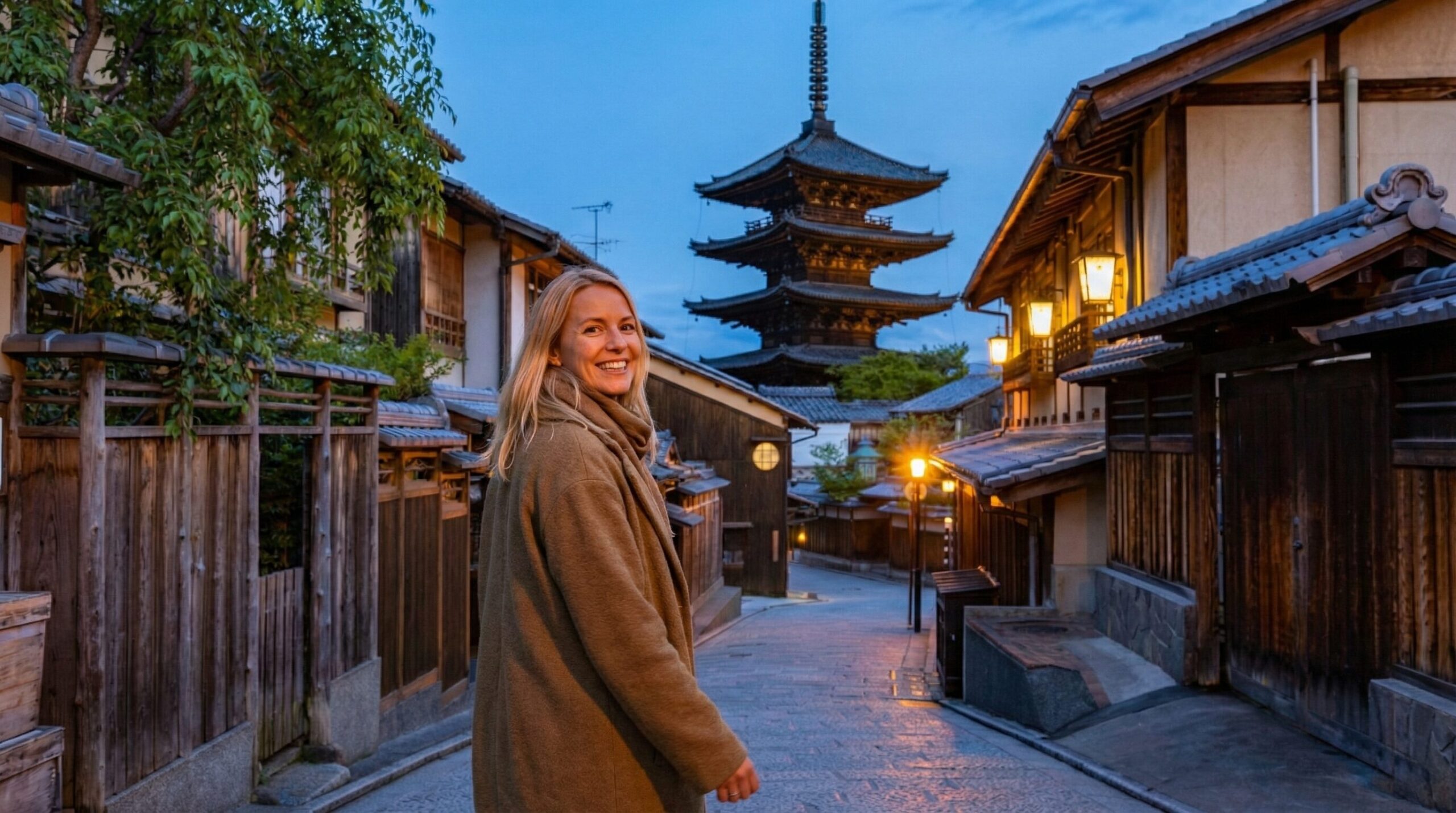
To understand Gion, you must first understand the concept of ura and omote—the hidden and the displayed. If you arrive in Gion at dusk, stepping off the bus near Yasaka Shrine, you are immediately swept into omote. The main thoroughfare, Hanamikoji, is a river of tourists. Selfie sticks clash like swords; taxi horns blare; rental kimonos flash in bright, synthetic patterns.
It is vibrant, chaotic, and undeniably beautiful, but it can feel more like a theme park than a living, breathing historical district. But Gion has a secret. It exists just one turn away. If you slip down a narrow gap between two timber buildings—a gap so thin you might brush your shoulders on the wood—the noise of the modern world vanishes instantly. The air changes. It smells of damp stone, old pine, and the faint, sweet smoke of incense. Here, the lanterns are not for show; they are guiding lights for the patrons of the ochaya (teahouses). This is the ura of Gion.
These are Kyoto’s Secret Gion Alleys. In these narrow veins of the city, the heartbeat of the ancient capital still thumps, slow and steady. To walk here is not just to sightsee; it is to trespass gently into a world of discipline, art, and silence that has survived for centuries.
The Geography of Shadows: Understanding Gion’s Layout
Before you wander, it helps to know what you are looking at. Gion is not a single monolith; it is divided, and its character changes depending on which side of Shijo Avenue you stand.
Gion Kobu vs. Gion Higashi
The district is split into two hanamachi (flower towns).
- Gion Kobu: The larger, more famous area south of Shijo Street. This is where the grandest teahouses and the famous Gion Corner are located. It is home to the widest main street, but also the most labyrinthine back alleys.
- Gion Higashi: To the north. Smaller, quieter, and often more intimate. This area feels less like a tourist destination and more like a neighborhood where people actually live and work.
The Architecture of Secrecy
The alleys are defined by Machiya (traditional wooden townhouses). These buildings are masterpieces of privacy. The front features distinct wooden lattices (koshi) that allow those inside to look out, but prevent those outside from looking in.
As you walk, notice the inuyarai—the curved bamboo fences at the base of the walls. Originally designed to protect the wood from rain and dog urine, they now serve as a polite but firm psychological barrier: Keep your distance. What happens inside is not for you.
The Walking Route: Where to Find the “Real” Gion
Do not rely on Google Maps here. The GPS signal often bounces off the narrow walls, and looking at a screen destroys the atmosphere. Instead, trust your instincts and follow the fading light.
The Shirakawa Canal (Morning)
While not a “secret” in the strictest sense, the area along the Shirakawa Canal (specifically Shinbashi Dori) transforms depending on the time of day.
- The Tourist Trap: At 6:00 PM, it is a wedding photo factory.
- The Secret: Go at 7:00 AM. In the early morning, the willow trees hang heavy and still over the water. The only sound is the rushing stream and the shhh-shhh of brooms as shopkeepers sweep the stone pavement. You might see a Geiko (Kyoto dialect for Geisha) without her makeup, hurrying to a lesson, clutching a shamisen case. This is the Gion of the locals.
The “Ghost” Alleys Leading to Kennin-ji
Head south of Hanamikoji, past the famous Ichiriki Chaya, and keep going towards the grounds of Kennin-ji Temple. The grid of streets here tightens.
- What to look for: Look for alleys that have no nameplates. Some are dead ends; others loop back on themselves.
- The Atmosphere: This is the residential heart of the geisha world. You will see small plaques by the doors listing the names of the practitioners living there. It is not a commercial zone; it is a dormitory of artists. The respect demanded here is palpable.
Ishibe-Koji: The Silent Stone Path (Higashiyama District)
Note: While technically bordering Gion in the Higashiyama district, this alley is essential to the atmosphere of the area. strict photography bans are in place. Tucked near Kodai-ji Temple, Ishibe-koji is arguably the most cinematic alley in Japan. It is paved with flagstones rather than asphalt, flanked by high wooden walls. Because of its beauty, it was overrun. Now, signs strictly prohibit photography to protect the residents’ privacy.
- Why go if you can’t take photos? Because that is the point of Beyond Nippon. Put the camera away. Walk the twisting stone path simply to feel the texture of the history. Without the pressure to capture the perfect shot, you will notice the details: the moss in the cracks of the wall, the glow of a small lantern, the muffled laughter from a high-end ryotei (restaurant).
The Etiquette of the Alley: How to Be Invisible
The friction between tourists and Gion’s residents is well-documented. To explore these secret alleys responsibly, you must adopt the mindset of a “transparent traveler.”
The “No Paparazzi” Rule
If you are lucky, you will see a Maiko (apprentice Geisha) or Geiko. A Maiko will be dressed in a trailing kimono, her face painted white, walking briskly on high wooden sandals (okobo). A Geiko, however, typically wears zori sandals.
- The Wrong Move: Running in front of her, blocking her path, or thrusting a camera in her face. This is considered an act of aggression.
- The Right Move: Stop moving. Stand against the wall. Watch her pass. Nod slightly if you make eye contact (you likely won’t; she is working). Treat her like a professional rushing to a board meeting, not a mascot character.
Respect the Private Property
In the alleys, the line between the street and the home is blurry.
- Do not touch the walls. The wood and clay are old and fragile.
- Do not lean on the inuyarai (bamboo fences).
- Keep your voice down. These walls are thin. If you are speaking loudly in English, the people having dinner inside can hear every word.
Understanding “Ichigensan Okotowari”
You will see many lanterns glowing invitingly. You may want to enter. However, many establishments in the deep alleys operate on Ichigensan Okotowari—”No first-time customers without an introduction.” Do not take this as discrimination. It is a system of credit and trust. The teahouse trusts the customer to behave; the customer trusts the teahouse to provide perfection. Without a history, that trust cannot exist. If a door is closed, admire it, but do not try to open it.
Dining in the Dark: Finding Your Place
Just because some doors are closed doesn’t mean you have to starve. The secret alleys hide incredible culinary experiences that are open to travelers—if you know how to find them.
The “Obanzai” Connection
Look for small lanterns that say “Obanzai” (Kyoto-style home cooking). These are often small, counter-only bars run by a generic “mama-san.” They are less formal than kaiseki ryotei and often welcome respectful foreigners.
- The Experience: You sit shoulder-to-shoulder with locals. Large bowls of simmered vegetables, tofu, and seasonal fish are lined up on the counter. You point to what you want. It is intimate, warm, and deeply authentic.
Hidden Bars
Gion is famous for its “hidden bars”—places with no signage, perhaps just a small light or a nondescript heavy door.
- Tip for Travelers: Look for buildings with multiple tenant signs. Often, the upper floors of these narrow buildings house quiet whiskey bars or cocktail lounges. If there is a menu outside with prices, it is safe to enter. These bartenders are often masters of their craft, treating a gin and tonic with the same seriousness as a tea ceremony.
Conclusion: The Memory of Stone and Wood
Gion is a place of layers. The top layer is the noise, the souvenirs, and the crowds. But if you have the courage to turn off the main street, to walk past the “No Entry” signs of your own hesitation, you find the layer underneath. Kyoto’s secret Gion alleys are not about “doing” anything. There are no rides, no museums, and often, no shops you can enter. They are about “being.”
They are about standing in a dim stone corridor at 9:00 PM, listening to the rain drip from the eaves, and realizing that this same sound has been heard by samurai, poets, and geisha for four hundred years. The buildings change, the people die, but the atmosphere of the alley remains. When you return home and look at your photos, you might realize the best moments weren’t the ones you captured on camera. They were the moments in the dark, quiet alleys, where you simply walked, watched, and let Kyoto reveal itself to you in whispers.