
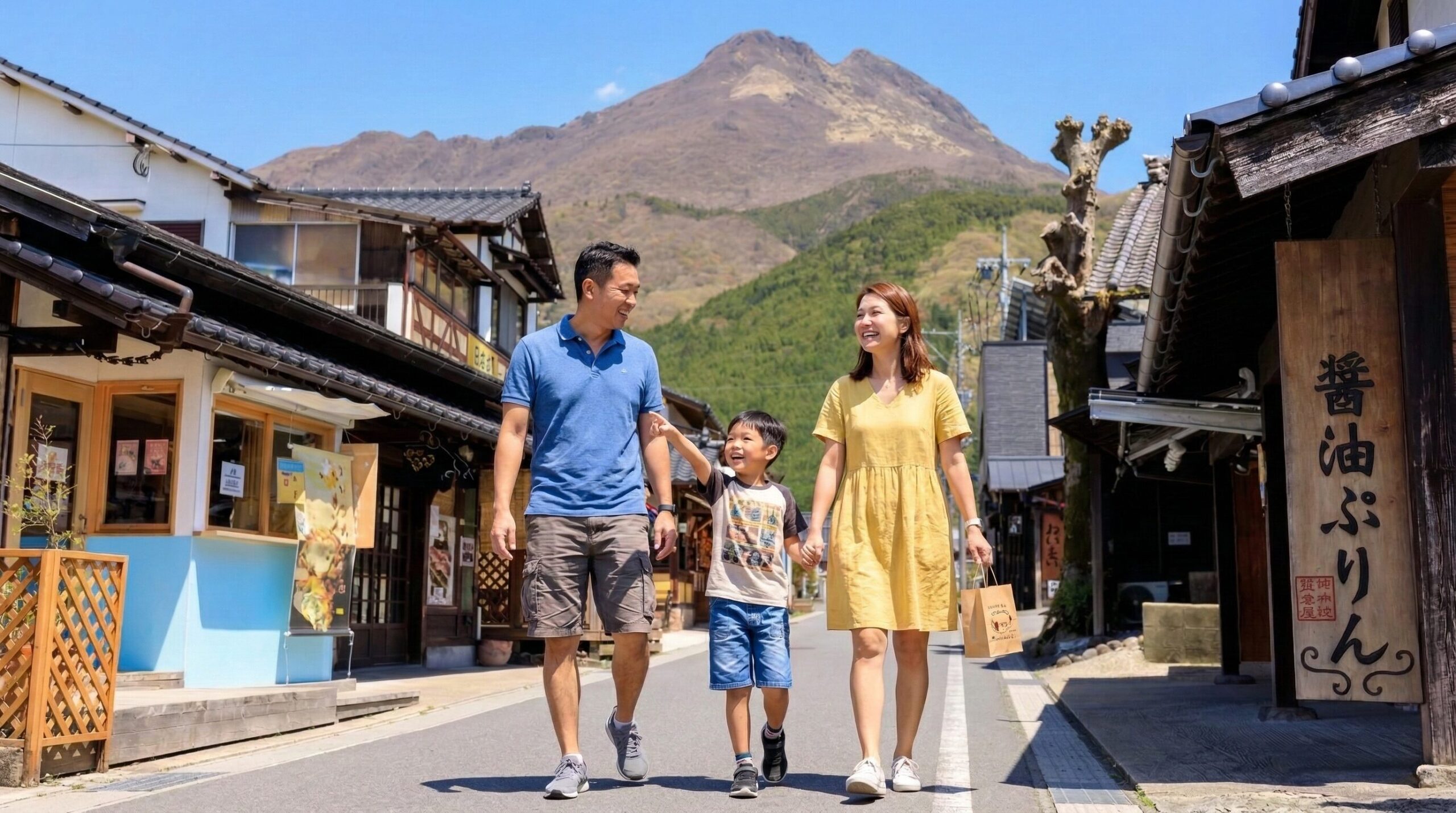
There is a persistent myth in the global travel community. It dictates that Japan is an exclusive, luxury destination, best reserved for solo backpackers willing to sleep in pods, or wealthy couples on a honeymoon.
The assumption is that bringing children—navigating the train fares, the hotel rooms, and the daily meals for four or five people—will instantly drain your life savings. This myth is built on a very specific, very narrow version of Japan.
If your itinerary consists solely of the “Golden Route” (Tokyo to Kyoto), riding the Shinkansen (bullet train) every few days, staying in Western-style adjoining hotel rooms, and visiting massive international theme parks, the costs will indeed be astronomical.
That version of Japan is a premium product designed for high-volume, superficial sightseeing.
But what happens when you step off that crowded path?
When you leave the major metropolitan corridors and embrace the rhythm of the provinces, the financial landscape changes dramatically. You discover a country that is incredibly accommodating to families.
You find communities designed around local parks, affordable regional transit, and hearty, inexpensive comfort food. Budget-friendly family travel in Japan is not about sacrificing quality.
It is about trading commercialized attractions for authentic cultural immersion. It is a conscious decision to slow down, travel deeper, and explore the quiet, breathtaking realities of the country.
Let us explore how your family can experience the real Japan without breaking the bank.
Key Details and Breakdown: The Economics of Authentic Travel
To master budget-friendly family travel in Japan, you have to fundamentally change how you source your basic needs: accommodation, transit, and food. The local economy operates on a different tier than the tourist economy.
The Accommodation Shift: Beyond the Western Hotel
Western-style hotels in major Japanese cities are notoriously strict about occupancy limits. A standard room rarely accommodates more than two people. For a family of four, you are forced to book two rooms or an expensive “family suite.”
- The Traditional Alternative: This is where traditional Japanese flooring—tatami—becomes a financial and practical lifesaver. In a traditional room, you do not rent beds; you rent space. At night, futons are unrolled side-by-side directly onto the woven grass mats.
- The Advantage for Families: Not only does a single large tatami room easily sleep an entire family, but it is also incredibly safe for toddlers—there are no high beds to fall out of.
- The Local Solution: Instead of luxury ryokan (which charge a high premium per person, including elaborate meals), look for minshuku (family-run guesthouses) or rent entire restored traditional homes (kominka) in rural areas. You get an entire house, a kitchen, and a private garden for the price of a single cramped hotel room in Shinjuku.
The Dining Paradigm: Eating Like a Local Family
Feeding a family three times a day in tourist-heavy districts like Arashiyama or Shibuya will decimate your daily budget. You must eat where the locals eat.
- The Shokudo: Every neighborhood in Japan has a shokudo—a casual, blue-collar diner. They are identifiable by the plastic food models in the window and the handwritten menus on the walls. Here, a massive, steaming bowl of udon noodles or a katsudon (fried pork cutlet over rice) costs around 800 to 1,000 Yen. They are loud, welcoming, and deeply authentic.
- The Famiresu: Do not ignore the Japanese “Family Restaurant” (famiresu), such as Gusto, Royal Host, or Joyfull. While they may lack the poetic romance of a hidden sushi bar, they are cultural institutions. They offer massive, inexpensive menus, unlimited drink bars, and a relaxed environment where children are expected to be children.
Practical Examples and Recommendations: Heading to Kyushu
The most effective strategy for budget-friendly family travel in Japan is regional displacement. Instead of forcing your family through the congested, expensive arteries of Honshu, head south.
The Oita Prefecture Alternative
Consider the island of Kyushu, specifically regions like Oita Prefecture. It offers everything a family could want—dramatic coastlines, deep forests, and world-class hot springs—at a fraction of the cost of places like Hakone or Mount Fuji.
- The Transit Savings: Buying four Shinkansen tickets from Tokyo to Kyoto costs a small fortune. Instead, book a cheap domestic flight (via low-cost carriers like Peach or Jetstar) directly to Kyushu. Once there, rent a standard family car. Renting a car for a week in rural Kyushu is vastly cheaper than buying individual train tickets for the whole family.
- The Freedom: A rental car fundamentally changes family travel. You are no longer dragging heavy suitcases and exhausted toddlers through crowded train stations. You can stop at roadside stations (michi-no-eki) to buy cheap, locally grown strawberries. You dictate the schedule.
- The Experience: In Oita, you can drive out to the rural edges of Beppu or Yufuin. You can rent a small, private family hot spring bath (kashikiri-buro) by the hour for a few thousand Yen. Your family can soak together in steaming, mineral-rich water looking out over a bamboo forest—a profound, private cultural experience that costs less than a round of coffees in a Tokyo cafe.
Municipal Parks over Theme Parks
Japan is home to Universal Studios Japan (USJ) and Tokyo Disney Resort, both of which require expensive tickets and hours of standing in line. To travel deeper and save money, look to Japan’s incredible network of municipal and national parks.
- The Vibe: Japanese public parks are engineering marvels. They are vast, meticulously maintained, and often feature massive, multi-story climbing structures and famously long roller-slides that wind down the sides of hills.
- The Reality: Places like Uminonakamichi Seaside Park in Fukuoka or the sprawling green spaces of rural prefectures cost only a few hundred Yen to enter (and are often free for children). You can rent bicycles, let the kids run wild safely, and enjoy a slow, peaceful afternoon surrounded by local families doing the exact same thing.
Tips for Travelers: Everyday Strategies for the Road
Implementing budget-friendly family travel in Japan requires mastering a few daily habits. These small adjustments compound over a two-week trip, saving you hundreds of dollars.
The Magic of the Supermarket (Super)
While convenience stores (konbini) are famous, the true budget savior is the local supermarket (such as Aeon, MaxValu, or local regional chains).
- The Strategy: Supermarkets offer incredible, freshly made bento boxes, sushi platters, and bakery items. Depending on the store, staff begin applying discount stickers (10% to 20% off) in the late afternoon, with deeper discounts (up to 50% off) typically appearing after 7:00 PM or closer to closing time.
- The Execution: Buy a discounted feast of fried chicken (karaage), rice balls (onigiri), and fresh fruit. Take it back to your rented machiya or eat it in a local park. It is a high-quality, deeply local meal for pennies on the dollar.
The Takuhaibin (Luggage Forwarding) Hack
While this costs a small amount of money upfront, it saves you from making expensive logistical mistakes.
- The Problem: Navigating subway turnstiles and crowded buses with three suitcases, a stroller, and two children is a nightmare. It often forces exhausted parents into taking expensive, unnecessary taxi rides.
- The Solution: Use Japan’s legendary takuhaibin (luggage forwarding) service, like Yamato Transport (the Black Cat logo). For around 2,500 to 3,500 Yen per large suitcase, you can ship your heavy luggage from your current accommodation directly to your next hotel or rental house. It usually arrives the next day. You travel on the local trains lightly and gracefully, with just a daypack.
Embrace the 100-Yen Shop
Stores like Daiso, Seria, and Can Do are not just for cheap souvenirs. They are vital infrastructure for a traveling family.
- The Utility: If you forgot a charging cable, need extra wet wipes, or lost a pair of gloves, head to the 100-Yen shop. Keep in mind that while basic items are 100 Yen, higher-quality goods like electronics often cost between 200 and 500 Yen. You can also find high-quality, beautifully designed chopsticks and ceramics here that make for excellent, affordable gifts for teachers and friends back home.
Hydration and Vending Machines
Japan’s legendary vending machines are incredibly convenient, but buying four bottles of water or green tea every time the family gets thirsty adds up very quickly.
- The Fix: Tap water in Japan is universally safe and exceptionally clean. Bring high-quality, insulated reusable water bottles from home. Fill them with ice and tap water at your accommodation every morning. If you need a flavored drink, buy large two-liter bottles of barley tea (mugicha) from the supermarket and decant them into your smaller bottles.
Focus on Free Cultural Experiences
You do not need to pay a high entrance fee to experience Japanese culture. The most profound moments are often entirely free.
- The Practice: Exploring the grounds of a massive neighborhood Shinto shrine costs nothing. Walking along a rural coastal seawall at sunset costs nothing. Attending a local summer matsuri (festival), listening to the thunder of the taiko drums, and watching the neighborhood carry the portable shrine (mikoshi) through the streets is a free, unforgettable spectacle. Let the environment be the entertainment.
Conclusion: The Wealth of the Quiet Path
Budget-friendly family travel in Japan is entirely possible, but it requires letting go of the standard tourist blueprint. It requires stepping away from the neon glow of the premium entertainment districts and walking into the quiet, welcoming heart of the local community. When you bypass the bullet train for a slow coastal drive, when you trade a cramped Western hotel room for the wide-open space of a tatami floor, and when you skip the crowded theme parks to slide down a hill in a rural municipal park, you are doing more than just saving money. You are giving your children a far more authentic, textured view of the world.
The greatest memories of family travel are rarely the ones you pay a premium for. They are found in the shared laughter over a steaming bowl of noodles in a neighborhood diner, or the quiet awe of soaking in a steaming hot spring beneath the autumn leaves. It’s time to go beyond the ordinary, protect your budget, and see the Japan locals know best. Travel deeper. Explore the real Japan.