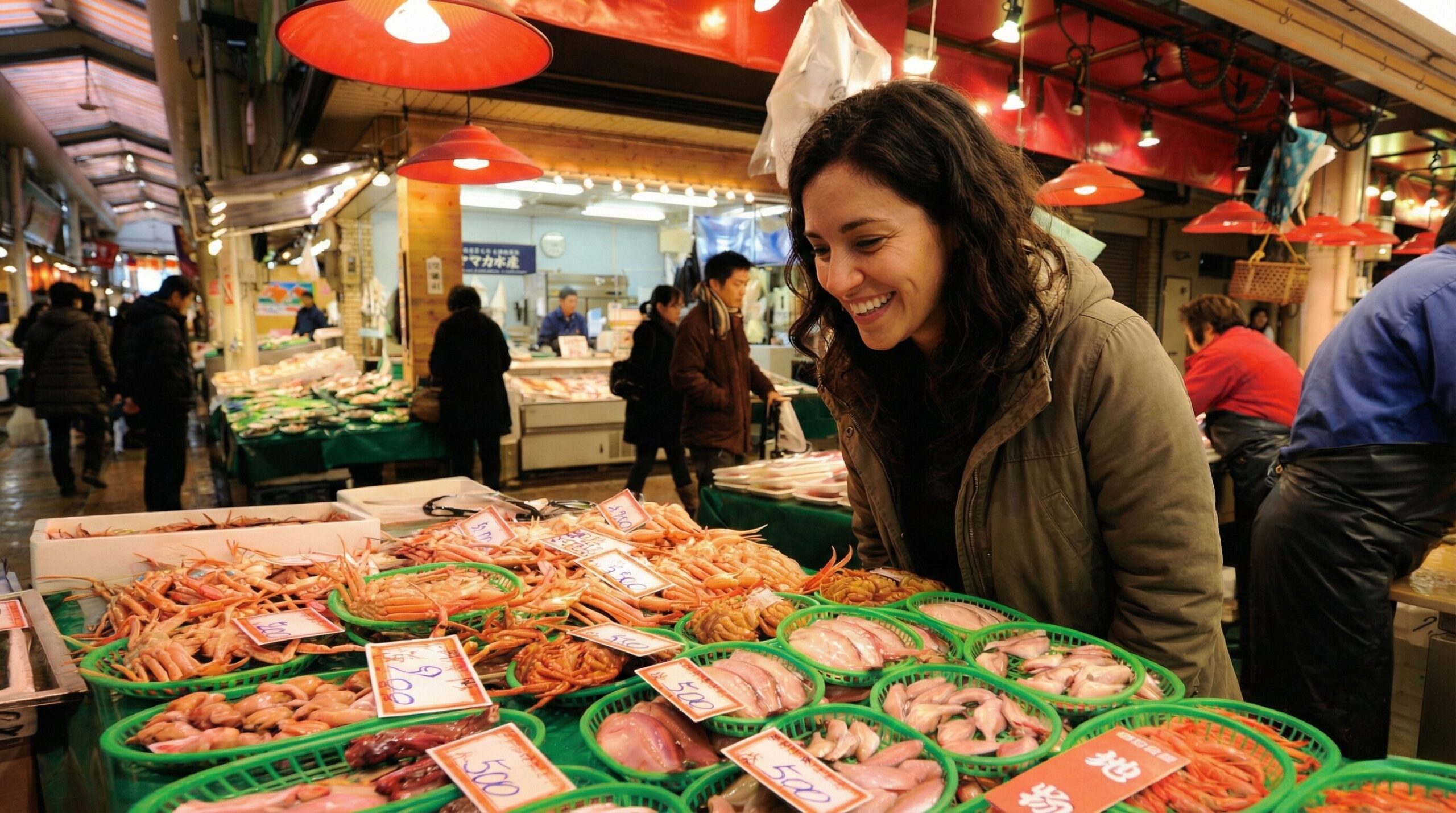
If Tokyo is the brain of Japan and Kyoto is its heart, then Kanazawa is arguably its stomach. Located on the Sea of Japan coast, this historic castle town is frequently dubbed “Little Kyoto,” but that moniker fails to capture the city’s distinct, briny soul. Here, the currents of the ocean dictate the rhythm of daily life, and nowhere is this more palpable than in its vibrant markets.
For the uninitiated traveler, a seafood market can be an overwhelming assault on the senses—a cacophony of shouting vendors, the sharp scent of saltwater, and a labyrinth of stalls that seem to go on forever. But for the traveler seeking to explore the real Japan, this chaos is an invitation.
This Kanazawa Seafood Market Guide is designed to help you navigate not just the geography of the market, but its culture. We will move beyond the superficial tourist snapshots of giant crabs and guide you toward the authentic flavors that define the Ishikawa region. From the bustling corridors of Omicho to the quieter corners known only to locals, prepare to taste the ocean in its purest form.
Omicho Market: The Beating Heart of Kanazawa
For over 300 years, Omicho Market (Omicho Ichiba) has served as the kitchen of Kanazawa. While it has become a popular tourist destination, it remains a functioning hub where local chefs from the city’s top ryotei (traditional restaurants) come at dawn to select the day’s ingredients.
The Atmosphere
Stepping into Omicho is like stepping into a covered city within a city. The market houses nearly 200 stalls under a sprawling arcade roof. It is loud, unapologetic, and vibrantly colorful. You will hear the rhythmic chant of fishmongers advertising their wares—a dialect-heavy Japanese that feels warm and welcoming. Unlike the sterile aisles of a supermarket, Omicho is tactile. You are encouraged to look closely at the glistening eyes of the sea bream and the vibrant red shells of the crabs. However, navigating this space requires a shift in mindset: you are not just shopping; you are participating in a centuries-old trade ritual.
Navigation Strategy
The market is a maze, but it is roughly organized by product type. The outer rim tends to host vegetable grocers and dry goods stores, while the inner arteries are dominated by fresh seafood.
- The Main Streets: These are wide and crowded, lined with the most famous kaisendon (seafood bowl) restaurants.
- The Alleys: Narrower paths often hide the smaller sushi counters and standing bars where locals grab a quick bite and a beer.
Seasonal Specialties: What to Eat and When
To truly use this Kanazawa Seafood Market Guide effectively, you must understand seasonality. In Japan, shun (seasonality) is everything. The “best” fish changes depending on the month you visit. Ordering the wrong item out of season is the hallmark of a tourist; ordering the peak seasonal delicacy earns you a nod of respect from the chef.
Winter (November – February): The Kingdom of Crabs
If you visit in winter, the market turns into a sea of red.
- Kano-gani (Male Snow Crab): The king of winter. Large, sweet, and incredibly expensive. Look for the blue tag on the leg, certifying it was caught in Ishikawa.
- Kobako-gani (Female Snow Crab): Smaller and cheaper than the male, but arguably more flavorful. It is prized for its uchiko (internal egg clusters) and sotoko (external eggs). It is a rich, savory delicacy often served in the shell with vinegar.
- Buri (Yellowtail): In winter, yellowtail develops a thick layer of fat. Kan-buri sashimi melts on the tongue like high-grade wagyu beef.
Spring (March – May): Sweetness and Shellfish
- Gasu-ebi (Gasu Shrimp): This is Kanazawa’s best-kept secret. These shrimp look unassuming—brown and slightly unappealing—but their flavor is sweeter and creamier than the famous Ama-ebi (sweet shrimp). Because they lose freshness quickly, they are rarely shipped outside Ishikawa. You must eat them here.
- Sayori (Japanese Halfbeak): A silver-skinned fish with a clean, transparent taste that signifies the arrival of spring.
Summer (June – August): The Rock Oyster
- Iwagaki (Rock Oysters): Unlike the small winter oysters of Hiroshima, these are massive, creamy monsters the size of a human hand. In summer, you will see stalls shucking them fresh. Eating one raw with a splash of ponzu sauce is the ultimate relief from the Japanese humidity.
Autumn (September – October): The High-End White Fish
- Nodoguro (Blackthroat Seaperch): Often called the “white salmon” because of its high fat content. When lightly seared (aburi), the fat renders and creates a velvety texture. It is one of the most expensive and sought-after fish in Kanazawa.
Authentic Dining Experiences: Beyond the Photo Op
Many travelers arrive, take a photo of a crab, and leave. To experience the “Real Japan,” you need to sit down and engage with the food. Here are three distinct ways to dine in and around the market.
The Kaisendon Pilgrimage
The Kaisendon—a bowl of rice topped with an artistic arrangement of fresh sashimi—is the signature dish of Omicho Market.
- The Experience: Visually stunning, these bowls are often topped with gold leaf (Kanazawa produces 99% of Japan’s gold leaf).
- Recommendation: While the queues at famous spots like Yamasan Sushi can be two hours long, look for smaller shops in the side alleys. The quality of fish is often identical, but the wait is shorter. Order the Omakase-don (Chef’s Choice Bowl) to get the best catch of the day.
Conveyor Belt Sushi (Kaitenzushi)
Do not let the term “conveyor belt” fool you. Kanazawa’s kaitenzushi is superior to many high-end counters in Tokyo.
- Why it’s different: The proximity to the port means the fish on the belt was swimming that morning.
- Where to go: Chains like Mori Mori Sushi are legendary, but Kanazawa Maimon Sushi or Pontasushi offer excellent quality. Order via the tablet or shout your order to the chef inside the ring for the freshest cuts.
3. Walking and Tasting (Tabearuki)
For a more casual approach, treat the market as a tasting menu.
- Uni (Sea Urchin): Served directly in the spiky shell.
- Grilled Skewers: Scallops, squid, and shrimp grilled over charcoal right in front of you.
- Draft Beer: Many fishmongers sell localized craft beer or sake cups to pair with your oysters.
Going Deeper: Beyond Omicho Market
While Omicho is the star, a true Kanazawa Seafood Market Guide must acknowledge the other players. If the crowds at Omicho feel too “touristy,” venture further.
Kanazawa Port (Iki-iki Fish Market)
Located about 15 minutes by car from the city center, this is where the serious buying happens.
- The Vibe: Industrial, raw, and devoid of English signs. This is a market for locals buying dinner, not for tourists buying snacks.
- Why visit: You can watch the fishing boats dock and unload. The prices here are significantly lower than in Omicho, and the crabs are just as fresh. There is a purity here that appeals to the traveler seeking the unvarnished reality of a port town.
The Izakayas of Katamachi
The market closes early (usually by 5:00 PM). To experience Kanazawa seafood at night, head to the Katamachi or Kiguramachi districts.
- The Connection: The best izakayas (Japanese pubs) here have direct relationships with Omicho vendors. Look for places with handwritten menus—a sign that the dishes change daily based on what was available at the market that morning.
Practical Tips for Travelers
To navigate the market like a pro and respect local customs, keep these tips in mind.
- Cash is King: While Japan is modernizing, many old-school fishmongers still only accept cash. Carry plenty of 1,000 yen bills.
- Eat Where You Buy: Walking while eating (aruki-gui) is generally frowned upon in Japan, though rules are looser in markets. However, the polite thing to do is to buy your oyster or skewer and eat it at the designated standing area of that specific shop. Do not walk to another vendor while eating food from the previous one.
- Disposal: Trash bins are rare. Return your skewers or shells to the vendor you bought them from; they will gladly dispose of them for you.
- Timing:
- 9:00 AM – 10:30 AM: The best time for browsing. The stalls are fully stocked, and the crowds haven’t peaked.
- 11:30 AM – 1:30 PM: The lunch rush. Expect long lines at restaurants.
- 3:00 PM – 4:00 PM: Discount time. Vendors start slashing prices on perishables before closing.
Conclusion
Kanazawa is a city where history is preserved not just in architecture, but in flavor. A visit to the seafood markets here is more than a meal; it is a lesson in the geography and seasons of the Sea of Japan. Whether you are savoring the creamy depth of a rock oyster in the summer heat or warming yourself with a bowl of crab soup in the dead of winter, you are participating in a story that has been told in this town for centuries. So, when you visit, don’t just look at the displays. Ask the fishmonger what is best today. Try the shrimp that looks ugly but tastes like heaven. Go beyond the ordinary guidebook recommendations. That is where you will find the real Japan—one bite at a time.