Tokyo is a city of neon, steel, and velocity. It is the Yamanote Line rushing at 8:00 AM; it is the scramble crossing in Shibuya; it is the sheer, overwhelming density of 14 million people. For the traditional traveler, the “Ryokan” (traditional inn) belongs in the mountains of Hakone or the old streets of Kyoto. It does not belong in a skyscraper in Otemachi.
However, a new wave of hospitality has emerged in the capital: the Modern Urban Ryokan. These are not dusty, wooden buildings struggling to survive in the shadow of towers. They are architectural marvels that reimagine what a ryokan can be in the 21st century. They take the core philosophy of Japanese hospitality—Omotenashi, silence, and nature—and encase it in modern glass and steel. Finding the Best Modern Luxury Ryokan in Tokyo is about finding a portal. It is about stepping off a concrete street, removing your shoes, and suddenly finding yourself in a world of soft tatami and incense, suspended hundreds of feet in the air. This guide explores the few, exclusive establishments that have successfully mastered this delicate hybrid of old-world peace and new-world luxury.
Defining the “Modern Urban Ryokan”
Before we list the locations, we must understand the category. A “Modern Luxury Ryokan” in Tokyo is distinct from a 5-star hotel like the Ritz-Carlton or the Aman.
The “Genkan” Effect
In a hotel, you wear your shoes to your room. In a ryokan, the transition happens at the door. You remove your shoes at the entrance (Genkan). This physical act signals a psychological shift: you are leaving the dirt and stress of the outside world behind. In modern Tokyo ryokans, this often means walking on tatami mats inside an elevator—a surreal and delightful experience.
The “Ochanoma” Concept
Traditional ryokans are centered around communal spaces. Modern versions reinterpret this. Instead of a lobby bar, you might find a guest-only lounge on your specific floor where tea, sake, and seasonal snacks are served freely, encouraging a sense of semi-private community.
The Onsen (Hot Spring)
A bathtub in a room does not make a ryokan. There must be a communal bath. In Tokyo, this is an engineering feat. The best modern ryokans drill deep into the earth to pump up mineral-rich “black water” (kuroyu) or transport water daily from Hakone, allowing you to soak in natural springs while watching the city lights.
HOSHINOYA Tokyo (Otemachi)
The Vertical Ryokan
If there is a king of this category, it is HOSHINOYA Tokyo. Located in Otemachi, the financial heart of Japan, it sits next to the Imperial Palace. From the outside, it is a monolithic black tower wrapped in a metal lattice that resembles the pattern of a kimono (Edo Komon).
The Experience
- The Entrance: You step through a massive cypress door. The lobby is vast, empty, and silent, lined with bamboo shoe lockers. You take off your shoes here. You will not wear them again until you leave. The entire building—hallways, elevators, rooms—is carpeted in soft, fragrant tatami mats.
- The “Ochanoma” Lounge: Each floor has only six rooms, clustered around a central “Ochanoma” (living room). This space is exclusive to the guests of that floor. You can wander out of your room in your kimono at any time. While tea and coffee are available 24 hours, specific delights await at different times: sake and seasonal treats in the evening, and fresh onigiri (rice balls) in the morning. It feels like staying in a wealthy friend’s mansion rather than a hotel.
- The Sky Onsen: On the top floor (17th), the bath is fed by saline-rich hot spring water drawn from 1,500 meters below Tokyo. The “outdoor” bath is a masterclass in design: high walls block the view of the surrounding skyscrapers, framing only the open sky above. You float in the hot water, looking up at the clouds drifting over the financial district.
Why It’s the Best
It completely erases the city. You are in the center of Tokyo, yet you hear nothing but the rustle of bamboo. It is the most seamless integration of luxury hotel convenience and ryokan spirituality in existence.
Onsen Ryokan Yuen Bettei Daita (Setagaya)
The Forest Retreat
While HOSHINOYA is a tower, Yuen Bettei Daita is a hideaway. Located in the trendy, quiet neighborhood of Setagaya-Daita (just a few stops from Shinjuku), it feels like a mountain resort that was teleported into the suburbs.
The Experience
- The Architecture: The building is low-rise, nestled amongst trees. The design uses traditional cedar wood, stone, and shadows to create a moody, intimate atmosphere.
- The Water: The hot spring water here is transported by truck from Hakone’s Lake Ashi sources. It is alkaline and smooth on the skin. The open-air baths overlook a meticulously curated Japanese garden.
- The Tea: The property focuses heavily on tea. The rooms often feature tea incense burners and artisanal tea sets, encouraging you to slow down and brew a proper cup.
Why It’s Unique
It offers a “neighborhood” vibe. Unlike the cold business district of Otemachi, here you can step out of the ryokan and wander the charming local streets of Setagaya, visiting independent bakeries and the famous “Totoro” cream puff shop nearby. It is a modern luxury ryokan for the traveler who wants to feel like a local resident.
Prostyle Ryokan Tokyo Asakusa
The Cultural Immersion
Asakusa is the “Shitamachi” (old downtown) of Tokyo, home to Senso-ji Temple. Prostyle Ryokan embraces this history but upgrades it with modern comforts.
The Experience
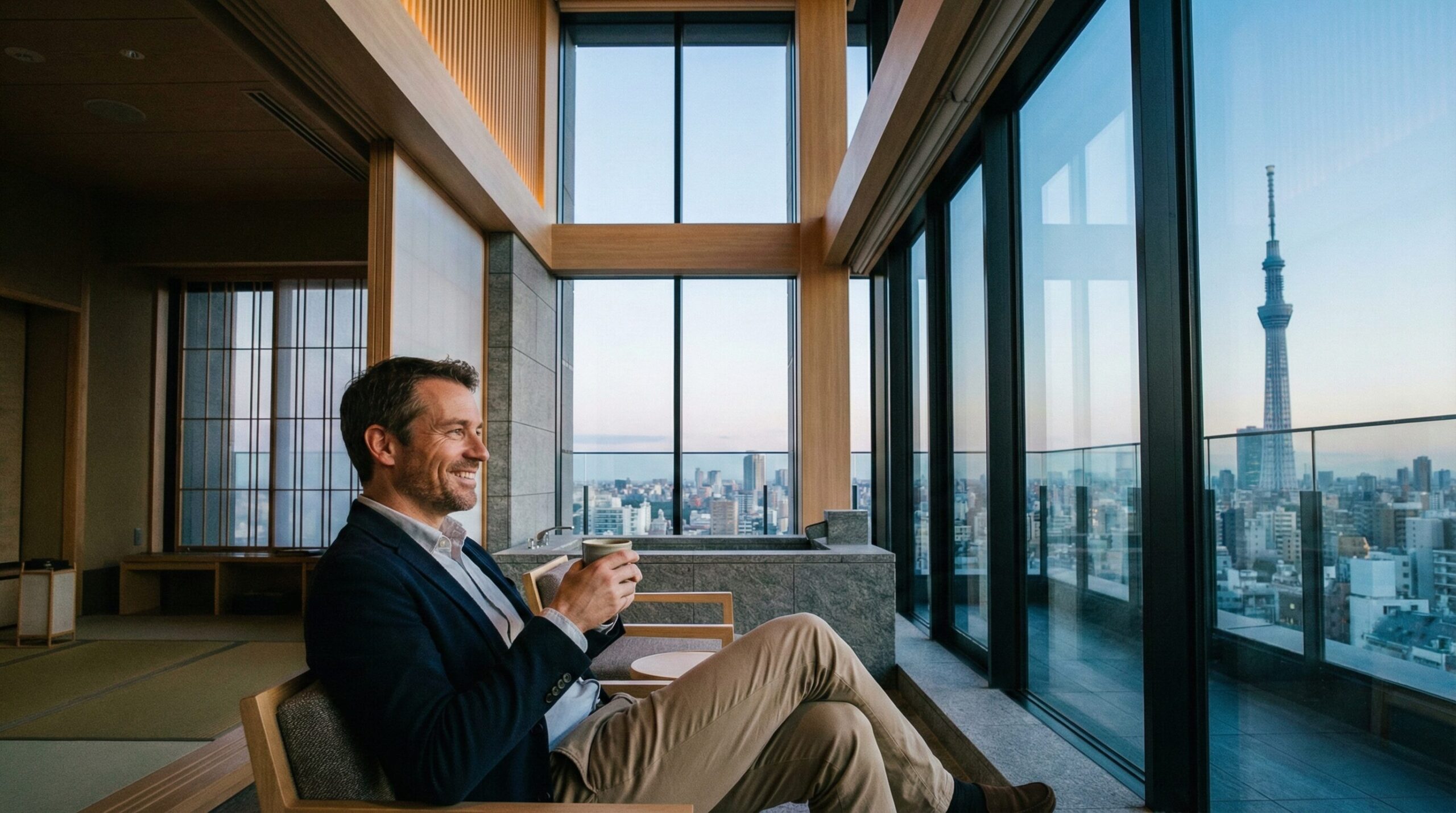
- In-Room Rotenburo: The highlight here is that many suites feature an open-air bath (rotenburo) on the balcony. Soaking in a private tub while looking out at the Tokyo Skytree is a visual contrast that defines modern Tokyo.
- The Design: The floors are tatami, but the beds are low-rise Western mattresses, offering the aesthetic of sleeping on the floor without the back pain that some travelers experience with futons.
- The Location: You are a 5-minute walk from the Kaminarimon Gate. This allows you to visit the temple at night or early morning when the crowds are gone, a privilege usually reserved for locals.
Why It’s a Contender
It is more accessible than HOSHINOYA but offers a higher level of intimacy than a standard hotel. It bridges the gap between a sightseeing base and a relaxation space.
Practical Examples: The “Modern Ryokan” Routine
Staying in these places requires a different rhythm than a hotel stay. Here is a sample itinerary for a night at a luxury urban ryokan.
15:00 – The Check-In Ritual Arrive exactly at check-in time. You are paying for the atmosphere; maximize it.
- Action: Remove your shoes. Accept the welcome sweet (wagashi) and matcha. Change immediately into the provided room wear. At HOSHINOYA, this is a specially designed soft jersey “Kimono” suitable for walking outside, while other ryokans provide traditional Samue or Yukata. In a ryokan, you wear this outfit everywhere—to dinner, to the lobby, to the bath.
16:30 – The First Soak Head to the communal bath before dinner.
- Tip: In modern luxury ryokans, the baths are often dimly lit to encourage meditation. Respect the silence. Afterward, enjoy the complimentary amenities often provided in the cooling area—such as the nostalgic coffee milk at HOSHINOYA, or the refreshing fruit popsicles (ice candy) at Yuen Bettei.
19:00 – Dinner (Kaiseki or Modern)
- HOSHINOYA: Their dining is “Nippon Cuisine”—a fusion of French techniques and Japanese ingredients, served in private tatami rooms.
- Yuen Bettei: Often features a seasonal Kaiseki course highlighting ingredients from the region of the onsen source (e.g., Hakone vegetables).
22:00 – The Evening Lounge
- Action: Visit the Ochanoma or the lobby lounge. There is often a “Sake Time” or nightcap service. Sit by the window, look at the Tokyo Tower or the quiet streets, and enjoy the stillness.
08:00 – The Japanese Breakfast Do not order the continental breakfast.
- The Meal: A modern ryokan breakfast is a masterpiece of small plates: grilled fish, rolling omelet, pickles, miso soup, and glistening white rice. It is fuel for the soul.
Tips for Travelers
Booking Strategy
These properties have very few rooms (HOSHINOYA has 84, Yuen Bettei has 35).
- Timing: You must book 3–5 months in advance, especially for cherry blossom season or autumn.
- The “Early Bird”: Look for “60-day advance” rates on their official websites, which can save you 10–20%.
The “Futon” vs. “Bed” Question
- Modern Twist: Most “Modern Luxury Ryokans” use raised platforms with thick mattresses that look like futons but feel like luxury beds. You do not need to worry about sleeping on the hard floor.
- Check the Room Type: If you absolutely need a Western-height bed (for knee issues), verify the room description says “Twin/Double Bed” and not “Futon Bedding.”
Tipping
Even in luxury ryokans, tipping is not required.
- The Service Charge: A 10–15% service charge is already added to your bill.
- Omotenashi: The staff provides excellence because it is their pride, not for a reward. Trying to tip can cause confusion and embarrassment. A sincere bow and “Arigato Gozaimasu” is the highest currency.
Noise Sensitivity
Tatami absorbs sound, but traditional paper screens (shoji) do not block it perfectly.
- The Vibe: These hotels are quiet. If you are traveling with very young, energetic children, check if the ryokan is “family-friendly.” HOSHINOYA is welcoming, but the atmosphere is hushed.
Conclusion
The Best Modern Luxury Ryokan in Tokyo offers something that the Park Hyatt or the Mandarin Oriental cannot: a sense of place. When you stay in a Western luxury hotel, you could be in New York, London, or Singapore. The sheets are the same; the club sandwich is the same. But when you lie on a tatami mat in Otemachi, smelling the faint scent of rush grass, knowing that just outside the thick walls is the chaotic energy of the world’s largest city, you know exactly where you are. You are in Japan.
You are suspended between the Edo period and the future. And in that suspension, you find a luxury that goes beyond thread counts—the luxury of peace. So, take off your shoes. The city can wait.