
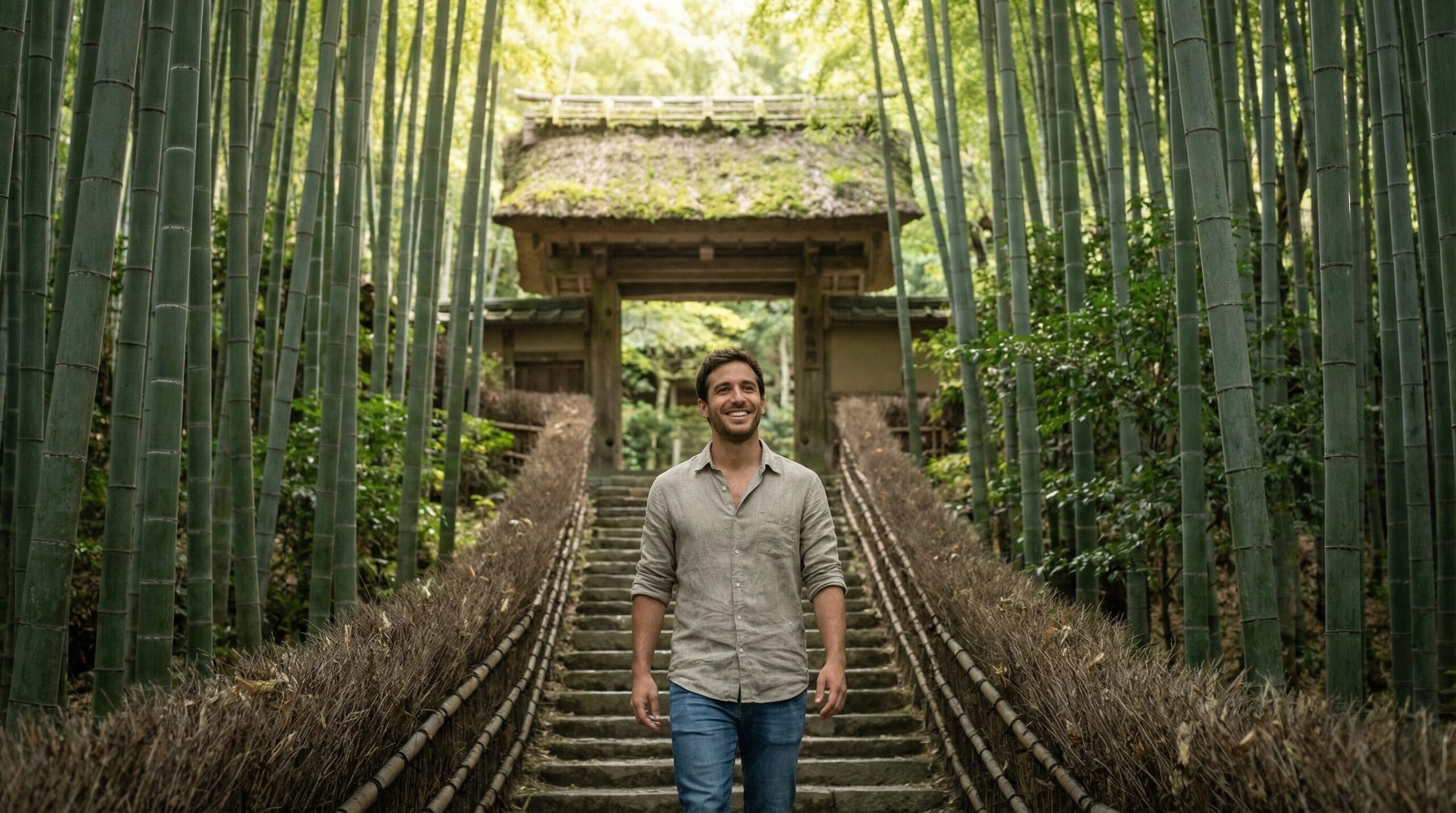
There is a version of Arashiyama that every traveler knows. It is the Arashiyama of the Togetsukyo Bridge, packed shoulder-to-shoulder with tourists snapping selfies. It is the Arashiyama of the famous Bamboo Grove, where the tranquility of nature is often drowned out by the click of shutters and the murmur of thousands of voices. But there is another Arashiyama.
If you rent a bicycle and ride about twenty to thirty minutes north of the main station, the crowds dissolve. The asphalt turns into the preserved cobblestones of the Saga-Toriimoto district. The souvenir shops are replaced by thatched-roof farmhouses and silence. Here, nestled in the foothills of Mount Atago, lie temples that offer something the main strip cannot: solitude. This guide is for the traveler who wants to stop looking at Kyoto and start feeling it. These are the 5 hidden temples of Okusaga—the deep, quiet north of Arashiyama.
Otagi Nenbutsu-ji: The Temple of 1,200 Smiles
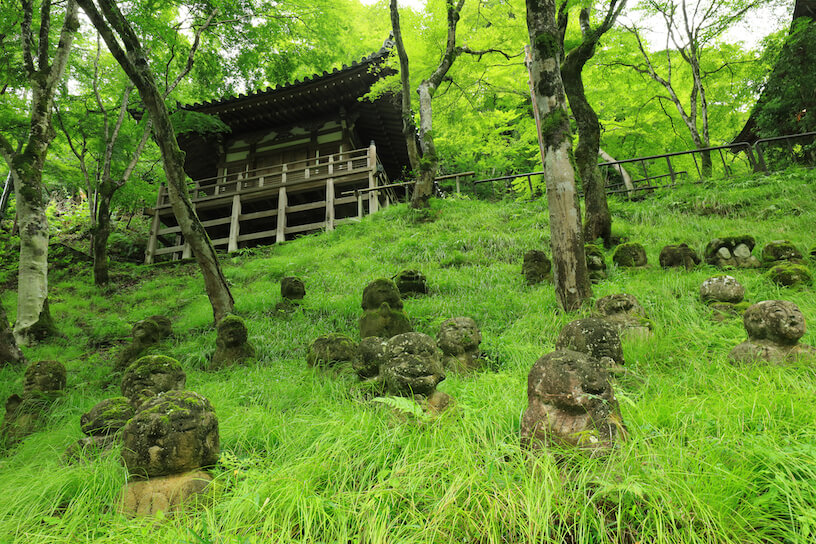
Located at the very top of the Saga-Toriimoto preserved street, Otagi Nenbutsu-ji feels less like a temple and more like a secret village inhabited by stone spirits. It is the furthest temple from the station, which blessedly keeps the tour buses away.
The Story in the Stone
Unlike the pristine, golden Buddhas of downtown Kyoto, the statues here are rough, moss-covered, and deeply human. In the 1980s, the head priest Kocho Nishimura, a sculptor, invited ordinary citizens to carve rakan (disciples of Buddha) to aid in the temple’s restoration. The result is 1,200 unique statues, each with a different expression. You will find statues drinking sake, holding cassette players, laughing hysterically, or cradling pets.
- Why it’s Authentic: It captures a rare side of Japanese spirituality—humor. It reminds us that enlightenment doesn’t always have to be serious.
- Best Moment: Visit on a rainy day. The moss glows a neon green, and the wet stone makes the statues’ expressions even more vivid.
Adashino Nenbutsu-ji: A Haunting Beauty
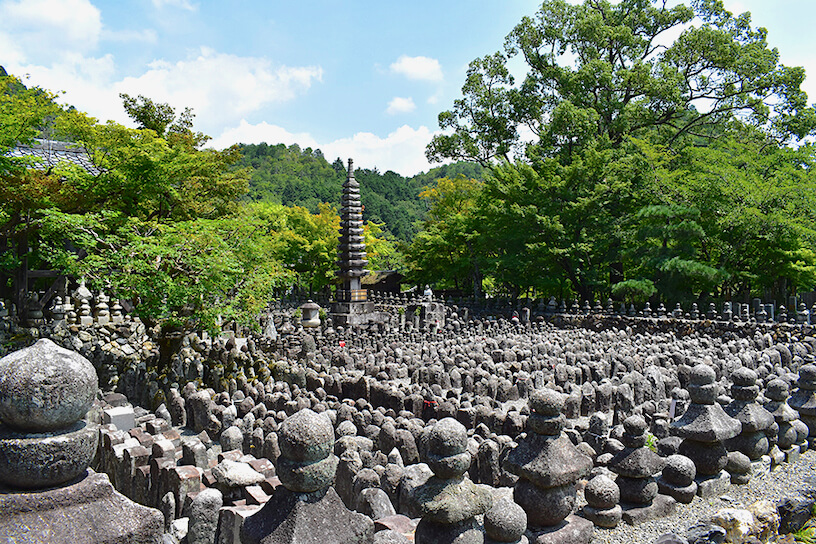
Just a short walk down the hill from Otagi lies Adashino Nenbutsu-ji. If Otagi is whimsical, Adashino is solemn. Historically, this area was a burial ground where bodies were abandoned to the elements. Today, the temple houses thousands of stone markers for souls without kin.
The Secret Bamboo Grove
Most travelers fight for space in the famous Arashiyama Bamboo Grove near the station. They don’t realize that Adashino Nenbutsu-ji has its own bamboo grove in the back.
- The Difference: It is smaller, yes, but it is often completely empty. You can stand here and actually hear the wind rustling through the stalks—the sound the Japanese call matzukaze (pine wind), a sound of pure serenity.
Gio-ji: The Moss Garden of Tragic Love
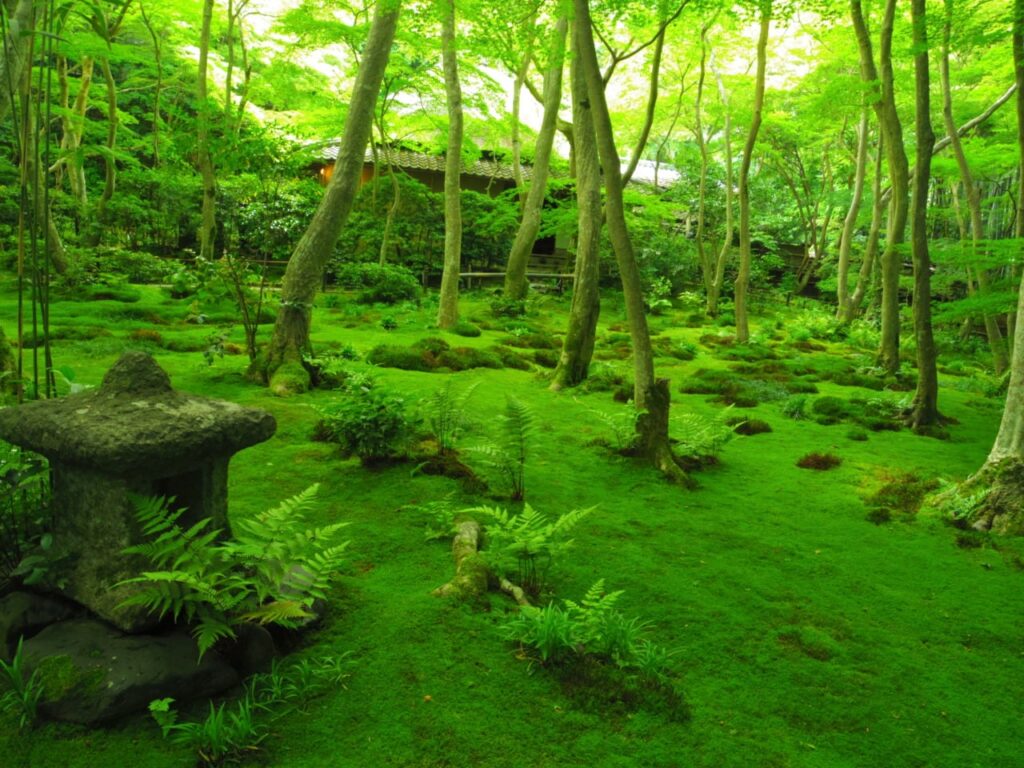
Gio-ji is tiny. You could walk the perimeter in three minutes, but you will want to stay for an hour. The temple consists of a small thatched-roof hut and a garden, but the garden is the masterpiece.
A Study in Green
The ground is carpeted in dozens of varieties of moss, creating a soft, velvet landscape that ripples under the maple trees.
- The Legend: The temple is dedicated to Gio, a dancer who fell out of favor with a powerful warlord and retreated here to become a nun. The melancholic beauty of the place perfectly mirrors her story.
- Visual Highlight: The contrast between the emerald moss and the vermilion maple leaves in autumn is arguably one of the finest sights in Kyoto.
Nison-in: The Path of Maples
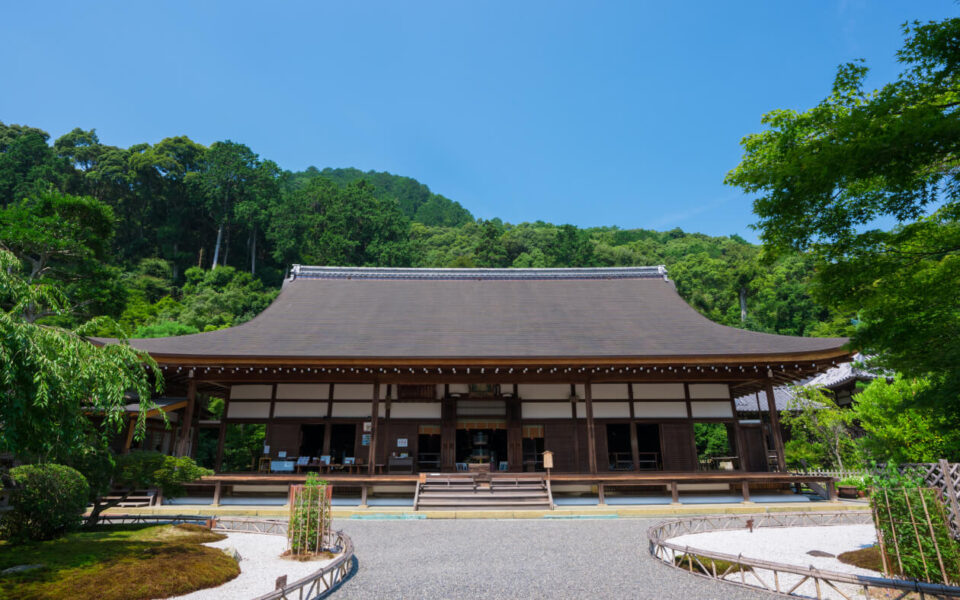
Located just a few minutes’ walk south of Gio-ji, Nison-in offers a sense of aristocratic grandeur that differs from the humble moss huts nearby, yet it retains that essential Okusaga silence.
The “Momiji-baba” Approach
The temple is famous for its wide, gentle slope leading up to the main gate, known as the “Momiji-baba” (Horse Riding Ground of Maples). In autumn, this path becomes a tunnel of red and gold; in summer, it is a cool, green sanctuary.
- The Name: “Nison” means “Two Images.” Unusually, this temple worships two main deities side-by-side: Shaka Nyorai (who sends souls off from this world) and Amida Nyorai (who welcomes them into the next). It is a poignant reminder of the cycle of life and death that pervades this historic funeral area.
- Why Visit: It offers a slightly wider, more open atmosphere than the enclosed moss gardens of Gio-ji, providing a breath of fresh air and architectural beauty on your route.
Jojakko-ji: The Mountain Outlook
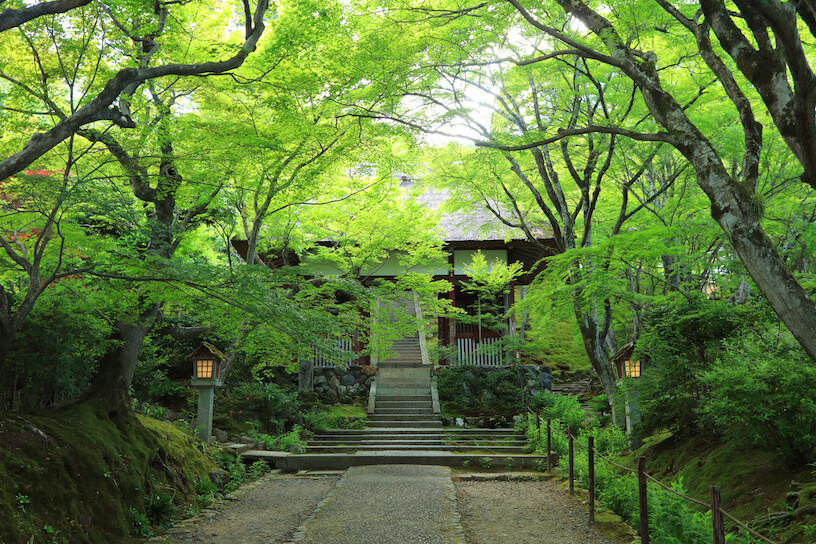
Perched on the steep slope of Mount Ogura, Jojakko-ji offers what the other hidden temples lack: a view. As you climb the stone steps, the dense canopy of maples frames a sweeping panorama of the Kyoto basin below.
The “Everlasting Light”
The name Jojakko-ji translates roughly to “The Temple of Everlasting Light.” It feels appropriate. The way the sunlight filters through the maple leaves here creates a stained-glass effect that changes hour by hour.
- Architecture: The Tahoto Pagoda (a two-story pagoda) sits high on the hill. Unlike the massive pagodas of Toji or Yasaka, this one feels intimate, hiding amongst the trees as if it grew there naturally.
Practical Examples: How to Plan Your Route
To truly enjoy this “Deep Arashiyama” route, you must abandon the standard tourist pace. Here is a recommended itinerary for a half-day of slow travel.
The “Okusaga” Cycling Route (3–4 hours)
- 09:00 AM: Arrive at Saga-Arashiyama Station (JR) or Arashiyama Station (Hankyu).
- 09:15 AM: Rent a Bicycle. Do not walk; the route to Otagi is uphill and long (approx. 3km). An electric assist bike (dendo-jitensha) is highly recommended.
- 09:45 AM: Ride straight to the top, bypassing everything else. Start at (1) Otagi Nenbutsu-ji right when it opens to have it to yourself.
- 10:30 AM: Roll downhill to (2) Adashino Nenbutsu-ji.
- 11:15 AM: Stop for tea at a traditional teahouse on Saga-Toriimoto Preserved Street. Look for the massive red Torii gate and thatched roofs.
- 12:00 PM: Visit (3) Gio-ji.
- 12:30 PM: Walk or ride just down the street to (4) Nison-in to walk the maple tunnel.
- 01:15 PM: End at (5) Jojakko-ji for the panoramic view of Kyoto, before heading back to the station area for lunch.
Tips for Travelers
- Silence is Golden: These temples are active places of worship, often with very few visitors. Keep your voice low. The atmosphere is fragile.
- Mosquito Warning: Gio-ji and Otagi are lush and damp. In summer (June–September), bring insect repellent. The moss gardens are beautiful, but they are also breeding grounds for mosquitoes.
- Footwear Matters: You will be walking on uneven stone steps and dirt paths, not paved sidewalks. Leave the heels at the hotel.
- The “One-Way” Trick: If you don’t want to cycle, take a taxi from the station directly to Otagi Nenbutsu-ji (approx. 2,000 yen). Then, walk downhill back to the station, visiting the other temples along the way. This saves your energy and knees.
Conclusion
The true beauty of Japan often hides in plain sight, obscured only by our own reluctance to venture a little further. Arashiyama is not just a bamboo grove; it is a collection of stories—of forgotten souls, tragic dancers, and whimsical monks—carved into stone and moss. When you visit these hidden temples, you aren’t just checking boxes on a sightseeing list. You are slowing down to the rhythm of the mountain. You are going beyond the ordinary—and that is where the real Japan begins.