
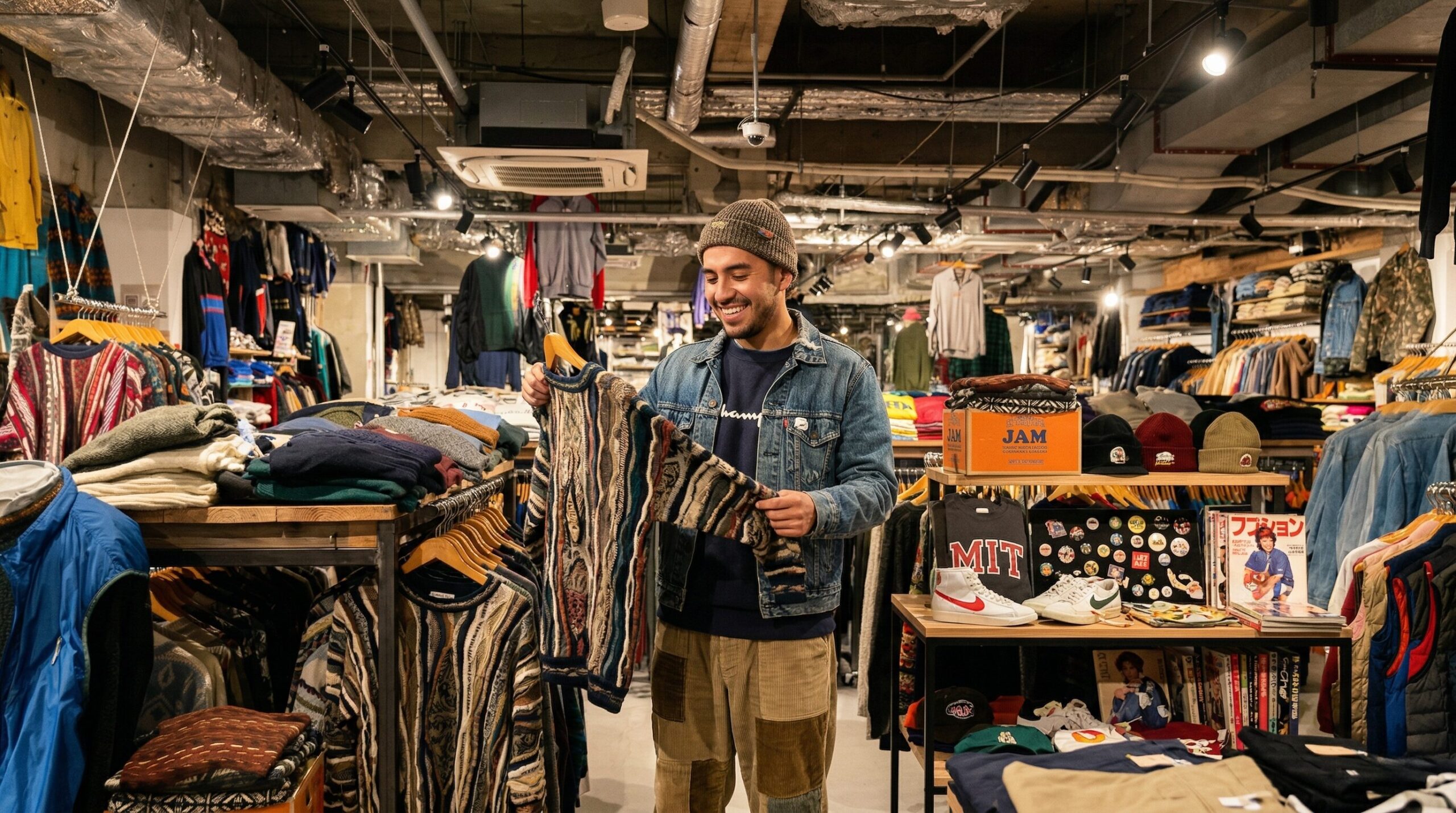
When the international fashion world turns its gaze toward Japan’s capital, it typically focuses on two extremes. On one end is the hyper-polished, architectural luxury of Ginza and Omotesando, where global fashion houses construct glass monoliths to house their latest collections. On the other end is the historical, cartoonish caricature of Harajuku—a heavily commercialized, pastel-drenched image of youth culture that, in reality, was commodified and exported decades ago. While these visible layers of the city’s sartorial landscape are fascinating, they represent a highly sanitized version of Japanese style. For the mindful traveler and the true aesthetic explorer, the most compelling garments are not found behind pristine glass storefronts. They are found down narrow, graffiti-covered stairwells, inside dilapidated post-war buildings, and in the dark corners of subterranean music venues. This is Tokyo’s underground fashion scene.
Operating far below the radar of mainstream trend forecasters, this clandestine ecosystem is fueled by pure rebellion, obsessive craftsmanship, and a fierce dedication to anti-fashion. In a country internationally recognized for its strict adherence to social conformity and corporate uniformity, underground fashion serves as a vital, explosive outlet for radical self-expression. By leaving the crowded tourist corridors to navigate this complex subculture, you travel deeper into the city’s creative heart. This guide will help you decode the aesthetic tribes, locate the hidden ateliers, and understand the profound philosophy driving the most avant-garde wardrobes in the world.
The Philosophy of Anti-Fashion: Key Details and Breakdown
To truly appreciate Tokyo’s underground fashion scene, one must first understand that it is not a monolithic trend. It is a fragmented, constantly evolving collection of subcultures that actively reject the sterile perfection of mainstream retail. When you step into an underground boutique, you are engaging with a unique set of cultural and economic rebellions:
- The Rejection of ‘Kawaii’ (Cute): While the world associates Tokyo street style with the cheerful, accessible “kawaii” aesthetic of the 1990s, the modern underground is often a direct, aggressive reaction against it. You will find subcultures embracing dark, post-apocalyptic cyberpunk aesthetics, distressed grunge, and heavy, genderless avant-garde draping. The goal is no longer to look approachable; the goal is to look imposing, structural, or intentionally chaotic.
- The Art of Upcycling and Remaking: Sustainability in the Tokyo underground is not a corporate buzzword; it is a creative necessity. With limited funds and a desire for absolute uniqueness, many underground designers are master upcyclers. They deconstruct vintage military surplus, traditional kimono silks, and 1980s sportswear, painstakingly hand-stitching them together to create radical, one-of-a-kind Franken-garments.
- The Blur of Nightlife and Retail: The most authentic fashion does not happen in broad daylight. The underground scene is inextricably linked to Tokyo’s niche music cultures—techno, noise, hardcore punk, and underground hip-hop. The designers, shop owners, and customers are often the same people populating the city’s hidden live houses and DJ bars. The clothing is specifically designed to be worn in these dark, strobe-lit spaces.
- The Evolution of Subversive Styles: While styles like Jirai Kei (often translated as “landmine type”) initially emerged with a subversive dark edge, it has now become a highly commercialized mainstream trend. Today’s true underground continues to push beyond these recognizable tropes into more avant-garde territory.
Hidden Ateliers and Backstreet Boutiques: Practical Examples and Recommendations
Finding the epicenters of this culture requires abandoning the major subway stations and venturing into Tokyo’s grittier, deeply residential, and artistic neighborhoods. Here is a curated map to experiencing the raw, unedited edge of the city’s style.
The Chaotic Canvas of Koenji (The Kitakore Building)
If there is a beating heart of Tokyo’s modern DIY fashion underground, it is Koenji. Located in the western wards of the city, Koenji is historically a working-class, punk-rock neighborhood. It is the antithesis of Omotesando’s polished luxury.
Highlights of a Koenji Fashion Walk:
- The Kitakore Building: This is not a standard retail building; it is a legendary architectural anomaly. The Kitakore Building is a dilapidated, two-story post-war structure that looks as if it might collapse at any moment. Inside, it functions as an incubator for Tokyo’s most radical designers.
- Hayatochiri: Located within Kitakore, this tiny, chaotic boutique is legendary in the global fashion underground (having previously pulled pieces for international pop icons like Lady Gaga). The walls are plastered with stickers and newspaper, and the racks are crammed with aggressively customized, hand-painted, and studded garments that defy all traditional rules of tailoring.
- The South Exit Thrift Labyrinth: Moving across the station from Kitakore at the North Exit, the streets radiating from Koenji’s south exit are packed with independent vintage shops. Look for stores specializing in boro (traditional Japanese patchwork), heavily distressed 1970s punk leather, and obscure European workwear, offering a masterclass in how Tokyoites curate history.
The Surviving Eccentrics of Ura-Hara (Harajuku’s Backstreets)
While the main artery of Takeshita Street has been entirely surrendered to mass tourism and cheap crepe stands, the labyrinthine backstreets known as Ura-Hara (Hidden Harajuku) still harbor a few fiercely independent outposts that refuse to dilute their vision.
Highlights of an Ura-Hara Walk:
- Dog Harajuku: Hidden down a narrow, graffiti-lined stairwell into a basement, Dog Harajuku is an institution. It is a sensory overload of customized, avant-garde, and historically significant vintage pieces. The shop is famous for its in-house remade items, featuring complex distressing, safety-pin architecture, and hand-painted graphics. The staff themselves are usually dressed in incredibly striking, boundary-pushing outfits, serving as walking lookbooks for the culture.
- The Niche Archival Shops: Ura-Hara is also home to tiny, unmarked boutiques that specialize in archival Japanese designer pieces (early Comme des Garçons, Undercover, Yohji Yamamoto). These shops treat clothing like rare art, offering visitors a chance to see the seminal, dark garments that built Tokyo’s global fashion reputation in the 1980s and 90s.
The Dark Avant-Garde of Shibuya’s Periphery
Shibuya is famous for its massive scramble crossing and towering commercial buildings, but the periphery of the neighborhood—particularly the areas bleeding into Tomigaya or the steep hills behind the station—hosts a quiet, highly sophisticated underground scene focused on dark, structural minimalism.
Highlights of Shibuya’s Periphery:
- Nude Trump: Another legendary, hidden space. This vintage boutique feels less like a store and more like the extravagant, velvet-drenched dressing room of a 1980s rock star. It is packed with glitter, faux fur, animal prints, and obscure European designer pieces, catering to the city’s drag queens, club kids, and nightlife eccentrics.
- The Artisanal Drapers: In the quieter streets, you will find minimalist, unmarked concrete boutiques selling garments from independent Japanese artisans. The focus here is on “dark fashion”—asymmetrical cuts, dropped crotches, raw hems, and an overwhelming palette of black, charcoal, and dark indigo. The designers focus on the texture of the fabric (heavy boiled wools, stiff linens) and the silhouette, creating clothing that looks like modern armor.
Mindful Observation: Tips for Travelers
Entering the spaces that define Tokyo’s underground fashion scene is not like walking into a standard retail store. These are highly personal, intensely curated spaces, often run by a single designer or a small group of friends. To navigate these boutiques respectfully and successfully, keep these practical tips in mind:
- The Rule of Photography: The golden rule of the Tokyo underground is absolute respect for privacy. Do not treat the staff or the customers like zoo animals. While someone’s outfit might be the most spectacular, complex garment you have ever seen, taking unsolicited photos is considered deeply rude and invasive. If you wish to photograph an incredible interior or a specific piece of clothing, you must ask permission first (“Shashin wo totte mo ii desu ka?”). Many shops strictly enforce a “No Photography” policy to protect their proprietary designs.
- Understanding the Sizing Reality: It is crucial to manage your expectations regarding fit. Japanese sizing is historically smaller than Western sizing. Furthermore, underground, customized, or vintage garments are almost always one-of-a-kind. If you find an incredible, hand-studded jacket in a Koenji basement, it is the only one in existence; there is no “size up in the back room.” Embrace the oversized, genderless aesthetic that defines much of the culture, focusing on how a piece drapes rather than how it fits conventionally.
- Cash and the Tax-Free Illusion: While the massive department stores in Ginza gladly offer tax-free shopping and accept all major foreign credit cards, the underground operates differently. A tiny, independent designer operating out of a dilapidated building in Harajuku is unlikely to have the infrastructure for tax-free tourist processing. Furthermore, many of the smallest, grittiest shops still prefer physical yen. Always carry a comfortable stack of 1,000-yen notes, as small independent boutiques often struggle to make change for large bills.
- The “Looking, Not Touching” Etiquette: In high-end archival shops or boutiques selling delicate, hand-remade items, do not aggressively rifle through the racks. The garments are often fragile. If a piece is displayed high up or looks particularly complex, politely ask the shop staff to show it to you. They are usually incredibly proud of their curation and, despite language barriers, will happily show you the intricate details of the stitching or the history of the fabric.
Conclusion
Japan’s true creative brilliance is rarely broadcast on massive digital billboards. It does not exist in the sterile, mass-produced uniformity of the international fast-fashion chains that have colonized the main avenues of the city. The profound, enduring, and relentlessly innovative soul of Tokyo style lives in the shadows. It is found in the meticulous, bleeding fingers of a designer hand-stitching vintage denim in a cramped Koenji apartment, in the heavy thud of platform boots walking down a dark Shibuya alley, and in the quiet, structural poetry of an asymmetrical black coat. By dedicating time to explore Tokyo’s underground fashion scene, you actively reject the superficial, pre-packaged version of modern tourism. You choose to travel deeper, trading the convenience of the shopping mall for a genuine, tactile connection to the country’s most rebellious subcultures. You stop simply buying souvenirs and begin to engage with wearable art. It is time to go beyond the ordinary, step down the unmarked stairwells, and discover the raw, breathtaking aesthetic innovation that the real Japan fiercely protects.