
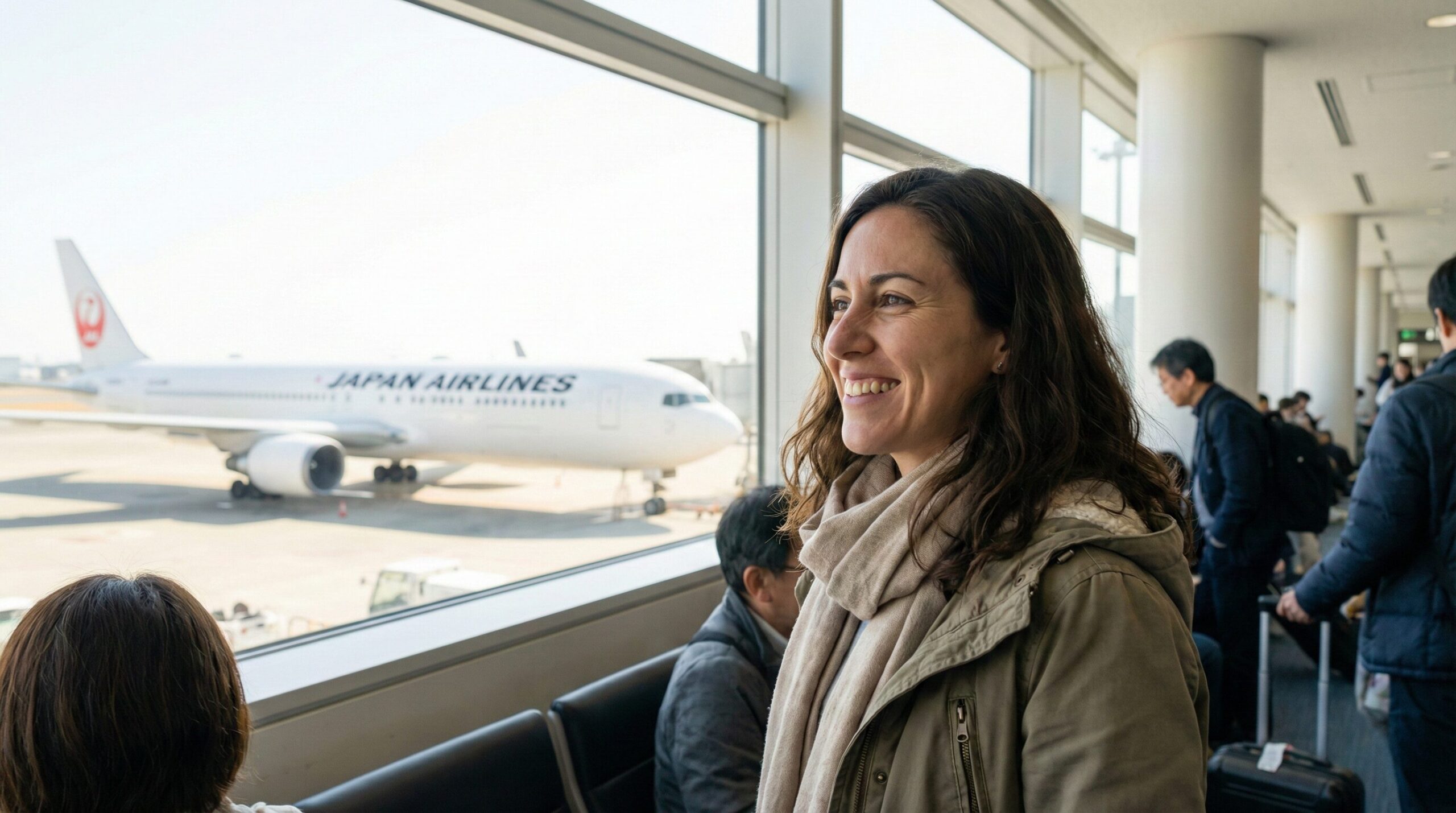
When the world dreams of travel in Japan, it dreams of the Shinkansen. The image of the bullet train slicing through the countryside past Mount Fuji is iconic. It is efficient, romantic, and undeniably convenient.
But here is a truth that seasoned travelers and locals know well: The train cannot take you everywhere.
Japan is an archipelago of over 6,800 islands stretching from the sub-arctic snows of Hokkaido to the subtropical coral reefs of Okinawa. While the rail network is a marvel, relying on it exclusively often means missing out on the “Real Japan” that lies at the edges. To truly Beyond Nippon—to reach the rugged coastlines of the San’in region, the remote islands of Kyushu, or the powder snow of Niseko—you need to take to the skies.
This Guide to Domestic Flights in Japan is designed to demystify the process. For many international visitors, the Japanese domestic aviation market is a black box of unfamiliar airline names and complex booking systems. But with the right knowledge, flying in Japan is not only often faster than the train—it can be significantly cheaper.
Forget the stress of international long-haul travel. Domestic flying in Japan is a different beast entirely: civilized, punctual, and filled with unique cultural quirks (like high-end bento boxes designed specifically for the sky). Let’s explore how to navigate it.
- The Landscape: Legacy Carriers vs. LCCs
- The “Secret” Middle Ground: Boutique Regional Airlines
- The “Tourist Pass” Hack: Save Hundreds of Dollars
- The Airport Experience: Haneda vs. Narita
- Soraben: The Culture of Sky Bentos
- Practical Guide: Step-by-Step
- Top 3 Recommended Routes for the “Real Japan”
- Tips for Travelers with Equipment
- Conclusion
The Landscape: Legacy Carriers vs. LCCs
Understanding the hierarchy of Japanese airlines is the first step to planning your route. Unlike Europe or the US, where the lines between full-service and budget are blurring, Japan maintains a distinct divide.
The Big Two: JAL and ANA
Japan Airlines (JAL) and All Nippon Airways (ANA) are the twin pillars of Japanese aviation. They dominate the market and offer a level of service that harkens back to the “Golden Age” of flying.
- Service: Even in Economy, expect impeccable politeness. Drinks are complimentary (usually including their signature consommé soup or kabosu citrus juice), and seats are generally more spacious.
- Reliability: These airlines prioritize on-time performance obsessively. If there is a delay, the support system is robust.
- Terminals: They invariably use the most convenient terminals (e.g., Terminal 1 and 2 at Haneda), saving you significant transit time.
- Why Fly Them: For peace of mind, baggage allowance (usually 20kg checked free), and access to the extensive network of smaller regional airports that budget airlines don’t touch.
The Low-Cost Carriers (LCCs)
In the last decade, LCCs have revolutionized travel in Japan. They are excellent for point-to-point travel between major hubs (Tokyo, Osaka, Sapporo, Fukuoka, Okinawa).
- Peach Aviation: The most prominent LCC, based in Kansai (Osaka). Known for its bright pink planes and frequent sales.
- Jetstar Japan: A joint venture with JAL, offering strong connectivity from Narita.
- Spring Japan: Formerly Spring Airlines Japan. It is now a subsidiary of the JAL Group, offering budget-friendly flights from Narita to cities like Hiroshima and Saga, combining LCC prices with JAL’s safety standards.
The Catch: LCCs in Japan are strict. The 7kg carry-on limit is enforced with a scale at the gate. They often use budget terminals (like Narita Terminal 3 or Kansai Terminal 2) which require extra walking or bus transfers.
The “Secret” Middle Ground: Boutique Regional Airlines
This is where the “Real Japan” shines. There is a tier of airlines that sits between the luxury of ANA/JAL and the austerity of LCCs. These are often subsidiaries or partners of the big two but maintain distinct regional identities.
Air Do (Hokkaido)
“The Wings of Hokkaido.” Their mascot is a cute bear, and onboard they serve onion soup made from Hokkaido produce. They offer a warm, northern hospitality and connect Tokyo directly to smaller Hokkaido cities like Asahikawa and Hakodate.
Solaseed Air (Kyushu/Miyazaki)
Based in Kyushu, Solaseed is known for its pistacio-green branding and excellent legroom (often better than JAL/ANA economy). They serve agochin soup (flying fish broth) onboard, a Kyushu specialty.
Starflyer (Kitakyushu/Fukuoka)
Perhaps the most stylish airline in the world. The planes are matte black. The leather seats are black. The flight attendants wear black. They offer generous legroom, personal seatback screens (rare for domestic), and serve Tully’s coffee with a piece of dark chocolate. Flying Starflyer feels like a private jet experience at a commercial price.
The “Tourist Pass” Hack: Save Hundreds of Dollars
This is the single most important tip in this Guide to Domestic Flights in Japan. International tourists are eligible for special fares that locals cannot buy.
JAL Japan Explorer Pass
- Cost: Fixed-price fare (roughly ¥5,500 to ¥11,000 / $35–$75 USD) per sector, regardless of demand.
- Condition: You must reside outside Japan and have an international return ticket.
- Benefit: It includes 2 checked bags (23kg each). This is a massive value compared to LCCs which charge for bags.
ANA Discover JAPAN Fare
- Cost: Dynamic pricing. While it offers discounts for tourists, the price fluctuates based on demand and season, unlike JAL’s fixed pass.
- Benefit: Earns mileage and allows you to access ANA’s massive domestic network.
The Strategy: Do not book these flights as “add-ons” to your international ticket unless the price is exceptional. Instead, go to the dedicated “Explorer Pass” websites of JAL or ANA after you have your main flights. You can book a flight from Tokyo to Ishigaki (a 3.5-hour flight) for under $100, a route that might cost $400 normally.
The Airport Experience: Haneda vs. Narita
For travel within Japan, the airport you choose in Tokyo matters immensely.
Haneda (HND): The Domestic Hub
- Location: Inside Tokyo. 30 minutes from the city center.
- Vibe: Bustling, efficient, gigantic.
- Usage: 90% of domestic flights operate from here. If you can fly out of Haneda, do it. It saves you an hour of transit compared to Narita.
Narita (NRT): The International/LCC Hub
- Location: Chiba Prefecture. 60–90 minutes from Tokyo.
- Usage: Most LCCs (Peach, Jetstar) fly from here to save on landing fees.
- The Math: If a Peach flight from Narita is ¥2,000 cheaper than a JAL flight from Haneda, you end up losing money (and time) on the train ticket to get to Narita. Always factor in the “cost of access.”
Soraben: The Culture of Sky Bentos
On the Shinkansen, eating an Ekiben (station bento) is a ritual. The domestic flight equivalent is the Soraben (Sky Bento).
Because domestic flights are short (usually 60–100 minutes) and meals are rarely served in Economy, Japanese airports have developed incredible delis.
Recommendation at Haneda: Visit the “Sora-Ben” shops in Terminal 1 or 2. Look for:
- Seasonal Bentos: Instead of self-heating boxes (which are prohibited on flights due to fire safety regulations), look for bentos designed to be delicious even when cold.
- Katsu Sando: High-end pork cutlet sandwiches (Maigen is a famous brand).
- Local Specialties: You can buy bentos featuring crab from Hokkaido or beef from Kobe before you even get on the plane.
Etiquette: It is perfectly acceptable to bring food and drink (even alcohol) on board. However, avoid overly smelly foods.
Practical Guide: Step-by-Step
Booking
- When to book: Japan has distinct booking windows. “Early Bird” fares (28 days, 45 days, 75 days in advance) offer significant discounts.
- Name Order: Be meticulous. Japanese systems are rigid. If your passport says “SMITH JOHN PAUL,” do not book as “SMITH JOHN.”
Check-In
- Domestic is Fast: You do not need to arrive 3 hours early. For major airports (Haneda/Itami), arriving 60 minutes prior is plenty. For smaller airports, 45 minutes is often fine.
- Security: Japanese domestic security is surprisingly relaxed compared to the US or Europe. You can often bring liquids on board (sometimes they just inspect them on a special scanner). You do not need to take off your shoes unless they are heavy boots.
Boarding
- Efficiency: Japanese boarding is a marvel of order. It happens in groups. People line up quietly. The plane will leave on time. If the departure is 10:00, the doors close at 9:50. Do not be late.
On Arrival
- Baggage: It comes out fast. There is no waiting for 45 minutes.
- Transport: Almost every Japanese airport is connected to the city by a dedicated bus or train. Buy your ticket at the arrival hall vending machines.
Top 3 Recommended Routes for the “Real Japan”
To truly use this Guide to Domestic Flights in Japan, consider these routes that replace long train rides with efficient hops.
Tokyo (HND) to Izumo (IZO)
- The Destination: The home of Izumo Taisha, one of Japan’s oldest and most sacred shrines, and the gathering place of the gods.
- Why Fly: The train takes 6+ hours with transfers. The flight is 80 minutes. JAL flies here.
- Bonus: The airport is nicknamed “Izumo Enmusubi (Matchmaking) Airport.”
Osaka (ITM) to Yakushima (KUM)
- The Destination: The moss-covered ancient forests that inspired Studio Ghibli’s Princess Mononoke.
- Why Fly: Taking the ferry takes half a day. A direct flight (via JAL commuter subsidiaries) drops you right into the subtropics.
Tokyo (HND) to Memanbetsu (MMB)
- The Destination: The gateway to Shiretoko National Park in eastern Hokkaido (World Heritage Site).
- Why Fly: This is as far as you can get from Tokyo. The train journey would take nearly a full day. The flight puts you in reach of drift ice and brown bears by lunch.
Tips for Travelers with Equipment
If you are a skier or cyclist, domestic flights are your friend.
- Ski Gear: JAL/ANA usually treat ski bags as standard checked luggage (within weight limits).
- Bikes: Many Japanese airports (especially Onomichi for the Shimanami Kaido cycling route) have “bicycle boxes” or dedicated handling for cyclists. LCCs will charge extra, but legacy carriers are often very accommodating if you pack it in a Rinko bag properly.
Conclusion
Japan is smaller than California, yet its terrain is so mountainous and its islands so scattered that distance is deceptive. The Shinkansen is the spine of the country, but the domestic flight network is its nervous system, reaching the fingertips and toes of the archipelago. By mastering the art of the domestic flight—utilizing tourist fares, trying the stylish regional airlines, and enjoying a Soraben at 30,000 feet—you unlock a version of Japan that most tourists never see. You trade hours on a train for hours exploring a remote shrine, a hidden beach, or a snow-covered peak. The next time you plan your itinerary, look at the map. If your destination looks far, check the flight schedules. The “Real Japan” is often just a 90-minute flight away.
Travel Deeper. Explore the Real Japan.