
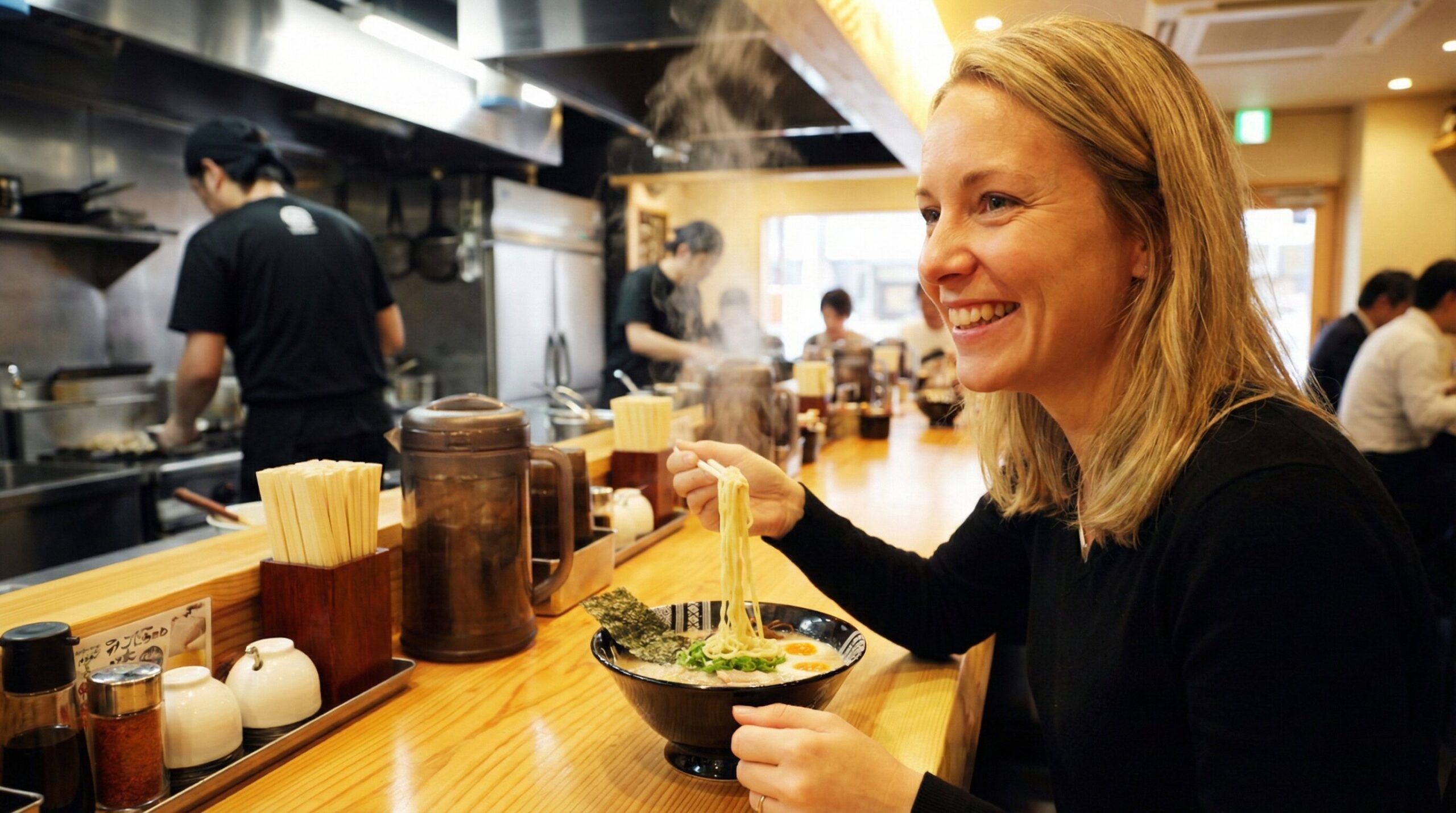
If Kyoto’s cuisine is a whispered poem, Kyushu’s food is a shout across a crowded room. Located in the southwest of the Japanese archipelago, Kyushu is a land of active volcanoes. It is a place of bubbling hot springs, and a history defined by being the gateway to the outside world.
For centuries, foreign ships docked here, bringing sugar, chili peppers, and frying techniques that the rest of isolationist Japan had never seen. This geography and history have created a food culture that is distinct from the main island of Honshu.
It is warmer, heartier, and unapologetically bold. Here, the soy sauce is sweeter, the pork is richer, and the alcohol of choice isn’t sake, but the potent, distilled shochu. For the traveler seeking “authentic experiences,” eating in Kyushu is not just about sustenance; it is about energy.
It is about squeezing into a vinyl-curtained food stall (yatai) shoulder-to-shoulder with locals, sharing a plate of dumplings while steam rises into the night air. This is your Kyushu Food Guide: Must-Try Local Dishes that define the southern spirit.
Fukuoka: The Kingdom of Umami
Fukuoka is the undisputed culinary capital of Kyushu. It is a city that loves to eat, and its signature dishes have become global icons—though nothing beats tasting them at the source.
Tonkotsu Ramen (Hakata Ramen)
You might think you know ramen. But until you have smelled the pungent, cloudy air of a Hakata ramen shop, you haven’t truly experienced it.
- The Broth: Unlike the clear soy broths of Tokyo, Hakata ramen is made by boiling pork bones for hours (sometimes days) until the collagen dissolves into a creamy, white liquid. It is rich, heavy, and deeply satisfying.
- The Noodles: Thin, straight, and firm. Because they are thin, they cook fast, but they also get soggy fast. This led to the Kaedama system—instead of ordering a giant bowl, you order a normal size and shout “Kaedama!” (refill) when you finish the noodles but still have soup left.
- The Experience: Do not go to a chain restaurant. Find a Yatai (street stall) along the Nakasu river or in the Tenjin area. The ramen tastes better when eaten on a wobbly wooden bench with the city noise behind you.
Motsunabe (Offal Hot Pot)
This is the soul food of Fukuoka’s working class. Motsu refers to beef or pork offal (intestines).
- Why try it? It sounds intimidating to Western palates, but the texture is soft and fatty, melting in your mouth like high-grade beef. It is simmered in a soy or miso broth with mountains of garlic chives and cabbage.
- The Finish: After eating the meat and vegetables, locals dump champon noodles into the remaining garlic-rich soup to soak up the flavor.
Oita: The Capital of Fried Chicken
Oita Prefecture is famous for its onsen (hot springs), but culinary travelers know it as the holy land of chicken.
Toriten (Tempura Chicken)
While most of Japan eats karaage (fried chicken with a crunchy, marinated skin), Oita prefers Toriten.
- The Difference: The chicken is coated in a tempura-like batter, making it fluffy and light rather than crunchy.
- How to Eat: It is dipped in ponzu (citrus soy sauce) mixed with Japanese mustard (karashi). The acidity of the ponzu cuts through the oil perfectly. It is a common set-meal lunch across the prefecture, from Beppu to Oita City.
Seki Aji & Seki Saba
For seafood lovers, the Saganoseki area of Oita offers a brand of horse mackerel (aji) and mackerel (saba) that is legendary. Caught by hand-line (single hook) rather than nets to avoid bruising the fish, the flesh is incredibly firm and sweet. It is usually eaten as sashimi, without any cooking, which is rare for mackerel in other parts of Japan.
Miyazaki: Charcoal and Tartar Sauce
Miyazaki feels tropical. Palm trees line the roads, and the food reflects this sunny, laid-back atmosphere.
Chicken Nanban
This is perhaps Kyushu’s most famous export after ramen.
- The Dish: Fried chicken is soaked briefly in a sweet and sour vinegar sauce (nanban sauce) and then smothered in homemade tartar sauce.
- Origin: It originated in a western-style restaurant in Nobeoka City. The combination of the vinegar’s tang and the creamy tartar sauce makes it the ultimate comfort food.
Miyazaki Jitokko (Charcoal Grilled Chicken)
Walk through the streets of Miyazaki City at night, and you will see pillars of black smoke rising from izakayas. They are grilling Jitokko, a local breed of free-range chicken.
- The Style: The chicken is grilled over a fierce charcoal fire. The flames actually touch the meat, turning it black with soot. It looks burnt, but it isn’t. The meat is chewy, juicy, and infused with a smoky aroma that pairs perfectly with shochu.
Nagasaki: The Fusion Kitchen
Nagasaki was the only port open to the West and China during Japan’s seclusion. Its food is a historical map of trade routes.
Champon
A noodle dish created by a Chinese restaurant owner in the late 19th century to feed hungry Chinese students in Nagasaki.
- The Dish: Unlike ramen, where soup and noodles are cooked separately, Champon noodles are boiled directly in the soup along with pork, seafood, pink kamaboko fish cakes, and vegetables. The result is a thick, hearty stew where the noodles have absorbed all the flavors.
Castella Cake
A sponge cake brought by Portuguese missionaries in the 16th century. Over 400 years, Nagasaki refined it. It is moist, heavy, and has a distinct layer of coarse sugar crystals on the bottom. It is the perfect souvenir (omiyage) to pair with tea.
Kagoshima: The Black and The Sweet
At the southern tip of Kyushu lies Kagoshima, facing the smoking Sakurajima volcano. The food here is defined by the “Black” brand.
Kurobuta (Black Pork)
Kagoshima’s Berkshire pork is famous nationwide. The meat is sweet, tender, and the fat has a lower melting point than regular pork.
- Must-Try: Shabu-shabu. You dip thin slices of the pork into boiling water or broth for just a few seconds. In Kagoshima, it is often eaten with a dipping sauce made of sweet dashi soy sauce (soba-tsuyu) and plenty of chopped scallions, rather than sesame sauce.
Satsuma-age
These are deep-fried fish cakes, often mixed with vegetables or cheese. While found all over Japan, the Kagoshima version (where it originated) is slightly sweeter and often served freshly fried and piping hot. It is the standard snack to accompany evening drinks.
Kumamoto: The Wild Side
Kumamoto sits in the center of Kyushu, and its food is robust and garlicky.
Basashi (Horse Sashimi)
This is the litmus test for the adventurous eater. Kumamoto is famous for eating horse meat raw.
- The Taste: Before you judge, try it. It is leaner than beef but sweeter, often called sakura-niku (cherry blossom meat) because of its pink color. It is served with garlic, ginger, and a special sweet soy sauce. It is clean, iron-rich, and surprisingly delicate.
Karashi Renkon
A lotus root stuffed with a mixture of miso and fiery Japanese mustard, then deep-fried in a yellow batter. It was originally created as a health food for a sickly lord in the Edo period. Be warned: it clears your sinuses instantly.
Practical Tips for the Kyushu Gourmet
To eat like a local in Kyushu, keep these “Beyond Nippon” tips in mind.
- The Condiment is King: Yuzukosho In Kyushu, you will find a small jar of green paste on almost every table. This is Yuzukosho—a fermented paste made from yuzu citrus peel, chili peppers, and salt.
- Tip: Put a tiny amount on your grilled chicken, sashimi, or in your miso soup. It adds a spicy, citrusy kick that defines the flavor of the region.
- Drink Shochu, Not Sake While you can get sake, Kyushu is shochu country.
- Imo-jochu (Sweet Potato): Common in Kagoshima and Miyazaki. It has a strong, earthy smell.
- Mugi-jochu (Barley): Common in Oita and Nagasaki. It is cleaner and milder.
- How to order: Ask for it “Mizuwari” (with water) or “Oyuwari” (with hot water). Drinking it “Rokku” (on the rocks) is for the brave.
- Lunch is the Deal Many high-end restaurants that serve expensive beef or elaborate courses at night offer reasonable lunch sets (Teishoku) for 1,500 to 2,500 yen. This is the best way to try ingredients like Miyazaki beef without breaking the bank.
Conclusion: A Feast for the Soul
Kyushu is a place where food is never an afterthought. It is the conversation starter, the reason for gathering, and the pride of the region. When you bite into a piece of charcoal-grilled chicken in Miyazaki, or slurp a bowl of tonkotsu ramen in Fukuoka, you are tasting the landscape. You are tasting the volcanic soil that grows the sweet potatoes, the currents of the Genkai Sea that feed the fish, and the history of trade that brought spices to these shores. So, when you visit, come hungry. Leave your diet in Tokyo. In Kyushu, the best way to understand the culture is to pick up your chopsticks and dig in.