
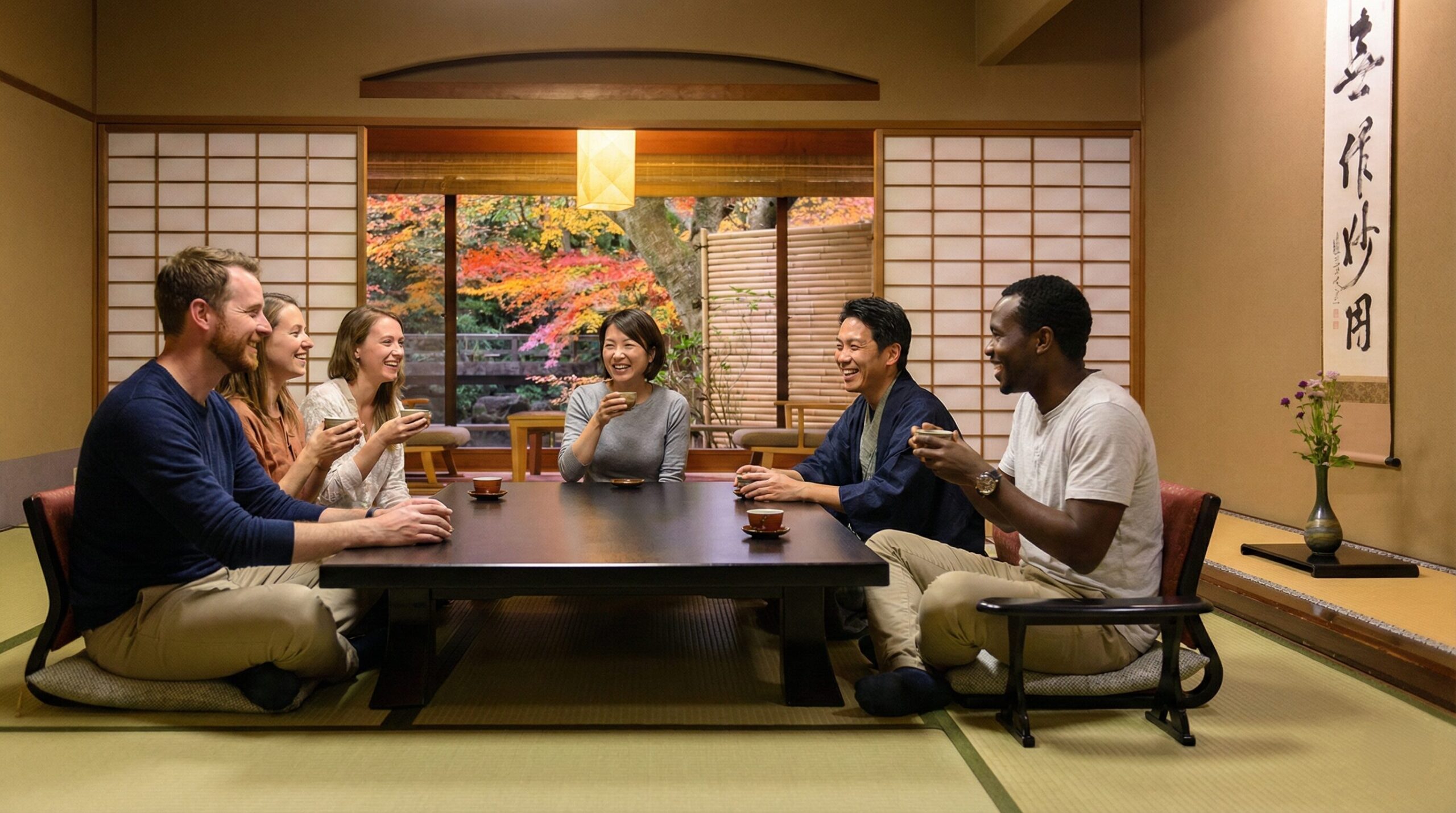
When you check into a Western luxury hotel, the room is static. The bed is the focal point, dominating the space from the moment you turn the key. The environment is designed to be observed, utilized, and left behind. But when you slide open the wooden door of a traditional ryokan with tatami elegance, you encounter something entirely different. You encounter an architecture of silence.
It begins with the scent. Before you even take a step, a subtle, earthy fragrance washes over you—the sweet, grassy aroma of freshly woven igusa (rush grass). Then comes the visual impact. The room appears remarkably, almost shockingly, empty. There is no towering bed frame. There are no bulky armchairs. There is only a low wooden table sitting gracefully on pale green woven mats. This is not an emptiness of lack; it is an emptiness of possibility. To stay in a traditional ryokan with tatami elegance is to experience a living space that breathes and transforms with the rhythm of the day. It is a masterclass in Japanese minimalism and mindfulness.
For the seasoned traveler looking to look past the neon signs and superficial sightseeing, mastering the nuance of the tatami room is the ultimate gateway to the real Japan. Let us explore the history, the hidden geography, and the delicate etiquette of Japan’s most revered form of hospitality.
Key Details and Breakdown: The Anatomy of a Tatami Room
A traditional ryokan with tatami elegance is not just a place to sleep. It is a carefully curated cultural experience. To appreciate it deeply, you must understand the elements that construct it.
The Foundation: The Tatami Mat
Tatami is the absolute foundation of traditional Japanese architecture. Historically a luxury reserved for nobility, it eventually became the standard flooring for Japanese homes.
- The Material: A true tatami mat is composed of a thick core of compacted rice straw, tightly covered with a woven surface of igusa (soft rush).
- The Sensation: Walking barefoot or in tabi (split-toe socks) across tatami is a distinct tactile experience. It gives slightly under your weight. It is cool in the humid Japanese summers and surprisingly warm during the biting winters. It naturally regulates humidity and purifies the air.
- The Measurement: Rooms in Japan are still measured by the number of mats they hold (e.g., a “6-mat room” or an “8-mat room”). The size of a single mat varies slightly by region, but its presence dictates the entire proportion of the space.
The Visual Anchors: Tokonoma and Shoji
Because a tatami room lacks heavy furniture, the architectural details provide the aesthetic anchor.
- The Tokonoma: This is a slightly elevated alcove, usually built into one corner of the room. It is the spiritual and artistic center of the space. Here, the innkeeper will display a hanging scroll (kakejiku) and a seasonal flower arrangement (ikebana). The art in the tokonoma is rotated regularly to reflect the exact micro-season. It is a space for visual poetry, not for placing your luggage.
- The Shoji and Fusuma: Light in a tatami room is rarely direct. It filters through shoji—sliding screens made of wooden lattice and translucent paper. This diffuses the harsh sunlight into a soft, shadowless glow. Solid sliding doors, known as fusuma, separate rooms and are often painted with delicate landscapes or sweeping calligraphy.
The Transformation: The Role of the Nakai-san
The most magical aspect of a traditional ryokan with tatami elegance is its dynamic nature. This transformation is orchestrated by your Nakai-san, the dedicated room attendant.
- Afternoon: The room is a tranquil lounge. You sit on flat cushions (zabuton) at a low table, drinking green tea and eating a seasonal sweet.
- Evening: If you are served in-room dining, the table becomes a private banquet hall for an elaborate kaiseki multi-course meal.
- Night: While you are soaking in the hot spring baths, the Nakai-san enters. The table is moved aside. Fluffy futon mattresses are unfurled directly onto the tatami, transforming the space into a plush, grounded bedroom.
Practical Examples and Recommendations: Where the Masters Host
You can find ryokans across the entire archipelago, but certain regions elevate the experience to an art form. To truly travel deeper, you must look for areas where the natural environment seamlessly blends with the interior design.
The Hidden Valleys of Kyushu
Far from the crowded tourist corridors of Honshu, the southern island of Kyushu offers some of the most profound ryokan experiences in the country. Specifically, the mist-shrouded valleys of Oita Prefecture are a haven for travelers seeking profound quiet.
- The Vibe: Oita is famous for its geothermal activity, meaning a traditional ryokan with tatami elegance here often features a private, steaming open-air bath (rotenburo) attached directly to your room.
- What to Look For: Venture into the quieter outskirts of Yufuin or the secluded hills behind Beppu. Look for ryokans built in the sukiya-zukuri style—a refined, rustic architectural aesthetic originally designed for tea ceremony houses. In these inns, you can slide open your shoji screens to let the autumn breeze roll across your tatami mats, bringing with it the faint scent of sulfur and wet pine, while you gaze at the striking silhouette of Mount Yufu.
The Deep Snow Country of Tohoku
For a starkly different atmosphere, journey north to the Tohoku region, to places like Akita or Yamagata.
- The Vibe: Here, the ryokan is a fortress of warmth against the brutal, beautiful winters. The contrast between the freezing snow outside and the golden warmth inside is intoxicating.
- What to Look For: Seek out inns that feature an irori—a sunken hearth cut directly into the tatami or wooden floor. Sitting cross-legged on a woven mat, listening to the crackle of burning charcoal while a heavy snowstorm blankets the cedar forests outside, is the pinnacle of Japanese winter travel.
The Cultural Heart of Kyoto
For those who prefer historical refinement, the ancient capital remains the gold standard for traditional hospitality.
- The Vibe: Kyoto ryokans (often called ryotei if they heavily focus on high-end cuisine) are masters of subtlety. The gardens are meticulously manicured, and the service is impeccably formal.
- What to Look For: Tucked away in the narrow alleys of Nakagyo or the forested foothills of Arashiyama, look for inns that have been operated by the same family for a dozen generations. The tatami here is often edged with fine silk borders, and the woodwork has been polished to a mirror shine by centuries of stockinged feet.
Tips for Travelers: The Unwritten Rules of the Mat
Staying in a traditional ryokan with tatami elegance requires a shift in behavior. The room is delicate. It requires respect. Understanding these unwritten rules ensures you are welcomed not just as a tourist, but as an honored guest.
The Absolute Boundary of the Genkan
Every Japanese home and ryokan room features a genkan—a sunken entryway. This is the border between the outside world and the clean interior space.
- The Rule: You must take off your outdoor shoes in the genkan. Step directly from your shoes up onto the elevated wooden floor or tatami without letting your bare or socked feet touch the sunken floor. Leave your shoes pointing toward the door.
The Slipper Protocol
Most ryokans will provide you with comfortable slippers to wear in the hallways. However, these slippers have a strict geographical limit.
- The Rule: Slippers are never, under any circumstances, allowed on tatami mats. When you reach the sliding door of your tatami room, step out of the slippers and leave them in the hallway. You walk on tatami only in bare feet or socks.
- The Bathroom Exception: You will find a separate pair of plastic or vinyl slippers inside the toilet room. You must switch into these when using the restroom, and—crucially—remember to switch back when you leave. Forgetting to take off the “toilet slippers” before walking back onto the tatami is a classic, albeit deeply embarrassing, traveler mistake.
Luggage Logistics
Tatami is woven grass. It is strong, but it is easily scarred by hard plastics and sharp metal.
- The Rule: Never roll a wheeled suitcase across a tatami floor. It will crush the igusa fibers and leave permanent tracks. When you bring your luggage into the room, lift it completely and carry it to the designated wooden alcove (often near the closet) or place it gently flat on the mat without dragging it.
The Tokonoma is Sacred
As mentioned earlier, the tokonoma (the decorative alcove) is the artistic heart of the room.
- The Rule: Do not treat the tokonoma as a shelf. Do not place your backpack, your smartphone, your room keys, or your jacket inside this alcove. It is meant exclusively for the art and the flowers carefully chosen by your host.
Sitting Gracefully
Chairs are a modern intrusion. In a pure tatami room, you sit on the floor.
- The Rule: You will be provided with a zabuton (a flat cushion). Do not step on the cushion to sit down. Step next to it, kneel or lower yourself, and then slide onto it. While the formal sitting posture (seiza—kneeling with your weight on your calves) is expected during tea ceremonies, most ryokan hosts understand it is painful for Westerners. Sitting cross-legged (for men) or with your legs tucked to one side (for women) is perfectly acceptable and respectful for relaxing and dining.
Conclusion: Finding the Quiet Center
A traditional ryokan with tatami elegance is not a hotel; it is a destination in itself. It forces you to slow down. It strips away the visual noise and the hurried pace of modern life, replacing them with the scent of dried grass, the soft glow of paper screens, and the quiet dedication of immaculate hospitality. When you slide that wooden door shut behind you, you are engaging with a centuries-old philosophy of space and nature. You are no longer just looking at Japan through a camera lens; you are living inside its cultural framework. Take a deep breath, listen to the silence, and let the room transform around you. It’s time to go beyond the ordinary, embrace the stillness, and see the Japan that locals know best. Travel deeper. Explore the real Japan.