
Kyoto is often viewed as a museum city—a preserved collection of static temples, frozen gardens, and silent statues. But if you listen closely, beneath the chanting of monks and the clicking of tourist cameras, there is another sound.
It is the rhythmic clack-clack of a wooden loom in Nishijin. It is the sharp hiss of a red-hot iron touching wet silk. It is the earthy thud of clay being thrown onto a wheel in the hills of Higashiyama.
For over a thousand years, Kyoto was the seat of the Imperial Court. This demand for perfection created a class of artisans, or Shokunin, whose skills were honed to a level bordering on the spiritual. Today, these traditions are not just history; they are living industries.
For the traveler seeking to “Travel Deeper,” simply buying a piece of Kiyomizu pottery or a Yuzen silk scarf is not enough. To truly understand the value of these objects, you must see how they are made. Better yet, you must try to make them yourself.
This is your guide to Kyoto’s Best Artisan Workshops—places where you can roll up your sleeves, smell the indigo, feel the wood, and connect with the hands that built the cultural capital of Japan.
- The Philosophy of the Shokunin
- The Blues of the Ancient Capital: Roketsu Dyeing
- The Sound of Silk: Nishijin Weaving
- Earth and Fire: Kiyomizu Pottery
- The Scent of the Heian Court: Incense Blending
- The Texture of Light: Karakami Paper
- Practical Tips for the Artisan Traveler
- Conclusion: The Souvenir of Experience
The Philosophy of the Shokunin
Before you book a workshop, it is essential to understand the mindset you are entering. In the West, “craft” is often a hobby. In Kyoto, it is a Do (Way)—a lifelong pursuit of perfection where the artisan strives to erase their ego and let the material speak.
When you enter a workshop (Kobo), you are entering a space of discipline. The tools are often older than the artisan using them. The techniques have been passed down through ten, sometimes twenty generations.
- Observation is Participation: In many high-end workshops, you may not be allowed to do the most difficult steps. This is not exclusion; it is respect for the difficulty of the craft. Watching a master work is as valuable as doing it yourself.
- The “Imperfection” of the Beginner: Do not expect to make a masterpiece. The cup you throw will be wobbly; the dye you apply might drip. Embrace this wabi-sabi (beauty in imperfection). The value lies in the struggle to control the material.
The Blues of the Ancient Capital: Roketsu Dyeing
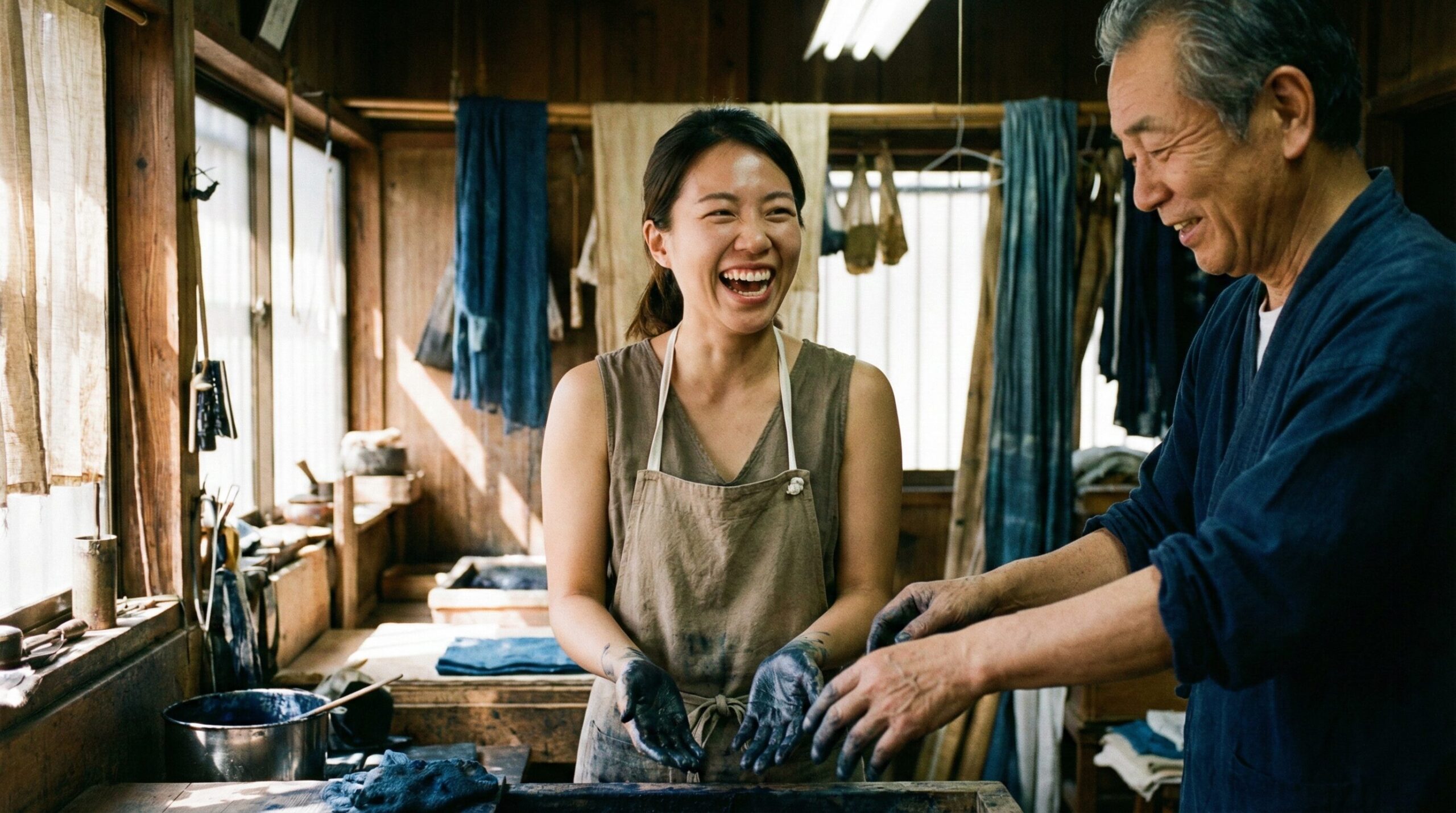
While “Kyoto Yuzen” (hand-painted silk) is famous, the older, more primal dyeing technique is Roketsuzome (wax-resist dyeing). It involves painting patterns with hot wax before immersing the fabric in indigo.
Where to Go: Yamamoto Roketsu Dyeing Studio
Located near Saiin, this studio is one of the last remaining dedicated Roketsu workshops in Kyoto. It feels entirely unlike a tourist center. You walk into a space that smells of heated wax and fermented indigo—a scent that is pungent, earthy, and unforgettable.
- The Experience: You are given a brush and a pot of molten wax. You paint your design on cotton or silk. The wax hardens instantly, so you must be decisive. Once painted, you dip the fabric into the vats of indigo dye. The magic happens at the end: the fabric is boiled to melt the wax away, revealing your white design against the deep, ocean-blue background.
- Why it’s Authentic: Mr. Yamamoto is a master who has dyed kimonos for royalty and famous actors. Yet, he is often there teaching beginners, explaining how the temperature of the wax changes the texture of the line.
- For the Traveler: It’s messy, warm, and deeply satisfying. You leave with a finished piece (a handkerchief, T-shirt, or noren curtain) that smells faintly of the dye vats—a sensory memory of Kyoto.
The Sound of Silk: Nishijin Weaving
The Nishijin district is a labyrinth of narrow streets where the sound of weaving looms can still be heard from behind closed doors. This is the home of Japan’s most luxurious textiles, used for Obi sashes and Noh theater costumes.
Where to Go: Watabun (Orinasu-kan)
Watabun is a historic weaving house. Their museum and workshop, Orinasu-kan, is housed in a stunning traditional machiya architecture.
- The Experience: Unlike simple coaster-making classes, here you can sit at a large hand-loom. You will quickly realize that weaving is mathematical. It requires rhythm—feet on the pedals, hands on the shuttle, eyes on the thread. The museum is famous for its elaborate “Noh” theater costumes and traditional heavy brocades. Here, you can observe the complexity of hand-weaving that machines cannot replicate.
- The Atmosphere: The workshop is quiet, filled with the soft light filtering through the garden. It connects you to the domestic side of Kyoto’s history—the generations of women who sat in these dim rooms creating fabrics of blinding beauty.
Earth and Fire: Kiyomizu Pottery
Kyoto pottery (Kyo-yaki / Kiyomizu-yaki) is known for its elegance and overglaze enamels. While you can buy it anywhere on the slopes leading to Kiyomizu Temple, making it requires venturing a bit further from the souvenir racks.
Where to Go: Zuikou Pottery
Located just a short walk from the chaos of Kiyomizu-dera, Zuikou offers a surprisingly calm oasis.
- The Experience: Avoid the “hand-building” classes (making a pinch pot) if you want the real challenge. Opt for the Electric Wheel course. Centering the clay on a spinning wheel is one of the most difficult physical skills in craft. It requires a stable core and gentle hands. The instructors here are professional potters who guide your hands, helping you pull a shapeless lump of mud into a delicate teacup or sake bottle.
- The Wait: Real pottery takes time. Your piece will be fired and glazed weeks after you leave. Having it shipped to your home a month later is a wonderful way to extend your trip. When you open that box in New York or London, the memory of Kyoto rushes back.
The Scent of the Heian Court: Incense Blending
In ancient Kyoto, aristocrats didn’t wear perfume; they scented their kimono with burning incense. The art of Koh-do (The Way of Incense) is as complex as the Tea Ceremony.
Where to Go: Yamadamatsu Koboku
Located near the Imperial Palace, Yamadamatsu has been a pharmacy and incense maker since the Edo period. The building itself smells intoxicating—a blend of sandalwood, cloves, cinnamon, and agarwood.
- The Experience: Join a “Sachet Making” or “Kneaded Incense” workshop. You sit at a table with various raw aromatics in front of you. You aren’t just mixing smells; you are following ancient recipes. You use a small mortar and pestle to grind the spices, measuring them with a tiny bamboo spoon. It feels like alchemy.
- Why it Matters: Scent is the strongest trigger for memory. By creating your own scent bag (nioi-bukuro), you create a portable piece of Kyoto. Keep it in your suitcase, and every time you open your luggage for the rest of the trip, you will smell the distinct fragrance of a Kyoto temple.
The Texture of Light: Karakami Paper
Kyo-karakami is the patterned paper used on the sliding doors (fusuma) of temples and tea houses. It uses woodblocks to press mica or pigments onto Japanese washi paper.
Where to Go: Kira Karacho (Cocon Karasuma)
Founded in 1624, Karacho is the only surviving karakami studio from the Edo period. While their main atelier is for professionals, they offer workshops at their salon.
- The Experience: You use hand-carved woodblocks that are centuries old. The key is the “baren”—the round pad used to rub the paper against the block. The pigment often contains mica (kira), which catches the light. As you lift the paper from the block, you see the pattern emerge—a motif of waves, pine trees, or gourds that has decorated Nijo Castle or the Katsura Imperial Villa.
- The Takeaway: You frame your print. It is a piece of architectural history. It teaches you to look at the walls of the temples you visit differently. You realize they are not just painted; they are printed by hand, sheet by sheet.
Practical Tips for the Artisan Traveler
To ensure your experience is respectful and smooth, follow these operational tips.
Book in Advance (Crucial)
The best workshops are small. They are often run by the artisans themselves, not a dedicated tourism staff.
- Action: Book at least 2-4 weeks in advance. Do not expect to walk in off the street.
The Language Barrier
While major spots like the Kyoto Handicraft Center have English speakers, smaller, more authentic kobo may not.
- Tip: If you are booking a very niche workshop (like metalworking or specialized dyeing), consider hiring a private guide-interpreter. However, craft is often non-verbal. “Watch and copy” is the universal language of the workshop.
Dress for the Occasion
- Textiles/Dyeing: Wear dark clothes or things you don’t mind getting splashed. Indigo stains are permanent.
- Pottery: Cut your fingernails short. Long nails will gouge the clay on the wheel.
- Sitting: Be prepared to sit on tatami mats (seiza or cross-legged) for an hour or two. Wear comfortable pants.
Shipping
For pottery, shipping costs can sometimes equal the cost of the workshop. Be prepared for this. It is the price of transporting fragile earth across the world.
Conclusion: The Souvenir of Experience
In a world of mass production, where everything is available on Amazon, the definition of luxury has changed. Luxury is no longer just the object; it is the story behind the object.
When you participate in one of Kyoto’s Best Artisan Workshops, you change your relationship with the city. You stop being a passive observer and become an active participant in its culture.
You will never look at a kimono the same way after struggling to weave a single inch of brocade. You will never look at a tea bowl the same way after feeling the centrifugal force of the clay in your own hands.
The best souvenir you take home from Kyoto won’t be in your suitcase. It will be the indigo stain under your fingernails, the scent of sandalwood on your clothes, and the memory of the quiet, dusty room where you sat with a master and learned, for a brief moment, to slow down.