
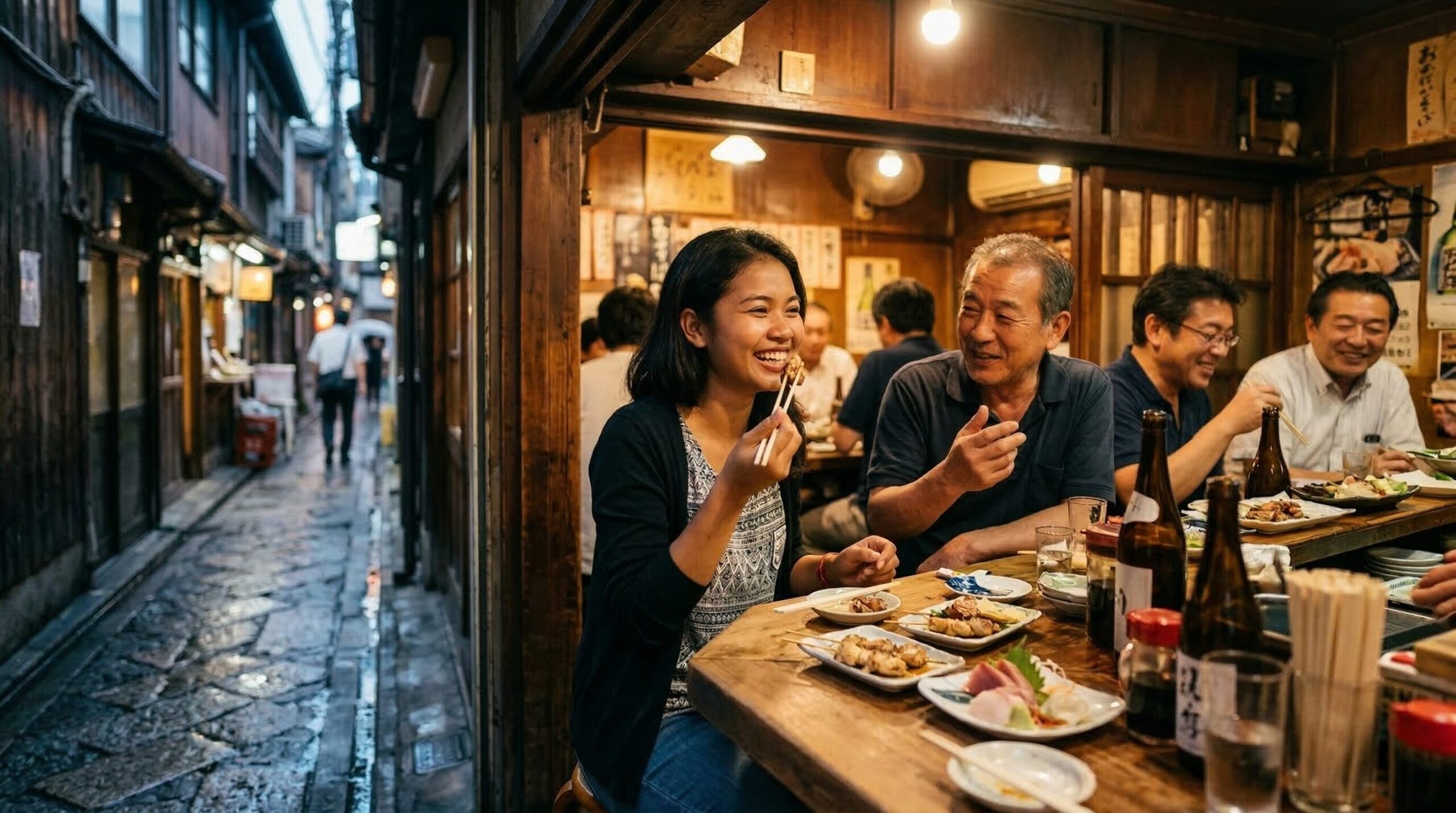
When the sun finally dips behind the western mountains, the rhythm of Kyoto shifts. The major temples close their heavy wooden gates, the tour buses depart, and the city’s illuminated monuments take on a quiet, statuesque presence. For many visitors, this signals the end of the day. But for the city’s residents, the evening is just beginning. While the main avenues of Kawaramachi and the polished restaurants of the downtown core fill with international travelers, a completely different culinary world wakes up in the shadows. Down narrow, unmarked lanes, red paper lanterns (akachochin) begin to glow. The air grows thick with the scent of grilling chicken and the sharp, inviting aroma of savory broth. The muffled sounds of laughter and the clinking of heavy glass mugs spill out from behind sliding wooden doors. This is the world of Kyoto’s backstreet food alleys.
To truly understand the culinary culture of this ancient city, one must look past the Michelin-starred kaiseki establishments and the highly publicized matcha dessert cafes. The soul of Kyoto’s food scene lives in the yokocho (alleyways) and roji (narrow residential paths). Here, dining is not a formal affair but an intimate, communal experience. For the mindful traveler willing to leave the guidebooks behind, navigating these narrow corridors offers a profound glimpse into the everyday lives, tastes, and traditions of the people who call Kyoto home.
The Anatomy of a Yokocho: Understanding Kyoto’s Backstreet Food Alleys
To the uninitiated, wandering into a dimly lit alleyway in a foreign city might seem intimidating. However, in Japan, these capillary-like streets are the lifeblood of neighborhood socialization. Kyoto’s backstreet food alleys are deeply safe, incredibly welcoming, and meticulously organized in their own chaotic way. Understanding the anatomy of these alleys helps demystify the experience and allows you to travel deeper into the culture.
- The Architecture of Intimacy: The physical space of a yokocho dictates the dining experience. Establishments here are often no larger than a standard bedroom. They typically feature a single, L-shaped wooden counter seating perhaps six to eight people. This proximity forces interaction; you are dining shoulder-to-shoulder with salarymen loosening their ties, local artisans, and off-duty chefs.
- Mastery over Variety: Unlike large family restaurants with pages of options, the tiny kitchens in these alleys demand specialization. You will rarely find an izakaya here that tries to do everything. Instead, you will find a master of yakitori (grilled chicken skewers), a specialist in oden (simmered winter stew), or a tiny counter serving nothing but Kyoto-style obanzai (traditional home-cooked vegetable dishes).
- The Visual Language: You don’t always need to read Japanese to know what lies behind the door. A red lantern often signals a casual, affordable izakaya. A simple white curtain (noren) hanging over the door means the shop is open; when the master brings the noren inside, the night is over. A rough-hewn cedar ball (sugidama) hanging above the entrance indicates an establishment that takes its sake seriously.
Hidden Culinary Corridors: Where to Wander
Kyoto is vast, and almost every neighborhood has its own cluster of local watering holes. However, certain areas offer a dense concentration of Kyoto’s backstreet food alleys that reward slow, observant exploration.
Route 1: The Pontocho Intersections (Beyond the Main Strip)
Pontocho is famous worldwide—a long, narrow alley running parallel to the Kamogawa River, lined with traditional wooden establishments. However, the main spine of Pontocho has become highly curated for tourists. The true hidden gems are found in the roji that shoot off perpendicularly, connecting Pontocho to the parallel Kiyamachi Street. These connecting alleys are so narrow you can touch both walls simultaneously. Here, you will find incredibly tiny, standing-only bars (tachinomi) and covert doorways leading to second-floor sake dens.
What to look for:
- Look for the narrowest passageways, often marked only by a single glowing sign on the ground.
- Seek out small counters serving kushikatsu (deep-fried skewers) where the batter is light, the cabbage is crisp, and the atmosphere is effortlessly local.
- Listen for the sizzle of wagyu beef on small tabletop grills; many hidden yakiniku spots thrive in these liminal spaces.
Route 2: The Gritty Charm of Shijo-Omiya
If you want to completely escape the tourist gaze, head west to Shijo-Omiya. This is a working-class transit hub where the Randen tramline begins. It lacks the polished wooden aesthetics of Gion, replacing them with the retro, slightly worn charm of the Showa era (1926–1989). The labyrinth of alleys behind the station is a haven for the everyday Kyoto resident. It is loud, vibrant, and incredibly authentic.
What to look for:
- Standing Bars (Tachinomi): Shijo-Omiya is the king of standing culture. These bars offer cheap, high-quality draft beer and small plates of sashimi or potato salad. It is a transitional space where locals grab a quick drink before heading home.
- Gyoza and Beer: Look for the sounds of pan-frying and the smell of garlic and sesame oil. Small, grease-stained counters here serve some of the best pan-fried dumplings in the city.
- Show-era Yakitori: Follow the thick smoke to find grizzled pitmasters turning skewers over white-hot binchotan charcoal, serving them simply with salt (shio) or a deeply reduced, decades-old soy glaze (tare).
Route 3: Demachiyanagi’s Academic Alleys
Located in the northeast, where the Kamo and Takano rivers converge, Demachiyanagi has a distinctly bohemian, intellectual atmosphere due to its proximity to Kyoto University. The alleys winding away from the station and the nearby shopping arcade are filled with establishments catering to professors, students, and local creatives. The vibe here in Kyoto’s backstreet food alleys is less about rapid-fire drinking and more about lingering conversation, jazz music, and carefully curated menus.
What to look for:
- Obanzai Counters: Look for large ceramic bowls sitting on the wooden counters, filled with braised daikon radish, simmered eggplant, and hijiki seaweed. This is Kyoto soul food.
- Craft Sake and Shochu: The bars here often have deep connections with independent brewers across Japan. Trust the master to pour you something unique based on your taste preferences.
- Late-Night Ramen: End your night as the university students do, ducking into a tiny ramen shop for a bowl of rich, chicken-based tori-paitan broth to fortify yourself for the walk home.
Navigating the Night: Tips for the Mindful Traveler
Stepping into a tiny, local establishment requires a level of cultural awareness. You are entering a community space. To ensure your experience in Kyoto’s backstreet food alleys is seamless and respectful, keep these practical tips in mind:
- Embrace the ‘Otoshi’: When you sit down, you will almost immediately be served a small dish of food you did not order. This is the otoshi, a customary seating charge (usually 300 to 500 yen) that acts as an appetizer. It is not a scam; it is a standard practice across Japan. Accept it graciously, as it is often a delicious showcase of the chef’s skills.
- Practice ‘Hashigo-zake’ (Ladder Drinking): The local way to experience these alleys is not to stay in one place all night. Hashigo-zake means hopping from one bar to the next. Have a beer and two skewers at the first place, move to a second for sake and sashimi, and finish at a third for noodles. This allows you to experience multiple atmospheres in a single evening.
- Cash is Still King: While larger restaurants have adapted to credit cards, the tiny establishments in backstreet alleys operate almost exclusively on cash. Bring plenty of 1,000-yen notes and 100-yen coins.
- Read the Room: If the restaurant only has six seats and a line is forming outside, it is polite to finish your drink, pay your bill, and offer your seat to the next person. Lingering for hours over a single glass of water is frowned upon in these high-turnover spaces.
- Communication is Beyond Language: Do not worry if there is no English menu. A smile, a polite “Sumimasen” (Excuse me), and the willingness to point at what the person next to you is eating goes a long way. Use translation apps for dietary restrictions, but otherwise, let the chef guide your meal.
Conclusion
Japan’s true beauty often hides in plain sight. It is found in the meticulous care a chef takes in slicing a single piece of fish, in the warm greeting of a shop owner who remembers your face from the night before, and in the shared laughter over a clinking glass in a room no wider than a hallway. By venturing into Kyoto’s backstreet food alleys, you step away from the curated museum-like experience of the city and engage with its living, breathing heart. You stop merely observing Japan through the lens of a tourist and begin to share in its daily rituals. It’s time to go beyond the ordinary, embrace the unfamiliar, and taste the Japan that the locals know best.