
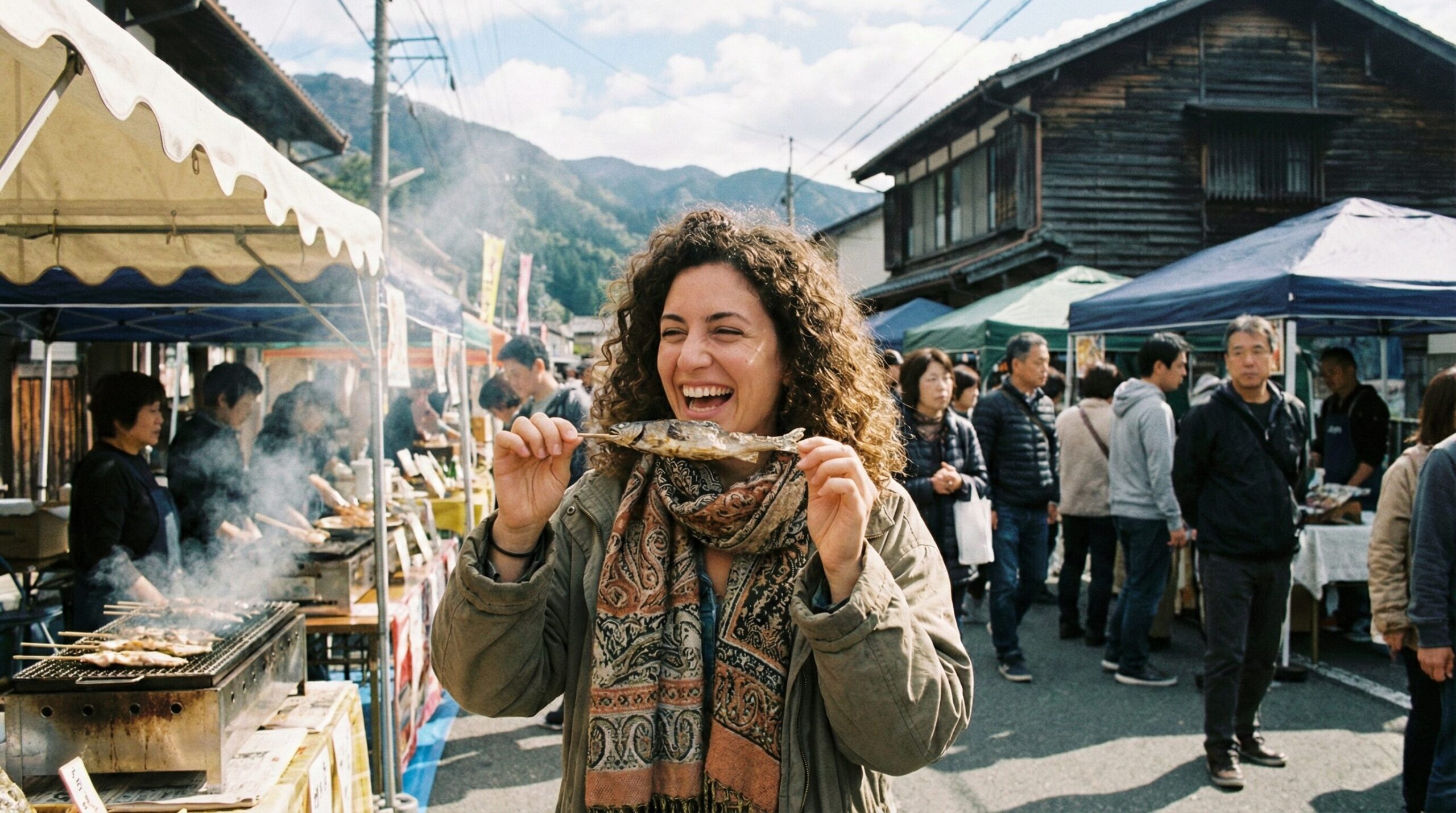
When most travelers think of Japanese dining, the image is often a pristine, Michelin-starred sushi counter in Tokyo or a hushed, centuries-old kaiseki room in Kyoto.
But beyond these refined, quiet spaces lies a much louder, more vibrant culinary heartbeat.
To find it, you must follow the smoke rising from charcoal grills, the glow of red paper lanterns, and the joyful hum of a community gathering under the open sky.
If you want to truly understand a region’s history, agriculture, and people, you have to eat what they celebrate. Local food festivals in Japan—often tied to seasonal harvests, ancient Shinto rituals, or sheer regional pride—offer an unvarnished look at the country’s diverse culinary landscape.
These events are rarely marketed to international tourists.
Instead, they are deeply local affairs where farmers, fishermen, and artisans share the fruits of their labor. Attending local food festivals in Japan is about shifting your perspective from a passive diner to an active participant in a regional tradition.
It is a chance to taste dishes that rarely make it onto English menus, cooked by the people who have spent their lives perfecting them.
If you are ready to travel deeper, step away from the heavily curated restaurant guides, and taste the real Japan, this guide will help you navigate the rich, smoky, and unforgettable world of regional culinary celebrations.
The Philosophy of the Harvest: Key Details and Breakdown
To navigate local food festivals in Japan, it helps to understand the cultural pillars that elevate these events from simple street food markets to profound cultural experiences.
The Principle of Shun (Peak Seasonality)
At the core of Japanese cuisine is the concept of shun—the exact moment when a particular ingredient is at its absolute peak of flavor. Food festivals are almost always scheduled around shun. They are not arbitrary dates; they are dictated by the natural world. Whether it is the brief, fleeting window for sweet mountain peaches in early summer or the arrival of fatty yellowtail in the dead of winter, these festivals are communal acknowledgments of the changing seasons. When you attend, you are tasting the landscape exactly as it exists in that precise week of the year.
Yatai Culture vs. Regional Pride Festivals
It is important to distinguish between standard festival food and hyper-local culinary events.
- Standard Matsuri Yatai: At almost any summer shrine festival, you will find rows of yatai (food stalls) selling nationwide staples like takoyaki (octopus balls), yakisoba (fried noodles), and kakigori (shaved ice). While delicious and deeply nostalgic, these are ubiquitous.
- Regional Food Festivals: These are dedicated events centered around a specific, highly localized ingredient or dish. The vendors are not traveling carnival workers; they are the local farmers, fishermen’s cooperatives, and multi-generational family restaurants stepping out of their kitchens to serve their specialty to the masses.
Food as a Cultural Anchor
In regions facing depopulation, local food festivals in Japan serve as vital cultural anchors. They bring younger generations who have moved to the cities back to their hometowns. By participating in these festivals, your presence and your purchases directly support local agricultural cooperatives and help ensure that highly specific regional recipes are passed down to the next generation.
Practical Examples and Recommendations: Where to Go
To move beyond the superficial, your itinerary should target festivals that celebrate unique regional terroir. Here are three distinct examples of local food festivals in Japan that offer deep cultural immersion.
The Akkeshi Oyster Festival (Hokkaido)
Located on the rugged, freezing eastern coast of Hokkaido, the town of Akkeshi is famous for producing some of the most sought-after oysters in the country. Because the water temperature remains low year-round, Akkeshi oysters grow slowly, developing a rich, creamy, and intensely sweet flavor profile.
- The Experience: Held over a week in October (and again in spring), the Akkeshi Oyster Festival takes place at a sprawling park overlooking the bay. The premise is brilliantly simple: you rent a small charcoal grill, buy buckets of freshly harvested oysters, scallops, and saury directly from the fishermen, and barbecue them yourself under the autumn sky.
- The Cultural Reality: This is not a polished, white-tablecloth affair. It is a raw, smoky, and communal celebration of the ocean’s bounty. You will be sitting shoulder-to-shoulder with local Hokkaido families, sharing grill space, and experiencing the profound connection between the icy sea and the food on your plate.
Nakatsu Karaage Festival (Oita Prefecture)
If you travel to the southern island of Kyushu, specifically to Oita Prefecture, you will find a region that takes fried chicken more seriously than anywhere else in the world. The city of Nakatsu is the undisputed holy land of karaage (Japanese fried chicken), boasting dozens of specialized shops, each with a fiercely guarded family recipe for their garlic-and-soy marinades.
- The Experience: During the annual Nakatsu Karaage Festival, the city’s top shops gather in a single park. The air is thick with the savory scent of frying oil and garlic. Attendees purchase small portions from multiple stalls to debate and compare the subtle differences in crunch, juiciness, and marinade depth.
- The Cultural Reality: While fried chicken might sound like casual fast food, in Nakatsu, it is a culinary art form rooted in the post-war era when the government heavily promoted poultry farming in the region. Attending this festival is a deep dive into hyper-local pride and a masterclass in how a single, simple dish can define a community’s identity.
Saijo Sake Matsuri (Hiroshima Prefecture)
You cannot discuss local food festivals in Japan without acknowledging the beverages that accompany them. Saijo, a historic district in Higashihiroshima, is one of Japan’s top three sake-brewing regions, blessed with pristine groundwater and ideal temperatures for fermentation.
- The Experience: Every October, the streets of Saijo fill with tens of thousands of enthusiasts. The historic breweries open their doors, allowing visitors to wander through the stunning white-walled kura (storehouses). The highlight is the “Sake Hiroba,” a square where you can sample from over 1,000 different varieties of sake from across the entire country.
- The Cultural Reality: Food is integral here. You must try Bishu Nabe, a traditional hot pot created by the local brewers. It is made by simmering pork, chicken, and local vegetables in copious amounts of regular sake, seasoned simply with salt and pepper. It is a dish born directly from the labor of the brewery workers, offering a taste of the region’s brewing history in a single bowl.
Actionable Tips for Travelers
Navigating local food festivals in Japan requires a bit of practical preparation. These are community events, not tourist attractions, and blending in respectfully will drastically improve your experience.
Cash is an Absolute Necessity
While urban Japan is rapidly adopting digital payments, local festivals remain fiercely cash-based.
- Carry Small Change: Do not try to hand a vendor a 10,000-yen note for a 500-yen skewer of grilled fish; it depletes their change reserve. Break your large bills at a convenience store beforehand and bring a heavy coin purse filled with 100-yen and 500-yen coins.
Master the Rules of Waste Disposal
Japan’s public spaces are famously devoid of trash cans, and festivals are no exception.
- The Etiquette: It is considered highly disrespectful to leave your empty trays or skewers on a park bench or hand them to a different vendor. Always return your trash to the exact stall where you purchased the food. If you are moving away from the area, carry a plastic bag in your backpack to hold your rubbish until you return to your hotel.
Do Not Walk and Eat
This is one of the most common faux pas committed by foreign visitors.
- Find a Spot: In Japan, walking while eating is generally frowned upon as it is considered messy and disrespectful to the food. When you buy something from a yatai, step to the side, find a designated eating tent, or stand near the stall to finish your food before moving on.
Arrive Early, Leave Early
Local food festivals operate on local time.
- Beat the Rush: The best ingredients—the fattiest cuts of beef, the largest oysters, the limited-edition seasonal sakes—sell out quickly. Do not arrive at 2:00 PM expecting a full menu. Aim to arrive shortly after the festival opens in the morning to experience the energy at its peak and secure the best dishes.
Conclusion
To truly know a place, you have to break bread with the people who live there. Local food festivals in Japan offer a rare, unfiltered window into the soul of the country’s rural regions. They strip away the formality of high-end dining and replace it with the warmth of an open fire, the scent of seasonal harvests, and the welcoming chatter of local vendors. When you prioritize these community gatherings over commercialized tourist traps, you are doing more than just eating well. You are supporting independent farmers, preserving regional recipes, and engaging in a form of travel that leaves a positive, meaningful impact. It’s time to go beyond the ordinary, follow the smoke, and see the Japan locals know best.