
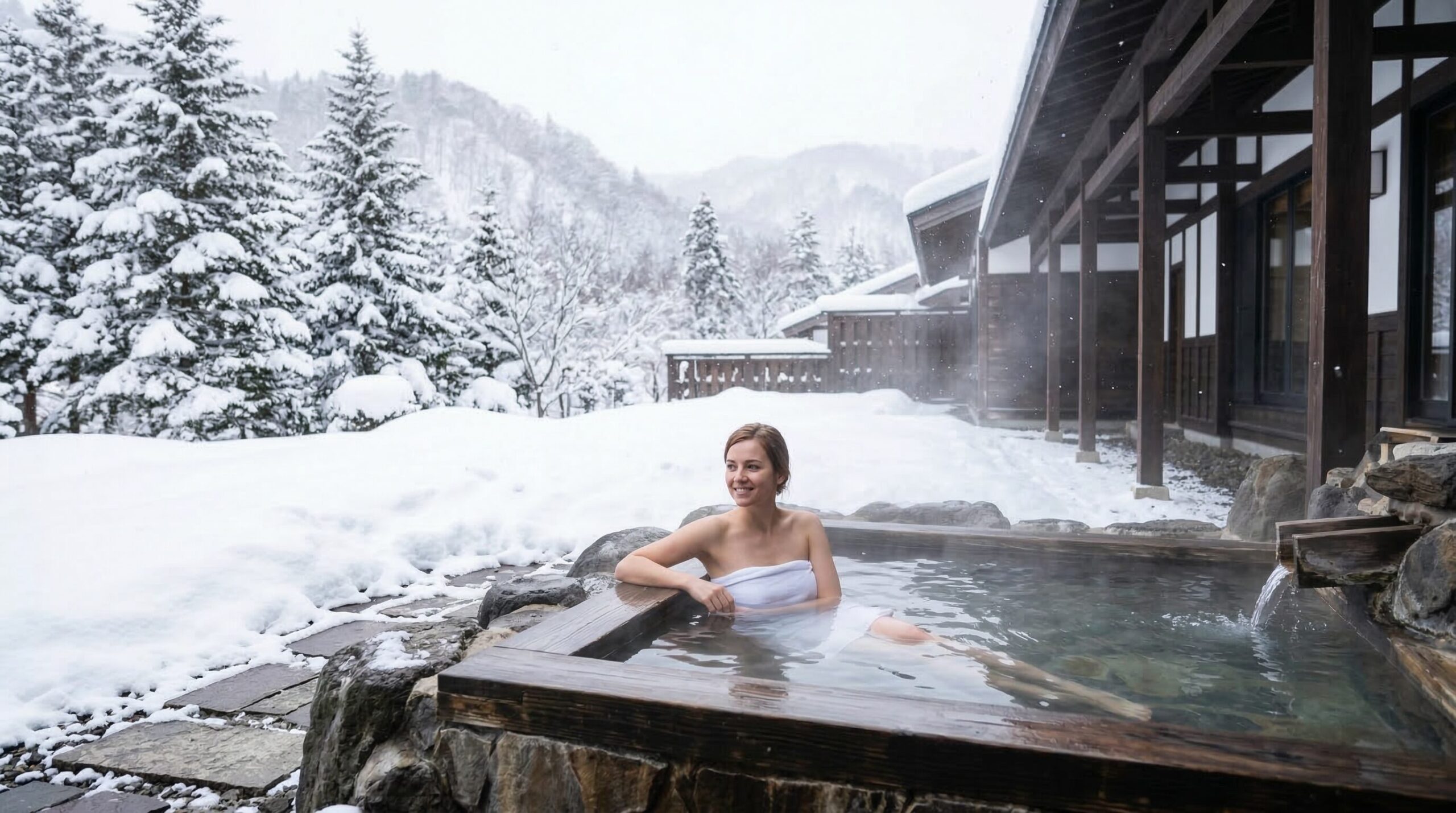
When the first heavy snows fall on Japan’s northernmost island, the landscape undergoes a radical transformation. Hokkaido in winter is often defined by motion and adrenaline: international skiers carving down the powder slopes of Niseko, or massive crowds navigating the ice sculptures of the Sapporo Snow Festival. But for the traveler seeking something deeper, the true magic of this northern frontier is not found in the busy resort towns. It is found in the absolute, echoing silence of the snow-covered forests. To understand the soul of Hokkaido, one must retreat to where the geothermal heat of the earth meets the freezing air.
Choosing to stay at a luxury ryokan in Hokkaido’s hot springs is not merely about finding premium accommodation; it is an immersion into the island’s raw, untamed nature, filtered through the lens of centuries-old Japanese hospitality (omotenashi). Here, luxury is not defined by gold fixtures or sprawling lobbies. It is defined by exclusivity, quietude, and the meticulous curation of space. It is the feeling of slipping into a steaming outdoor bath (rotenburo) while snowflakes melt instantly on your shoulders.
For the mindful traveler looking to step away from superficial sightseeing, venturing into the deep snow country offers an authentic, restorative encounter with Japan’s wild north.
The Anatomy of Northern Comfort: Key Details and Breakdown
The concept of a traditional inn takes on a different character in Hokkaido compared to Kyoto or Kyushu. Because the island was developed relatively recently in modern Japanese history, its architecture and atmosphere are less bound by rigid classical rules. A luxury ryokan in Hokkaido’s hot springs often blends traditional elements with a robust, almost rustic elegance designed to withstand the harsh environment. Understanding this unique anatomy helps travelers appreciate the depth of the experience:
- The Architecture of Warmth: Buildings are designed to frame the hostile winter landscape safely. You will often find expansive, floor-to-ceiling glass windows in the lounges and guest rooms, turning the blizzard outside into a silent, cinematic masterpiece while you sit by a wood-burning stove on a tatami mat.
- The Power of the ‘Onsen’: Hokkaido is one of the most volcanically active regions in the world. The mineral content here is famously potent. From the milky, sulfur-rich waters of Noboribetsu to the clear, skin-smoothing alkaline springs of the eastern lakes, the water is treated as serious medicine. Many premium ryokans pipe this water directly into private, en-suite open-air baths.
- The Ezo Cuisine: Food in Hokkaido is legendary. A kaiseki (multi-course) meal here leans heavily on the island’s incredible agricultural and marine bounty. Instead of the delicate, Kyoto-style vegetable dishes, expect robust flavors: rich sea urchin (uni), sweet hairy crab (kegani), A5-grade Wagyu beef from local farms, and root vegetables that have been sweetened by surviving the frost.
Where the Snow Falls Quietly: Practical Examples and Recommendations
To find genuine solitude, you must venture slightly beyond the standard tourist maps. While regions like Niseko offer luxury, they cater heavily to a Western, ski-focused crowd. For a more authentic, localized experience, consider these regions.
Route 1: The Hidden Valleys of Noboribetsu
Noboribetsu is famous for Jigokudani (Hell Valley), a spectacular, steaming volcanic crater. While the main town has large, bustling hot spring hotels, hidden just off the main valley floor are small, exclusive ryokans tucked into the primeval forest. Here, the focus is entirely on the healing properties of the water and the quiet observation of nature.
Highlights of a Noboribetsu Retreat:
- Private Sulfur Baths: The highest-end properties offer private, open-air baths built from fragrant hinoki (Japanese cypress). The contrast between the stark white snow, the dark wood, and the opaque, milky-white thermal water is visually and physically striking.
- Forest Bathing in Winter: Some properties sit adjacent to protected oak and bamboo forests. You can often watch Ezo red foxes or Yezo sika deer stepping delicately through the snowdrifts right from your room’s window.
- A Focus on Stillness: The luxury here is the absence of noise. These ryokans often restrict the number of guests, ensuring that the heavy snowfall is the only sound you hear at night.
Route 2: The Deep Freeze of Akan Mashu National Park
For the traveler willing to journey to eastern Hokkaido, the reward is an landscape of staggering scale and spiritual depth. Lake Akan, partially frozen in winter, is home to the indigenous Ainu people, whose reverence for nature deeply influences the atmosphere of the region. A luxury ryokan in Hokkaido’s hot springs in this area often integrates Ainu design motifs and philosophies into its architecture and service.
Highlights of an Akan Retreat:
- Lakeside Rotenburo: Imagine soaking in a stone pool positioned perfectly on the edge of a frozen caldera lake, with the jagged peaks of Mount Oakan rising in the distance. The air temperature might drop to -20°C (-4°F), making the heat of the spring feel almost electric.
- Indigenous Ingredients: The local kaiseki meals here might feature wild venison, rare mountain berries, and river fish, reflecting the historical diet of the region’s first inhabitants.
- Ice Horizons: In the early morning, the phenomenon of “diamond dust” (ice crystals forming in the air) can often be seen sparkling over the frozen lake, a sight reserved only for those who brave the deep north.
Route 3: The Secret Canyons of Jozankei
Located just a short drive from the center of Sapporo, Jozankei is a narrow canyon carved by the Toyohira River. Despite its proximity to a major city, the geography of the gorge makes it feel entirely isolated. The premium ryokans here are built directly into the steep cliffs overlooking the river, offering a vertically dramatic perspective of the snow country.
Highlights of a Jozankei Retreat:
- River-Sound Therapy: The architecture of these inns often prioritizes the sound of the rushing, half-frozen river below. Leaving the window cracked slightly allows the sound of the water to become a natural white noise for deep sleep.
- Modern Traditionalism: Jozankei boasts some of the most avant-garde luxury ryokans in Japan, where traditional tatami rooms are fused with mid-century modern furniture, local Hokkaido art, and ambient lighting design.
- Autumn to Winter Transition: If you time your visit for late October, you might catch the breathtaking overlap of the final crimson autumn leaves being dusted by the first white snows of the season.
Mindful Exploration: Tips for Travelers
Staying at a luxury ryokan in Hokkaido’s hot springs is a deeply intentional experience. To fully absorb the rhythm of the snow country, keep these practical tips in mind:
- Embrace the Temperature Contrast: Do not fear the cold. The Japanese philosophy of hot spring bathing relies on the shock of the freezing air to amplify the soothing heat of the water. When using an outdoor bath, step out into the cold air to cool down, then return to the water. This cycle deeply relaxes the muscles and mind.
- Dress for the Environment: Even inside a heated luxury inn, the corridors leading to the baths can be chilly. Wear the provided haori (a thick, jacket-like layer) over your cotton yukata, and utilize the tabi (split-toe socks) to stay warm while moving around the property.
- Savor the Seasonal Menu: Hokkaido’s culinary seasons are incredibly brief and distinct. If the chef presents a dish featuring a specific type of crab or a rare mountain vegetable, understand that it may only be available for a two-week window. Ask questions about the provenance of the ingredients; the staff take immense pride in their local agriculture.
- Disconnect Completely: While these premium properties offer high-speed Wi-Fi, the greatest luxury they provide is an excuse to unplug. The harsh weather outside is a natural barrier, inviting you to stay indoors, read a book by the fire, steep in the mineral waters, and let the outside world fade away.
Conclusion
Japan’s true beauty often hides in the places where the elements are most extreme. It is found in the resilience of an ancient forest bearing the weight of heavy snow, in the steam rising from a volcanic vent, and in the quiet dedication of a chef preparing a warm meal in the dead of winter. By choosing a luxury ryokan in Hokkaido’s hot springs, you step away from the crowded ski lifts and the artificial lights of the snow festivals. You open yourself up to the raw, majestic silence of Japan’s northern frontier. It’s time to go beyond the ordinary, brave the cold, and discover the deep, authentic warmth that the locals know best.