
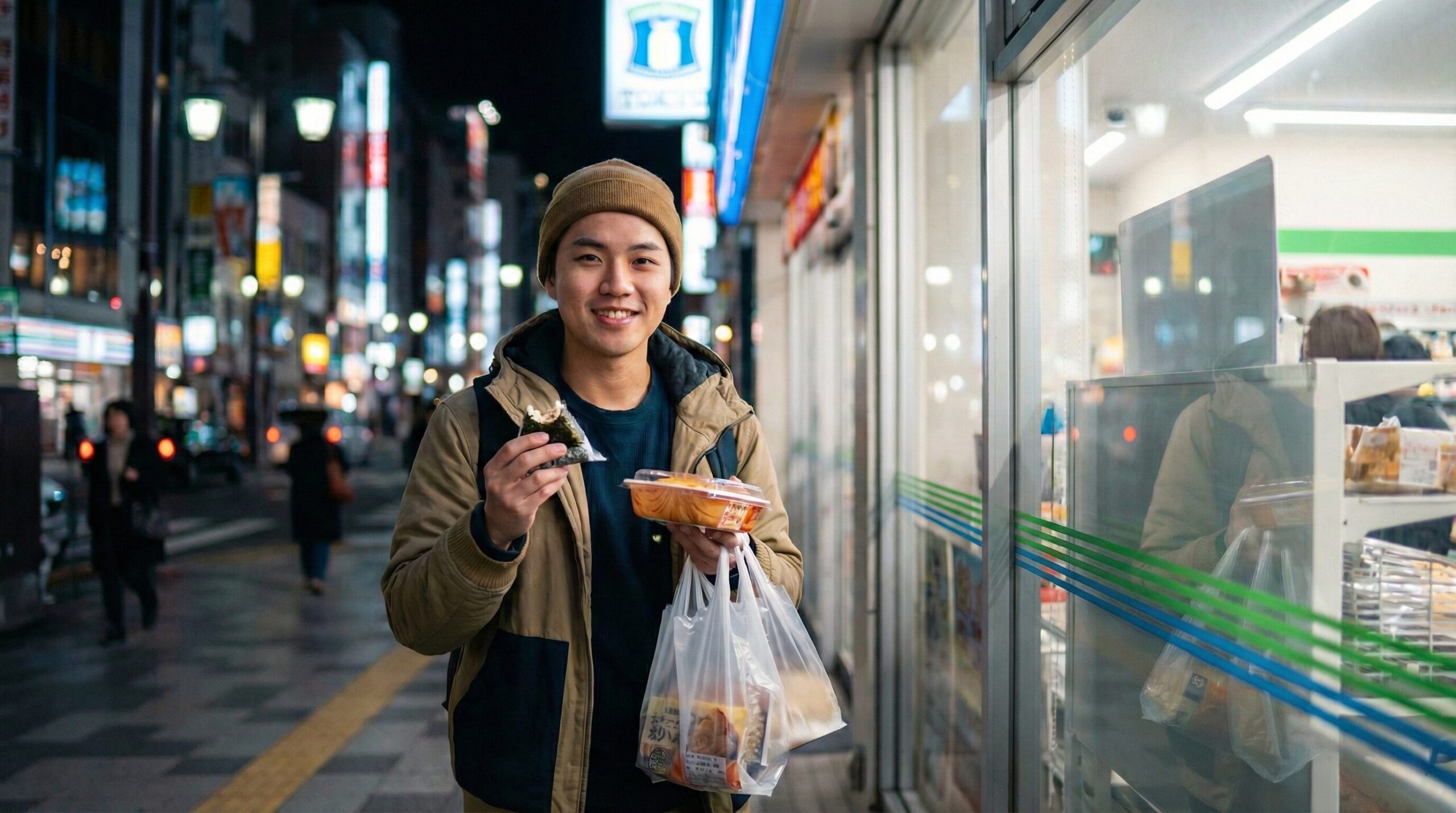
In most cities around the world, a “convenience store” is a place of last resort . It is where you go for a bag of stale chips, a lukewarm soda, or an emergency phone charger . It is utilitarian, often grim, and rarely delicious .
In Tokyo, the “Konbini” is a religion. Walk down any street in the capital—from the neon canyons of Shinjuku to the quiet residential lanes of Setagaya—and you will see them . They are glowing beacons of safety, open 24 hours a day, 365 days a year .
They are immaculately clean, staffed by impeccably polite clerks, and stocked with food that rivals many casual restaurants . For the traveler, the Konbini is the ultimate travel hack. It is where you get breakfast for under $5 . It is where you find a hot meal at 3:00 AM after a night of karaoke . It is where you withdraw cash, buy concert tickets, and ship your luggage .
But beyond the utility, there is a deep culinary culture here . The competition between the major chains is fierce, driving a constant cycle of innovation . New products are launched every Tuesday, creating a fast-fashion approach to food that keeps locals obsessed .
This is your Tokyo Convenience Store Food Guide. We are going to look past the obvious and dive into the shelves to find the items that define the taste of modern Tokyo .
- The Big Three: Know Your Tribe
- The Onigiri (Rice Ball) Section: The Triangle of Life
- The Bento Box: A Full Meal for 500 Yen
- The Hot Snack Counter: Fried Gold
- The Sandwich Wars: Anthony Bourdain was Right
- Drinks: From Coffee to Strong Zero
- The “Healthy” Konbini: Salad Chicken
- Practical Tips for the Konbini Traveler
- Conclusion: The Mirror of Society
The Big Three: Know Your Tribe
Before you eat, you must understand the landscape. There are three major players in Tokyo, and locals often have fierce loyalties .
7-Eleven: The King of Quality
If you are looking for a proper meal, go to 7-Eleven.
- The Reputation: They are the market leader for a reason. Their supply chain is legendary . They deliver fresh food to stores multiple times a day .
- The Strength: Their private brand, “Seven Premium,” is high quality . Their deli items (potato salad, grilled fish, hamburg steak) are restaurant-grade .
- The Vibe: Efficient, bright, and focused on the basics done perfectly .
Lawson: The Dessert Destination
If you have a sweet tooth, look for the blue sign with the milk can .
- The Reputation: Lawson positions itself as slightly more upscale and health-conscious (“Natural Lawson” is a sub-brand focused on organic/healthy options) .
- The Strength: Their dessert brand, “Uchi Café,” revolutionized convenience store sweets . They famously introduced the “Premium Roll Cake,” which changed the industry standard for cream .
- The Vibe: Warm, welcoming, and the best place for a coffee break .
FamilyMart: The Fried Chicken Shack
If you need a hot, greasy snack to fuel a night out, “FamiMa” is your spot .
- The Reputation: They are the fun, slightly chaotic younger sibling .
- The Strength: “Famichiki.” It is a boneless slab of fried chicken that has a cult following . The store jingle (played when the door opens) is so famous it has been turned into a pop song .
- The Vibe: energetic and snack-focused .
The Onigiri (Rice Ball) Section: The Triangle of Life
The first thing you will see near the entrance is the Onigiri shelf. This is the heart of the Konbini .
The Engineering of Freshness
You will notice the triangular rice balls are wrapped in plastic with numbers (1, 2, 3) printed on the corners.
- The Innovation: This packaging separates the Nori (seaweed) from the rice until the moment you open it . This ensures the seaweed stays crisp and crunchy, unlike homemade rice balls where it gets soggy .
- How to Open:
- Pull the center strip down (1).
- Pull the right corner gently (2) .
- Pull the left corner gently (3) .
- Tip: Do it slowly. If you rip it, you’ll be eating naked rice and holding a sheet of seaweed .
Must-Try Flavors
- Tuna Mayo (ツナマヨ): The undisputed king. It is tuna salad inside rice. Simple, creamy, and savory.
- Salmon (Sake/Sha-ke): Grilled salted salmon flakes. A classic breakfast taste .
- Spicy Cod Roe (Karashi Mentaiko): A punch of salt and spice. Deeply umami .
- Umeboshi (Pickled Plum): Sour and salty. It is a traditional preservative and palate cleanser .
- The “Premium” Line: Look for the round, hand-formed rice balls wrapped in higher-quality washi paper . These use expensive rice varieties and have more generous fillings (like whole shrimp tempura or seared beef) .
The Bento Box: A Full Meal for 500 Yen
Move past the rice balls to the Bento section. This is not airplane food .
The Variety
- Makunouchi Bento: The “classic” box . Rice with black sesame, grilled fish (usually salmon or mackerel), a slice of omelet, a tempura prawn, and some pickles . It is balanced and healthy.
- Pasta: You might be skeptical of convenience store spaghetti, but the “Napolitan” (ketchup-based pasta with sausage) or the Mentaiko Cream Pasta are surprisingly good comfort foods.
- Donburi (Rice Bowls): Katsudon (pork cutlet with egg) or Oyakodon (chicken and egg) . The engineering here is often brilliant—the sauce/meat is in a top tray, separating it from the rice below so the rice doesn’t get mushy . You pour it on just before eating .
The Microwave Ritual
When you buy a bento, the clerk will ask: “Atatamemasu ka?” (Shall I warm this up?).
- Answer: “Hai, onegaishimasu” (Yes, please) . They have industrial-strength microwaves that heat the food in 20 seconds. They will tape a wet hand wipe (oshibori) and chopsticks (waribashi) to the lid .
The Hot Snack Counter: Fried Gold
Next to the cash register is a glass case filled with golden-brown fried items. This is the “Hot Snack” corner .
The Holy Trinity of Chicken
Every chain has its champion. You must try them all to find your allegiance .
- Famichiki (FamilyMart): Boneless, juicy, incredibly greasy, and seasoned with a heavy hit of black pepper . It comes in a paper bag that tears off at the top so you can eat it without getting your hands dirty .
- Karaage-kun (Lawson): These are nuggets, not a cutlet. They come in a cute cardboard cup with a rooster mascot . They are closer to a soft, minced chicken texture. The “Red” (spicy) flavor is addictive .
- Nana-chiki (7-Eleven): A slightly more refined, thicker cut of boneless chicken. Less grease, more meat .
Winter Special: Oden
From October to March, many stores serve Oden, a traditional stew. While some still have simmering vats on the counter, others now sell it in pre-packaged pouches to ensure hygiene . It is a traditional stew. You pick the items you want, and they put them in a bowl with broth and a smear of hot yellow mustard (karashi) .
- What to Order:
- Daikon: Radish that has soaked up the broth for hours. It melts in your mouth .
- Tamago: Hard-boiled egg, stained brown by the soup .
- Mochi-kinchaku: A fried tofu pouch filled with sticky rice cake (mochi).
- Chikuwa: Tube-shaped fish cake .
The Sandwich Wars: Anthony Bourdain was Right
When Anthony Bourdain visited Japan, he famously raved about the Lawson Egg Salad Sandwich. He wasn’t wrong .
The Secret of the Shokupan
The magic isn’t just the filling; it’s the bread. Japanese sandwich bread (Shokupan) is milk bread . It is incredibly fluffy, slightly sweet, and has no crusts. It is like eating a cloud .
- The Egg Sandwich (Tamago Sando): The filling is simply mashed boiled eggs and Kewpie mayonnaise. The yolk is rich and orange, not pale yellow . It is creamy, savory, and perfect.
- The Fruit Sandwich: Look for sandwiches filled with whipped cream and whole strawberries, kiwi, or mango . It looks like a dessert, but it is sold as a sandwich . It is a beautiful example of Japanese aesthetic precision—the cross-section (moe-dan) is art .
Drinks: From Coffee to Strong Zero
The beverage aisle is a colorful wall of confusion and delight .
The 100-Yen Coffee Revolution
Every Konbini now has a high-quality coffee machine near the entrance .
- How to Buy:
- Hot Coffee: Go to the register and ask for a cup (“Hotto Ko-hee, R/L size”). They give you an empty cup . You place it under the machine and press the button .
- Iced Coffee: Go to the freezer section (where the ice cream is) . You will find cups filled with ice cubes. Bring this to the register, pay, then put it under the machine and press the “Ice Coffee” button .
The “Strong Zero” Phenomenon
You will see tall cans of Chu-Hi (shochu highball) with “9%” written in bold . The most famous is Strong Zero.
- Warning: These are potent. They are sugar-free, fruit-flavored, and pack a massive alcohol punch for about 150 yen . They are the fuel of Tokyo’s nightlife (and the cause of many hangovers). Drink responsibly .
Tea Culture
Don’t just buy water. Try the unsweetened teas .
- Oi Ocha (Green Tea): The standard. Grassy and refreshing.
- Mugi-cha (Barley Tea): Nutty, caffeine-free, and hydrating. Perfect for summer .
- Jasmine Tea: Floral and fragrant.
The “Healthy” Konbini: Salad Chicken
For those worried about the carbs and grease, there is a savior: Salad Chicken. This is a vacuum-sealed, pre-steamed chicken breast . It comes in flavors like Herb, Lemon, Smoked, or Plain. It is moist (not dry!), high in protein, and low in calories . You can eat it straight out of the packet like a banana . It started a fitness boom in Japan and is the go-to lunch for office workers on a diet .
Practical Tips for the Konbini Traveler
To navigate the store like a local, keep these operational tips in mind.
The “Point Card” Question
When you pay, the clerk will almost always ask something that sounds like: “Pointo ka-do wa omochi desuka?” They are asking if you have a loyalty point card (V Point, Ponta, etc.) .
- Response: Just shake your head or say “Nai desu” (I don’t have one). Do not panic .
Trash Etiquette
Finding a trash can in Tokyo is impossible—except at the Konbini .
- The Rule: You are generally expected to throw away trash bought at that store . However, they are the unofficial garbage dumps of the city .
- Sorting: You must separate your trash.
- Moeru Gomi: Burnable (Paper, food waste) .
- Purasuchikku: Plastics (Wrappers, Bento lids).
- Bin/Kan/Petto: Bottles and Cans (There is usually a specific hole for these) .
Eating In vs. Eating Out
- The Tax: Japan has a dual tax rate. 8% for takeout, 10% for “eat-in” .
- Eat-In Spaces: Some larger Konbini have a small counter with chairs . If you use it, tell the clerk “Eat-in” so they charge you the 10% .
- Walking and Eating: Generally, walking while eating is frowned upon in Japan . However, eating while standing directly in front of the convenience store is socially acceptable. It is the “Konbini Crouch” .
Late Night Logistics
- ATMs: 7-Eleven ATMs (Seven Bank) are the best for foreign cards. They work 24/7 .
- Tickets: The Loppi (Lawson) or the Multi-copy machines (FamilyMart) are where you buy tickets for Disneyland, the Ghibli Museum, or concerts . They often have English menus .
Conclusion: The Mirror of Society
The Tokyo Convenience Store is more than a shop; it is a mirror of Japanese society . It reflects the obsession with seasonality (look for Sakura-flavored everything in March), the demand for perfection (even in a $2 sandwich), and the reliance on efficiency to keep the massive city moving. For the traveler, it is a sanctuary . It is the place where you can be anonymous, where you don’t need to speak fluent Japanese to get a hot meal, and where you can explore the culinary trends of the country for the price of pocket change . So, don’t feel guilty about skipping a fancy dinner for a Bento box and a Strong Zero. Sit on a bench in Yoyogi Park, open your Onigiri (carefully, pull 1-2-3), and enjoy the taste of the real Tokyo .