
For a specific generation of travelers, the image of Tokyo is forever filtered through a soft, 1990s pastel lens. We don’t just see a red and white tower; we see a beacon where memories of a past life were unlocked. We don’t just see a hillside shrine; we see the home of the Fire Guardian. Sailor Moon (Bishoujo Senshi Sailor Moon) is more than an anime; it is a global cultural touchstone.
But unlike many fantasy series set in imaginary lands, Naoko Takeuchi grounded her magical girl opera in a very real, very specific neighborhood: Azabu-Juban. In the 90s, Azabu-Juban was a quiet, slightly disconnected district lacking a subway station.
Today, it is one of Tokyo’s most affluent neighborhoods, yet the geography remains startlingly accurate to the manga and anime.
This guide to Sailor Moon Spots in Tokyo is not merely a list of shops selling merchandise. It is a walking tour of the “Juban District.” It is an invitation to walk the same slopes Usagi Tsukino ran down (late for school, toast in mouth) and to find the magic hidden in the everyday streets of Minato Ward.
Azabu-Juban: The Holy Land
To find Sailor Moon, you must go to Azabu-Juban. This high-end residential district near Roppongi is where Usagi lived, went to school, and fought the Dark Kingdom. The attention to detail in the anime backgrounds is legendary, capturing local landmarks that still exist today.
Patio Juban & Kimi-chan Square (The Meeting Spots)
In the center of the shopping street lies a distinct brick-paved plaza known as Patio Juban.
- Patio Juban (The Anime): This plaza, often featuring circular steps and a fountain statue (The Goddess of Hope), is where Usagi and friends would sit on the benches to discuss the latest enemy attack.
- Kimi-chan Square (The Reality): A short walk from the main Patio, you will find a smaller square with the statue of “Kimi-chan.” It depicts the girl from the nursery rhyme “The Girl with the Red Shoes” (Akai Kutsu).
- The Experience: Both spots offer a poignant, quiet atmosphere perfect for a coffee break. Standing here, you are literally standing in the center of Usagi’s social world.
Kurayami-zaka (The Cursed Slope)
Tokyo is a city of hills (saka or zaka). In the anime, the “Cursed Bus” disappeared on a steep slope near the shrine.
- The Reality: While the area has many slopes (like Sendai-zaka), the specific model for this legend is widely believed to be Kurayami-zaka (literally “Darkness Slope”).
- The Vibe: It is a steep, atmospheric hill flanked by ancient stone walls near the Austrian Embassy. Walking up this slope at twilight, with the shadows lengthening, evokes the eerie atmosphere of the show’s first season.
The “Shopping Arcade” Vibe
Walk down the main Azabu-Juban Shotengai. While the specific “Crown Game Center” and “OSA-P” jewelry store are fictional (or based on buildings long gone), the vibe is identical. The mixture of old Japanese cracker (senbei) shops sitting next to modern McDonald’s is exactly the landscape Naoko Takeuchi was documenting.
Azabu Hikawa Shrine: Rei’s Home
If Azabu-Juban is the body of the show, this shrine is the spirit. Azabu Hikawa Shrine is widely accepted as one of the primary models for the Hikawa Shrine where Rei Hino (Sailor Mars) lived and worked as a shrine maiden.
- The Visuals: While the anime exaggerated the stairs for dramatic effect, the main hall and the grounds bear a striking resemblance.
- The Connection: Naoko Takeuchi actually lived in this area, and the setting is drawn from her daily life.
- The Visit: It is a quiet, leafy sanctuary in the middle of the concrete jungle. You will often see ema (wooden prayer plaques) drawn with Sailor Moon fan art hanging on the racks—proof that fans from around the world continue to make the pilgrimage.
- Note: There is another “Hikawa Shrine” in Akasaka, which also claims connection, but geographically, the Azabu Hikawa Shrine fits the “Juban” narrative perfectly.
Tokyo Tower: The Eternal Icon
You cannot talk about Sailor Moon Spots in Tokyo without the tower. It appears in almost every episode. It is where the final battles take place; it is the romantic backdrop for Mamoru and Usagi; it is the symbol of the modern world the Sailor Guardians are sworn to protect.
- The View from Roppongi Hills: To see the tower as it appears in the anime art (looming large and romantic), don’t go to the tower. Go to the Roppongi Hills Mori Tower Observation Deck. The view of Tokyo Tower glowing orange against the night sky is the quintessential “Moonlight Densetsu” visual.
- Shiba Park: For a ground-level view, sit on the grass in Shiba Park (Minato Ward). This is often the setting for the peaceful, romantic dates in the series.
Small Worlds Tokyo: Crystal Tokyo in Miniature
Location: Ariake (Tokyo Bay Area)
While the real locations offer nostalgia, Small Worlds Tokyo offers fantasy. This is the world’s largest indoor miniature theme park, and it features a permanent “Pretty Guardian Sailor Moon” Area.
- The Concept: It is a 1:80 scale recreation of Azabu-Juban in the 90s, transitioning into the futuristic Crystal Tokyo of the 30th Century.
- The Detail: You can see Usagi’s house (with the roof removed to see inside her bedroom), the Crown Game Center, and the Dead Moon Circus tent.
- Day and Night: The lighting cycles every 15 minutes. At “night,” the streetlights turn on, and you might spot the Sailor Guardians fighting on the rooftops. It is an obsessive, loving tribute to the series that allows you to see the geography of the show from a god’s-eye view.
Sailor Moon Store (Harajuku)
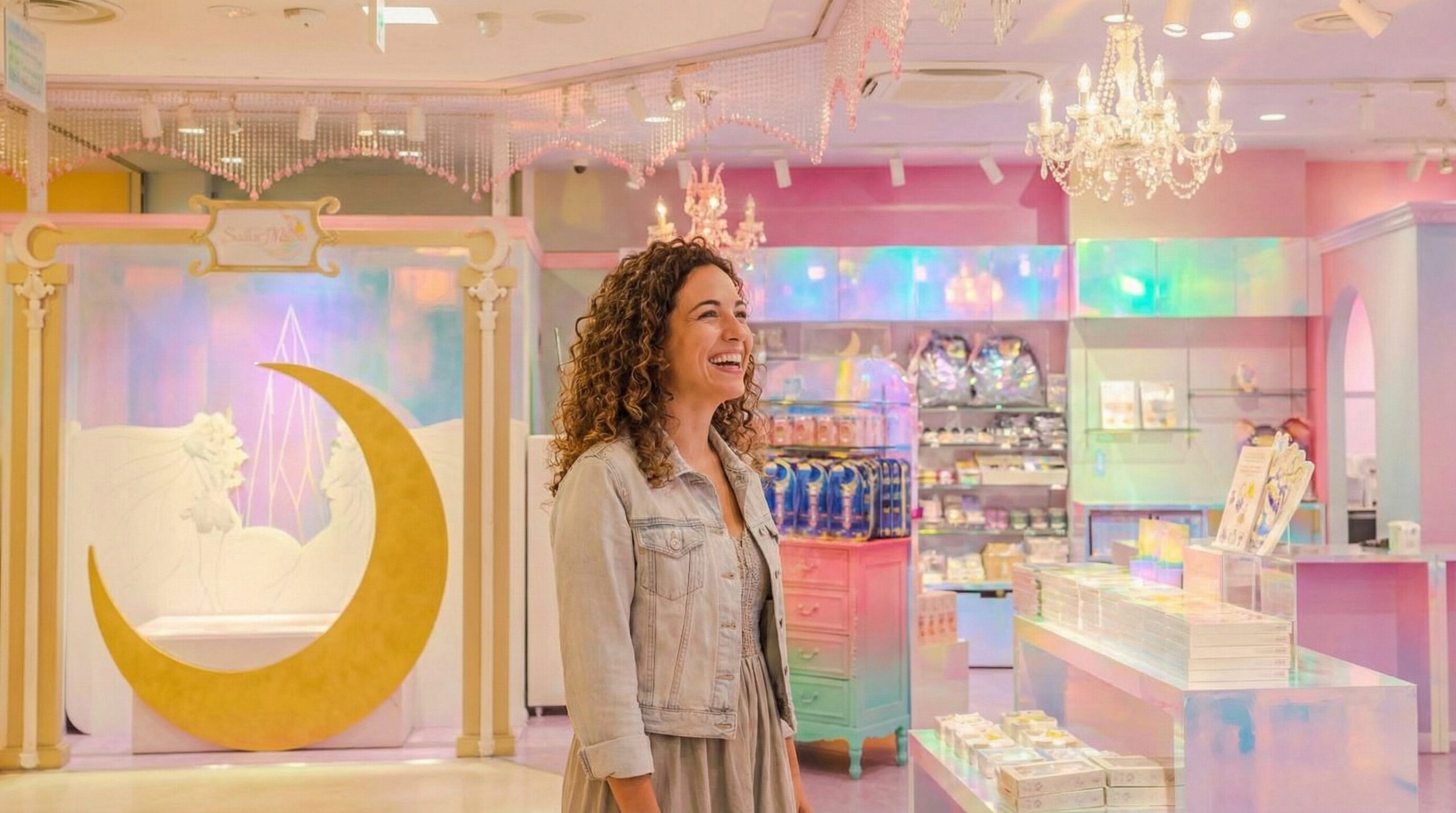
For those looking to take a piece of the magic home, the pilgrimage must end in Harajuku. Located inside the Laforet Harajuku department store is the official Sailor Moon Store.
- The Goods: Unlike general anime stores in Akihabara, this shop carries high-end fashion items, jewelry, and exclusive lifestyle goods designed for the adult fan.
- The Vibe: The store is split into two sections: a “pink” side for cute goods and fashion, and a “blue” side for more elegant, subtle merchandise. It respects that the fans have grown up.
Practical Examples: The “Moon Prism” Walking Route
To truly experience the atmosphere, dedicate a half-day to walking the real streets. Here is a curated itinerary.
The “Usagi’s Commute” Route (Approx. 3 Hours)
- 14:00 – Start at Azabu-Juban Station (Exit 4): You emerge right into the Patio Juban area. Take a moment to appreciate the main plaza, then walk slightly south to find the “Kimi-chan” statue. Imagine Luna jumping onto the bench next to you.
- 14:30 – Walk the Shotengai: Head towards the “Taiyaki” shop (Naniwaya Sohonten). Usagi loved snacks. This shop is legendary (the model for the hit song “Oyoge! Taiyaki-kun”) and serves classic fish-shaped pastries Usagi would definitely eat.
- 15:15 – The Cursed Slope: Walk towards the Austrian Embassy to find Kurayami-zaka. Activity: Experience the “Dark Kingdom” atmosphere, then continue towards Azabu Hikawa Shrine. Pay your respects. Toss a coin (5 yen is lucky), bow twice, clap twice, bow once. Wish for protection from the Dark Kingdom (or just a safe trip).
- 16:00 – Arisugawa-no-miya Memorial Park: Just a short walk away. This park often appears as the generic park background where characters meet. It is lush, green, and filled with streams.
- 17:30 – The Tower at Twilight: Walk or take a taxi towards Shiba Park. Watch Tokyo Tower light up as the sun sets. This is the “Magic Hour.”
Tips for Travelers
- Respect the Residents: Azabu-Juban is a wealthy, quiet residential neighborhood. When photographing the streets or the shrine, be mindful of privacy. Do not photograph private homes or block the narrow sidewalks.
- The “Shining Moon Tokyo” Warning: You may see older blog posts mentioning a Sailor Moon show restaurant called “Shining Moon Tokyo.” This is permanently closed. Do not plan your trip around it.
- Museum Exhibits: The “Sailor Moon Museum” was a temporary exhibition in Roppongi (2022/2024). It travels. Before your trip, search “Sailor Moon Exhibition Tokyo 2026” to see if a temporary event is running.
- Manhole Covers: As of 2024/2025, five Sailor Moon-themed manhole covers were installed in Minato Ward (near Azabu-Juban and Tokyo Tower). Use a “Manhole Map” app to hunt them down—they are beautiful, durable pieces of public art.
Conclusion
Visiting these Sailor Moon Spots in Tokyo is a unique experience because it blends fantasy with ordinary life. You aren’t visiting a castle; you are visiting a shopping street, a park bench, a hill. But for the fan, these ordinary places are charged with meaning. Walking through Azabu-Juban is a reminder of why we loved the show in the first place: it wasn’t just about saving the universe. It was about saving this world. This specific town. These people. The magic of Sailor Moon wasn’t just in the transformation brooches; it was in the idea that magic could exist right here, around the corner, in the shadow of Tokyo Tower. So go ahead. Stand at the bottom of the hill. Look up at the moon. And feel the nostalgia wash over you.