
Kyoto is a city of contradictions. It is the spiritual heart of Japan, a place of profound stillness and ancient wisdom. Yet, it is also a city where the most famous sites—Kinkaku-ji (The Golden Pavilion), Kiyomizu-dera, and the Fushimi Inari Shrine—are often so crowded that the very spirituality they represent feels drowned out by the click of camera shutters and the murmur of tour groups.
There is a particular irony in visiting Ryoan-ji, the world’s most famous Zen rock garden. It was designed for deep contemplation, a riddle of fifteen stones meant to provoke enlightenment. Today, you are likely to view it over the shoulder of a stranger, jostling for position on a crowded wooden veranda.
But the “Real Japan” is still there. It is just hiding in plain sight. For the traveler willing to look Beyond Nippon’s top-ten lists, Kyoto offers a different experience. Tucked away in sub-temples (tatchu) and quiet residential wards are Kyoto’s Secret Zen Gardens. These are places where you can still sit alone on the tatami mats, listening to the sound of rain hitting the pebbles, and actually feel the Zen philosophy the gardens were built to embody.
This guide explores these hidden sanctuaries—places where stone, moss, and sand combine to create a universe in miniature.
- Understanding the Zen Garden: Reading the Landscape
- Komyo-in: The Rainbow Moss Temple (Tofuku-ji Complex)
- Zuiho-in: The Cross in the Sand (Daitoku-ji Complex)
- Taizo-in: The Art of Contrast (Myoshin-ji Complex)
- Entoku-in: The North Garden (Higashiyama)
- Practical Examples: How to Visit Like a Local
- Tips for Travelers
- Conclusion
Understanding the Zen Garden: Reading the Landscape
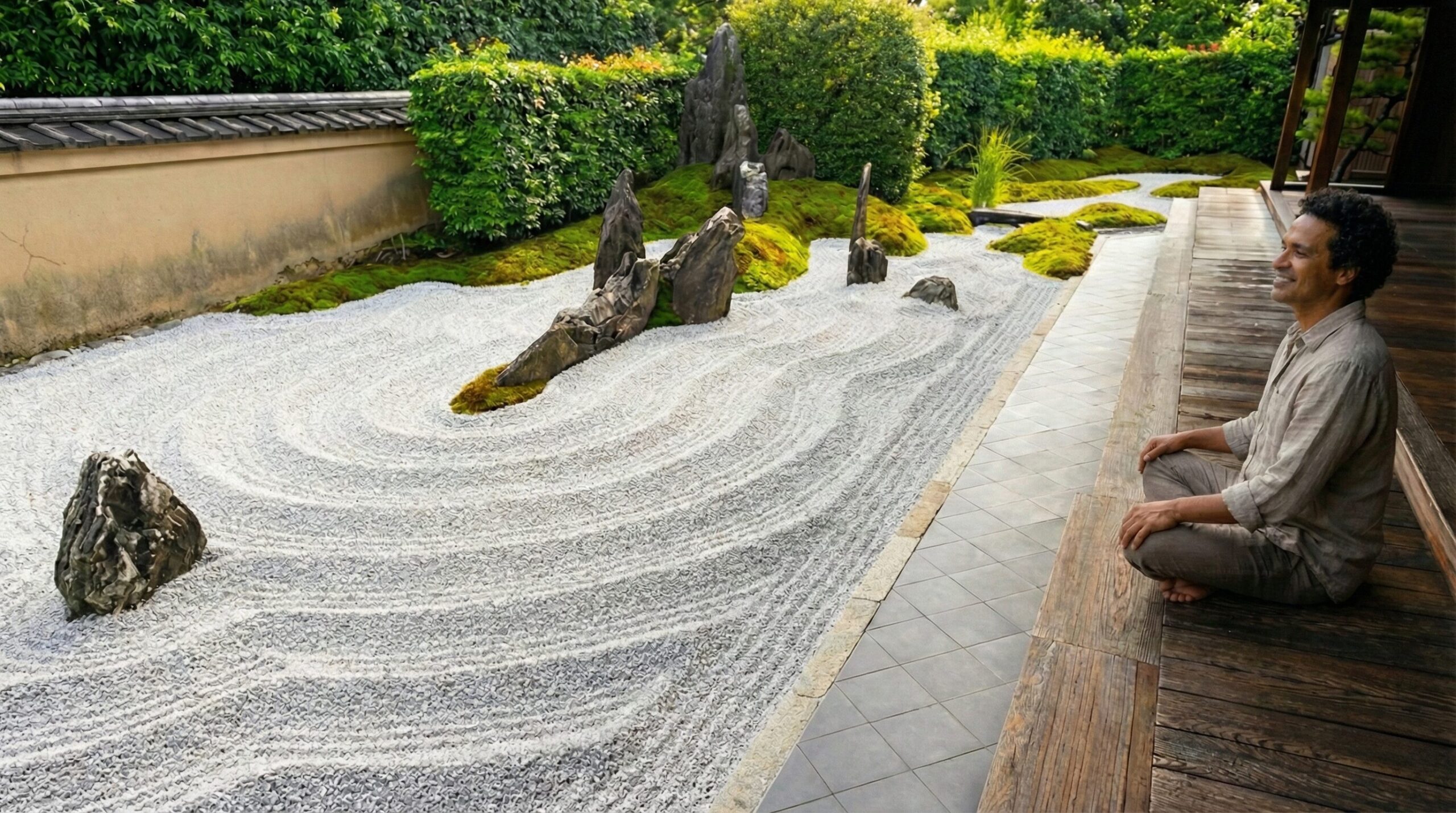
Before we step through the gates, it is essential to understand what we are looking at. A Zen garden, particularly the Karesansui (Dry Landscape) style, is not a garden in the Western sense. It is not meant for strolling, picnicking, or admiring colorful flowers.
It is a painting made of three-dimensional objects. It is a tool for meditation.
The Elements
- White Sand (Gravel): Raked into patterns, this usually represents water—oceans, rivers, or ripples caused by a falling drop. The act of raking the sand (samu) is itself a form of moving meditation for the monks.
- Rocks: These are the mountains, islands, or animals (often cranes and turtles, symbols of longevity). Their placement is never random; it follows strict aesthetic rules of balance and tension.
- Moss: Representing forests or islands, moss softens the harshness of the stone and adds the dimension of time (age).
- Shakkei (Borrowed Scenery): The technique of incorporating the distant background—a mountain or a forest—into the garden’s design, making a small space feel infinite.
When you visit these secret gardens, do not just look at them. Sit. Breathe. Let your eyes trace the lines of the rake. The garden is a mirror; what you see in the stones often reflects what is in your own mind.
Komyo-in: The Rainbow Moss Temple (Tofuku-ji Complex)
While the Tofuku-ji main temple draws massive crowds for its autumn foliage, nestled just a few minutes’ walk away is a sub-temple that remains one of Kyoto’s best-kept secrets: Komyo-in.
The Garden of Rays
The garden here is known as Hashin-tei (“Garden of Wave Crests”). Unlike the austere, rigid rectangles of many Zen gardens, Komyo-in is organic and free-flowing. Designed by the modern landscape genius Mirei Shigemori in 1939, it features rocks arranged in a radiating pattern that resembles beams of light (or waves) emanating from a central point. These rocks are set into a sea of white gravel and lush, vibrant moss.
Why It Is Special
- No Barriers: In most temples, a rail or a rope separates you from the garden. At Komyo-in, the wooden veranda opens directly onto the gravel. The boundary between you and the garden dissolves.
- The “Rainbow” Effect: While usually referred to simply as the “Moss Temple of Tofuku-ji,” the garden offers a vibrant spectrum of colors. While the moss is green, the changing seasons—azaleas in spring, maple leaves in autumn—create a shifting palette of color against the white sand that feels like a living kaleidoscope.
- The Silence: It is not uncommon to be the only person here for an hour. You can wander from room to room, viewing the garden from different angles through the elegantly framed circular and square windows.
Location: 15-809 Honmachi, Higashiyama Ward (South of Tofuku-ji). Best Time: During a light rain, when the moss glows neon green and the stones turn dark and lustrous.
Zuiho-in: The Cross in the Sand (Daitoku-ji Complex)
Daitoku-ji is a sprawling complex of Zen temples in northern Kyoto, often called the “headquarters of tea ceremony culture.” While many visitors flock to Daisen-in, the sub-temple of Zuiho-in holds a fascinating, hidden history.
The Hidden Christian Connection
This temple was founded by Otomo Sorin, a famous feudal lord (daimyo) of the 16th century who converted to Christianity. He was known as the “Christian Daimyo.”
The garden, designed in the 1960s by Mirei Shigemori (who also did Komyo-in), subtly honors this history.
- The Cross: In the quiet “Garden of the Cross” behind the main hall, the rocks are arranged in a formation that, when viewed from the correct angle, creates a hidden crucifix. It is a tribute to the time when Christianity was banned in Japan and believers had to hide their faith.
- The Rough Seas: The main garden features aggressively raked gravel that rises into high, sharp ridges. This represents the rough seas that Portuguese missionaries crossed to bring Christianity to Japan, and the turbulent life of Sorin himself.
The Experience
Zuiho-in feels powerful and masculine. The energy of the raked sand is dynamic, almost violent, contrasting with the silence of the architecture. It serves as a reminder that Zen is not just about peace; it is about confronting the storms of existence with a steady mind.
Location: 81 Daitokuji-cho, Murasakino, Kita Ward. Best Time: Mid-afternoon when the shadows of the rocks lengthen across the raked sand.
Taizo-in: The Art of Contrast (Myoshin-ji Complex)
Myoshin-ji is a “city within a city,” a vast walled complex of 46 sub-temples. Taizo-in is one of the few open to the public year-round, yet it remains blissfully quiet compared to the major tourist hubs.
The Motonobu Garden
Taizo-in holds a treasure: the Motonobu-no-Niwa. This garden was designed by the famous painter Kano Motonobu in the 16th century. It is one of the rare cases where a painter applied his brush techniques to three-dimensional earth.
The garden is a “dry landscape” that mimics a painting. The rocks are arranged to look like a waterfall (without water), flowing under a stone bridge and into a gravel “ocean.” The evergreen trees are kept clipped low to maintain the perspective, ensuring the “painting” looks perfect from the viewing platform.
The Yin and Yang Gardens
Further into the temple grounds, you encounter the Yoko-en, a modern masterpiece representing the balance of Yin and Yang through contrasting landscapes.
- Yang: A dry landscape featuring white gravel and strong rocks, representing brightness and hardness.
- Yin: A pond garden with real water and lush greenery, representing darkness, softness, and absorption.
Surrounding them are weeping cherry trees (shidare-zakura) which are spectacular in April. But even without the blossoms, the stark beauty of the dual gardens offers a profound meditation on duality and balance.
The Suikinkutsu
Listen carefully near the washbasin. Taizo-in features a Suikinkutsu—a buried earthen jar. When you pour water over the stones, it drips into the jar underground, creating a metallic, bell-like resonance that sounds like distant music. It is a sound designed to reset your focus.
Location: 35 Myoshinji-cho, Hanazono, Ukyo Ward. Recommendation: Purchase the matcha ticket. You can sit in a designated room overlooking the Yin-Yang garden and drink tea in absolute peace.
Entoku-in: The North Garden (Higashiyama)
Most travelers in Higashiyama go to Kodai-ji, the famous temple established by Nene (the wife of Toyotomi Hideyoshi). Just across the street is Entoku-in, where Nene actually lived out her final years. Because it is smaller and less flashy, the crowds often bypass it.
The Momoyama Masterpiece
The North Garden at Entoku-in is a designated Place of Scenic Beauty. It was originally part of Fushimi Castle, moved here stone by stone.
What makes this garden unique is its proximity. The massive stones are arranged very close to the veranda. You feel an intense, looming presence from the rocks. It reflects the bold, powerful aesthetic of the Momoyama period (late 16th century), a time of samurai warlords and unification.
The Night Illumination
Unlike many temples that are strictly day-only, Entoku-in often participates in night illuminations (light-ups) during spring and autumn. Seeing the raked sand glowing under soft lights, while the maples overhead are lit against the black sky, is a hauntingly beautiful experience.
Location: 530 Shimokawara-cho, Kodaiji, Higashiyama Ward. Tip: You can buy a combined ticket for Kodai-ji and Entoku-in, but visit Entoku-in last. It is the perfect place to decompress after the crowds of the larger temple.
Practical Examples: How to Visit Like a Local
Visiting these gardens requires a different mindset than visiting a museum or a theme park. Here is how to blend in and get the most out of the experience.
The “Five-Minute” Rule
When you arrive at the main viewing platform (usually a wooden veranda called an engawa), do not take a photo immediately. Sit down. Take off your shoes (if you haven’t already at the entrance). Place your hands in your lap.
Give yourself five minutes of stillness. Let your eyes adjust to the details—the varying shades of green in the moss, the texture of the clay wall. Then, you may take your photo. This small ritual changes “sightseeing” into “experiencing.”
The Season of Rain
Tourists often cancel plans when it rains. Do not do this. Zen gardens are at their absolute peak during the rain.
- The Stones: Dry stones look gray and dusty. Wet stones turn jet black, deep blue, or rusty red. Their true colors emerge.
- The Moss: Moss swells and becomes vibrant green when wet.
- The Atmosphere: The rain drives away the casual tourists. You might have the entire temple to yourself. The sound of rain on the temple roof is considered part of the garden’s soundtrack.
Tips for Travelers
Check the “Special Openings”
Some of Kyoto’s most secret gardens are sub-temples that are usually closed to the public but open for a few weeks in spring and autumn. Look for signs saying “Tokubetsu Haikan” (Special Viewing).
- Resource: The Kyoto City Tourism Association website often lists these schedules.
Dress Modestly and Warmly
Zen temples are open-air structures. In winter, the wooden floors are freezing. In summer, they are humid.
- Winter: Wear thick socks. The temple slippers are often flimsy. You will be sitting still, so the cold will seep in.
- Summer: Mosquitoes love moss gardens. Bring repellent, but apply it before you enter (don’t spray it inside the temple).
Photography Etiquette
- No Tripods: Almost all temples ban tripods and monopods.
- Be Mindful of the View: If you are standing to take a photo, check if someone is sitting behind you trying to meditate. Do not block their view. Crouch down.
- Silence the Shutter: If possible, use the silent shutter mode on your camera or phone. The loud “clack” echoes in these wooden spaces.
Combine with Zazen (Meditation)
Some temples, like Shunko-in (Myoshin-ji complex) or Ryosoku-in (Kennin-ji complex), offer English-guided Zazen meditation sessions. This is the ultimate way to understand the garden—by using it for its intended purpose.
Conclusion
In a world that is constantly screaming for our attention—with notifications, advertisements, and endless scrolling—Kyoto’s Secret Zen Gardens offer a rare commodity: emptiness. They are spaces designed to have nothing in them, so that you can find something in yourself.
When you sit on the edge of the wooden deck at Komyo-in, watching the light fade over the raked gravel, you realize that the “Real Japan” isn’t found in the loudest festivals or the brightest neon districts. It is found here, in the shadow of a rock placed by a monk four hundred years ago, in the space between the ripples.
So, on your next trip to Kyoto, walk past the bus queue for the Golden Pavilion. Turn down the quiet alleyway. Find the small wooden gate.
Step inside, and listen to the stone.
Travel Deeper. Explore the Real Japan.