
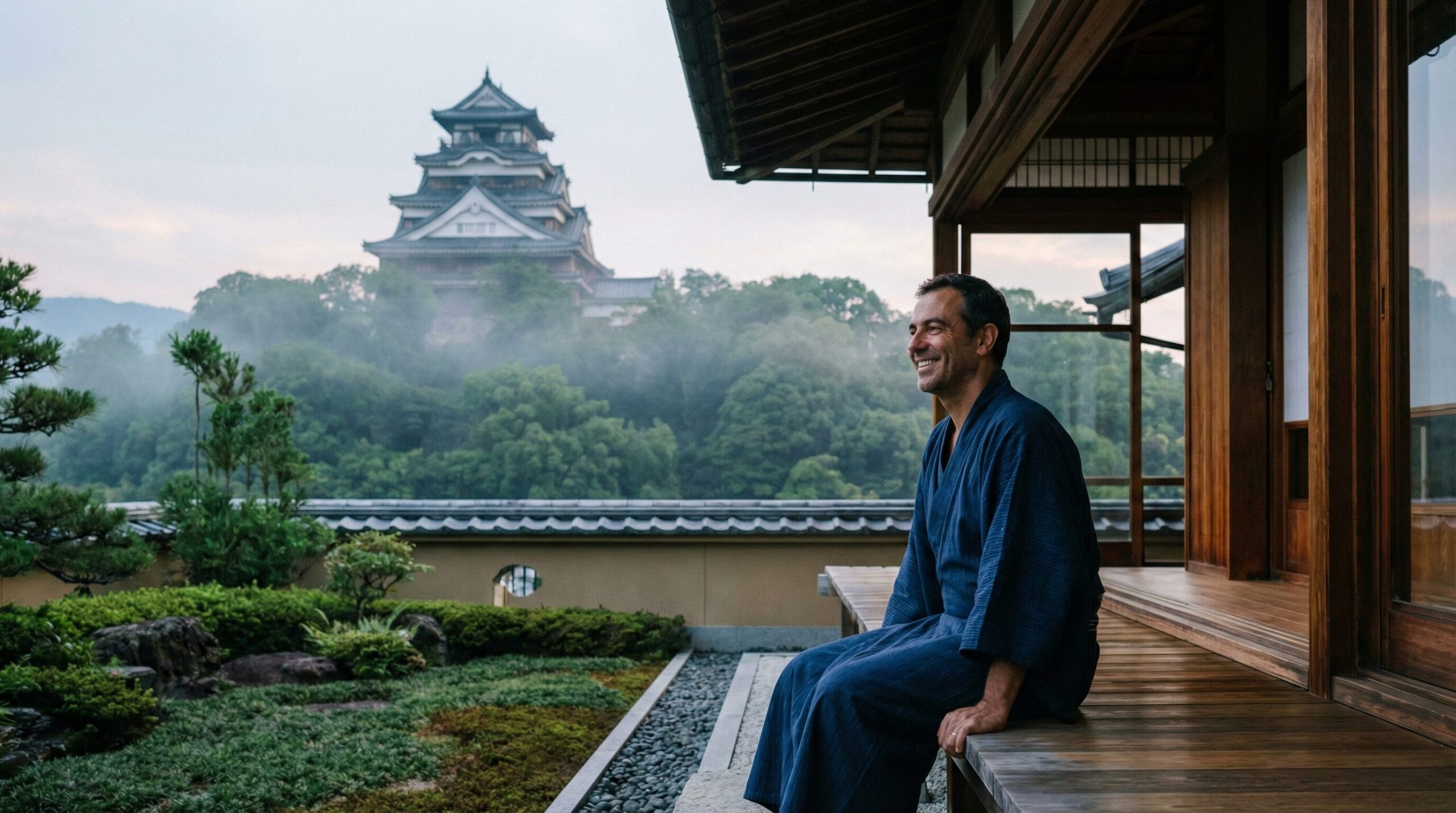
In the landscape of the Japanese imagination, the castle (Shiro) is the anchor. It is the architectural peak of the feudal era—a towering structure of white plaster and black tile, surrounded by formidable stone walls and moats designed to keep the world at bay.
For most travelers, a castle visit is a day trip. You climb the steep wooden stairs of Himeji or Matsumoto, marvel at the armory, take a photo from the park, and then retreat to a modern hotel near the train station.
This is the standard itinerary. But it misses the most atmospheric part of the castle experience: the night. The true magic of a castle town (Joka-machi) reveals itself after the gates close. The crowds disperse, the floodlights turn on, bathing the donjon in a ghostly, majestic glow, and the silence of the Edo period returns to the streets.
To experience this, you must stay within the inner circle. Staying at a Luxury Ryokan near Japanese Castles is not merely about proximity; it is about immersion. It is about waking up to the view that a feudal lord (Daimyo) would have commanded. It is about eating cuisine developed for samurai elites and sleeping in rooms that whisper of history.
This guide explores the rare and exquisite inns that allow you to live, for a night, in the shadow of the Shogun.
The Architecture of Power: Understanding the “Castle Ryokan”
Before booking, it is essential to understand the unique relationship between these inns and the castles they neighbor. Unlike the resort ryokans of Hakone or Beppu, which focus on nature and hot springs, castle-town ryokans focus on history and prestige.
The Legacy of the Honjin
In the Edo period, daimyos were required to travel to Edo (Tokyo) every other year (a system called Sankin-kotai). Along the way, they stayed in designated luxury lodgings called Honjin. Many of today’s historic luxury ryokans near castles are either former Honjin, merchant houses that served the samurai class, or estates built on the grounds of former high-ranking retainers.
The Art of Shakkei (Borrowed Scenery)
The defining feature of a luxury ryokan near a castle is Shakkei. This is a gardening technique where distant views are incorporated into the garden design. In this context, the castle itself becomes the “borrowed scenery.”
A truly great room in a castle town like Hikone is designed so that when you slide open the shoji doors, the castle tower sits perfectly framed within the window, looking like a painted scroll come to life. In other historic towns like Kanazawa, the focus turns inward to the exquisite garden, creating a private sanctuary.
Samurai Cuisine (Honzen Ryori)
While Kaiseki is the standard for tea ceremony cuisine, castle towns often preserve Honzen Ryori—the highly ritualized banquet cuisine of the samurai class. It is grander, often featuring local game, river fish, and sake presented in lacquered heirlooms.
The Collection: Where to Stay
Here are four distinct destinations where the luxury ryokan experience is inextricably linked to a historic castle.
Kanazawa Castle & Kinjohro (Ishikawa Prefecture)
The Castle: Kanazawa Castle, the seat of the powerful Maeda clan.
The Ryokan: Kinjohro
If there is one ryokan that embodies the “Luxury Ryokan near Japanese Castles” aesthetic, it is Kinjohro. Located in the historic Hashiba-cho district, it is a short, atmospheric stroll across the bridge to the castle grounds.
- The History: Founded in 1890, it operates on the scale of a daimyo’s estate. It is one of the few places in Japan where the architecture feels as significant as the castle itself.
- The Experience: You enter through a massive wooden gate that shuts out the modern world. The garden is a masterpiece of moss and stone.
- The Connection: Kanazawa Castle is famous for its “Ishikawa Gate” and distinct lead tiles that turn white with age. Kinjohro reflects this aesthetic. The cuisine here is Kaga-Ryori at its finest—rich, elegant, and served on antique Kutani porcelain that might be as old as the castle walls.
- Why Stay: To feel the wealth of the “One Million Koku” Maeda clan. It is opulent, serious, and deeply traditional.
Hikone Castle & Ryotei Ryokan Yasui (Shiga Prefecture)
The Castle: Hikone Castle, a National Treasure. One of the few original castles (not a concrete reconstruction) to survive wars and fires.
The Ryokan: Ryotei Ryokan Yasui
Hikone is a quiet, atmospheric town on the shores of Lake Biwa. The castle sits on a hill, watching over the city.
- The History: This ryokan has hosted historical figures and politicians for over a century. It is located within the old castle town radius.
- The Room: Request a room with a view. While not every room faces the castle, the premium suites offer glimpses of the hilltop keep. The real value here, however, is the atmosphere of the Joka-machi.
- The Connection: The ryokan specializes in Omi Beef (one of Japan’s top three wagyu brands). Historically, the Hikone domain was one of the few places permitted to produce beef (as medicine) during the meat-banned Edo era. Eating Omi beef here connects you directly to that unique local history.
- Why Stay: For the authenticity of an original castle. Unlike Osaka or Nagoya castles (which are modern reconstructions), Hikone is wood and stone. The creaking floorboards of the ryokan match the creaking floors of the castle keep.
Kyoto Nijo Castle & Nazuna Kyoto Nijo-jo (Kyoto Prefecture)
The Castle: Nijo Castle, the Kyoto residence of the Tokugawa Shogun. It is a palace rather than a fortress, famous for its “Nightingale Floors” and Kano school paintings.
The Ryokan: Nazuna Kyoto Nijo-jo
This represents the “Modern Luxury” interpretation. It is a relatively new entrant, but it respects the context perfectly.
- The Concept: It is a renovation of a large traditional townhouse. The theme is “Tea.” Each room is dedicated to a different type of Japanese tea (Matcha, Gyokuro, Hojicha), and the bath experience involves steeping in tea-infused water.
- The Location: It is located in a quiet residential neighborhood just a few blocks from Nijo Castle.
- The Connection: While you cannot see inside the high walls of Nijo Castle from the rooms, the ryokan captures the vibe of the Shogun’s Kyoto. It is secluded, private, and enclosed. The open-air baths (rotenburo) in the private gardens of the suites offer the same meditative silence you find in the castle’s Ninomaru Garden.
- Why Stay: For a blend of design-forward luxury and historical proximity. It is perfect for travelers who want the “castle town” feeling but prefer a bed to a futon.
Hirosaki Castle & Ishiba Ryokan (Aomori Prefecture)
The Castle: Hirosaki Castle, the northern guardian. Famous for having the best cherry blossoms in Japan.
The Ryokan: Ishiba Ryokan
For the traveler seeking “Authentic Experiences” over polished luxury, this is a hidden gem. It is a Registered Tangible Cultural Property.
- The History: Built in the Meiji era (1879), this inn has been run by the Ishiba family for generations. It started as a tobacco merchant house.
- The Atmosphere: This is not “luxury” in the sense of marble baths; it is the luxury of time. The polished corridors, the central courtyard garden, and the antique clock ticking in the lobby transport you back to the late 19th century.
- The Connection: It is a short walk to the castle park. In winter, when the castle is buried in snow and the “Snow Lantern Festival” is running, returning to the warmth of Ishiba Ryokan’s hearth (irori) is magical.
- Why Stay: To experience the rustic, hearty hospitality of the Tohoku (northern) region.
The Sensory Details: What Defines the Experience
When you book a luxury ryokan near a Japanese castle, you are paying for specific sensory details that you cannot get in a hotel.
The Sound of the Night Watch
In many castle towns, there is a distinct lack of high-rise buildings near the castle due to preservation laws. This means the acoustics are different. At night, the sound of the wind through the pine trees (matsu) that line the moats is audible. It is a sound that has remained unchanged for 400 years.
The Taste of “Gozen”
Dinner is often served on tray tables (ozen), mimicking the dining style of the lords.
- Example: In Hikone or Matsumoto, you might be served river fish like Ayu (sweetfish) or Iwana (char), grilled with salt. These were protein staples for the inland samurai.
- Sake: Castle towns were centers of commerce and brewing. The local sake list at these ryokans will be extensive, often featuring breweries that have supplied the local lords for centuries.
The Morning Mist
The best reason to stay overnight is the morning. Japanese castles are often built on plains or hills that attract morning mist. Waking up at 6:00 AM and walking to the castle moat before the tourists arrive is a spiritual experience. The water is still, reflecting the stone walls. The herons are hunting. You have the National Treasure to yourself. This solitude is the ultimate luxury.
Practical Tips for the Castle Traveler
To ensure your “Beyond Nippon” journey goes smoothly, consider these logistical tips.
Booking for the “Light Up”
Most major castles (Osaka, Himeji, Kanazawa, Matsumoto) have nightly illumination events.
- Tip: Check the sunset times. Ask the ryokan staff if they have a private shuttle or a recommended walking route to see the castle lit up at night. Some ryokans offer “lantern walks” specifically for guests.
The “Castle View” Premium
If a room is advertised as having a “Castle View,” book it immediately. These are rare.
- Reality Check: Due to the defensive nature of castles (high walls, moats, surrounding parks), very few ryokans have a direct, unobstructed view of the main keep from the bed. Often, the view is of the moat or the turrets. Do not be disappointed; this is historically accurate. Commoners were not supposed to look down on the lord!
Seasonality and Crowds
- Cherry Blossom Season (Sakura): Castles are the #1 destination for Sakura. Ryokans near Hirosaki or Himeji book out 6–12 months in advance.
- The Alternative: Visit in Winter (Jan-Feb). Japanese castles covered in snow (especially Hikone or Matsumoto) are breathtakingly beautiful, monochrome ink paintings come to life. The ryokans are quieter, the crab and sake taste better, and the atmosphere is more contemplative.
Luggage Handling
Castle towns often have cobbled streets or narrow alleys. Rolling a massive suitcase to a historic ryokan can be noisy and difficult.
- Tip: Use the Takkyubin (luggage delivery) service to send your large bags from your previous hotel. Arrive at the castle ryokan with just an overnight bag. It looks more elegant and fits the “samurai traveler” aesthetic.
Conclusion: A Night in History
In the end, a castle is a monument to permanence. It was built to last, to intimidate, and to impress. But a ryokan is a monument to the ephemeral—the seasonal flower arrangement, the hot water that warms you for an hour, the meal that captures the flavor of a single day in autumn.
Combining these two—the stone permanence of the castle and the soft, fleeting hospitality of the ryokan—creates a travel experience that resonates on a deeper frequency.
When you stay at a Luxury Ryokan near a Japanese Castle, you are not just a tourist passing through. You are a guest of the town’s history. You are sleeping on the same ground where battles were planned, where poets wrote haiku about the moon rising over the donjon, and where the spirit of old Japan still lingers in the quiet of the morning.