
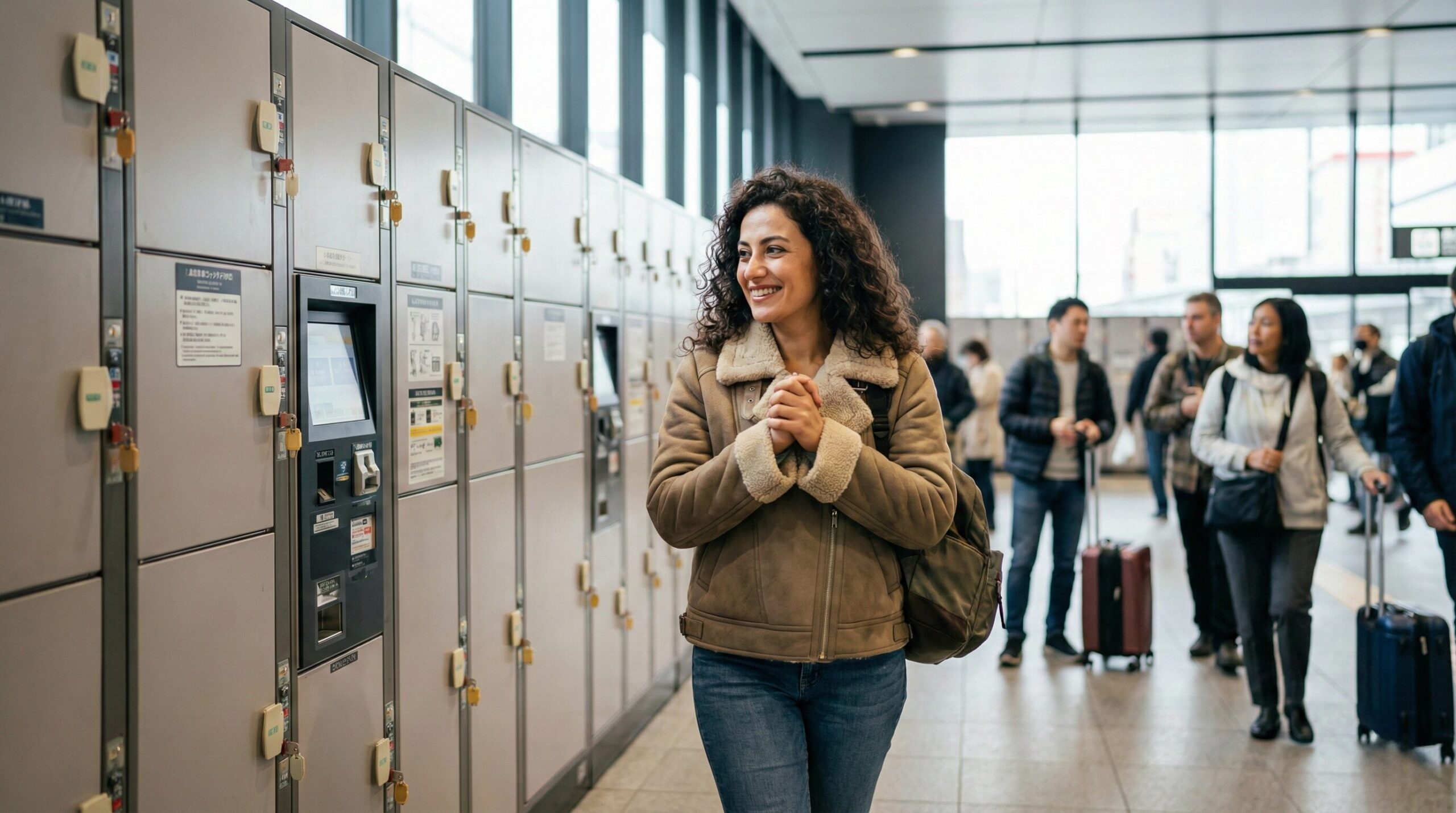
Imagine this scenario: You have just arrived at Tokyo Station. It is 10:00 AM.
Your hotel check-in isn’t until 3:00 PM. You have two large suitcases, a backpack, and a burning desire to explore the Imperial Palace grounds immediately. Do you drag your luggage across the gravel paths? Do you waste an hour going to the hotel just to drop bags?
No. You look for the wall of grey metal boxes, the unsung heroes of Japanese travel: the Coin Lockers.
In Japan, “Coin Lockers” (Koin Rokka) are not just storage; they are a lifestyle. They are ubiquitous, located in almost every train station, shopping mall, and tourist attraction. They are the reason you see so many people walking around effortlessly, even though they are in the middle of a cross-country trip. They allow for the “stopover travel” style that makes exploring Japan so efficient—hopping off a train at Himeji to see the castle for three hours before continuing to Hiroshima, all without burdening your back.
However, for the uninitiated, standing in front of a high-tech locker bank with flashing lights and Japanese text can be intimidating. Is it cash only? Will my suitcase fit? How do I get it back?
This is your manual on How to Use Coin Lockers in Japan. We will decode the sizes, the payment systems, and the secret strategies to finding an empty box in a crowded station.
Understanding the Hardware: Types and Sizes
Before you try to stuff your bag into a box, you need to know what you are dealing with. Japanese lockers have evolved into two distinct species.
The “Old School” Key Type
These are the classic, analog lockers found in smaller stations, rural areas, or older parts of major terminals.
- The Mechanism: Physical key.
- How it Works: You put your bag in, insert coins, turn the key, and take the key with you.
- The Pro: Simple and reliable. No technology to fail.
- The Con: You usually need exact change (100-yen coins). If you lose the key, you are in for a bureaucratic nightmare and a hefty fine (usually around 2,000–3,000 yen for key replacement).
The “New School” Touchscreen / IC Card Type
These are dominating major hubs like Shinjuku, Tokyo, and Osaka. They are often keyless.
- The Mechanism: Central touchscreen control panel.
- How it Works: You select a locker number on the screen. You pay using your IC Card (Suica/Pasmo) or cash.
- The Magic: If you use an IC Card, the card becomes your key. You just tap it to open the locker later. No physical key to lose.
- The Paper Ticket: If you pay by cash, the machine prints a small QR code ticket. You scan this code to retrieve your bags. Do not lose this slip.
The Size Chart: Will It Fit?
This is the most common question. Lockers generally come in three standard sizes, though dimensions can vary slightly by manufacturer.
- Small (approx. 400–500 yen)
- Dimensions: ~35cm (H) x 34cm (W) x 57cm (D)
- Best for: Backpacks, shopping bags, purses, jackets.
- Reality Check: generally will not fit a standard rigid carry-on suitcase (unless it is very compact/slim).
- Medium (approx. 600–700 yen)
- Dimensions: ~57cm (H) x 34cm (W) x 57cm (D)
- Best for: Carry-on suitcases (cabin size), heavy rucksacks.
- Availability: These fill up moderately fast.
- Large (approx. 800–1,000 yen)
- Dimensions: ~87cm (H) x 34cm (W) x 57cm (D)
- Best for: Large check-in suitcases (up to about 70-80L).
- Availability: Highly competitive. In major stations like Kyoto or Tokyo, these are often gone by 9:00 AM.
- Extra Large / Wide (approx. 1,000–1,200+ yen)
- Dimensions: Wider and taller.
- Best for: Golf clubs, snowboards (rare), or massive trunks.
- Availability: Extremely rare. Do not count on finding one.
Step-by-Step Guide: The Operation Ritual
Let’s break down the exact movements required to use these machines so you don’t look like a confused tourist blocking the flow of traffic.
How to Use the “Key Type” Locker
- Find an Empty Locker: Look for a key hanging in the lock. If the key is there, it’s empty. If the key is missing, it’s taken.
- Load: Put your bag in. Push it all the way back.
- Coin Prep: Look at the price (e.g., 500 yen). The coin slot usually takes 100-yen coins (though some newer types accept 500-yen coins). (Bills are definitely rejected).
- Tip: If you don’t have coins, look for a “Money Changer” machine nearby, or buy a gum at a kiosk to break a bill.
- Insert & Turn: Insert coins. The lock will click. Turn the key to the left (usually) to lock.
- Check: Pull the door to ensure it’s locked.
- Keep the Key: Put it in a safe place immediately.
How to Use the “Touchscreen / Suica” Locker
- Find an Empty Locker: Look for the lights on the locker bank.
- Green Light / Blue Light: Available.
- Red Light: Occupied.
- Load: Put your bag in a green-lit locker. Push the handle down (or close the door firmly) until it clicks or the light flashes.
- Go to the Screen: The central screen controls the whole bank.
- Select “Deposit” (Azukeru): The screen will usually display the layout of the lockers. Tap the box number you just put your bag in.
- Choose Payment:
- Option A (Suica/Pasmo): Tap your card on the reader. The locker locks. A receipt prints (optional). Done.
- Option B (Cash): Insert bills/coins. The locker locks. A ticket with a QR code/PIN prints. Take it.
- Retrieval:
- Select “Retrieval” (Toridasu).
- Tap your Suica OR Scan your QR code.
- The door pops open.
The “3-Day Rule” and Other Critical Rules
There are hidden rules to the locker system that can ruin your trip if ignored.
The 3-Day Limit
You cannot live out of a locker. Generally, you can leave items for a maximum of 3 days (including the day of deposit).
- What happens after 3 days? Station staff will empty the locker. Your items are moved to a central storage office (often far away or at a different station). To get them back, you have to go to the office, show ID, pay the storage fee for the extra days, and often pay a penalty fee.
- The “Day” Calculation: Fees are usually calculated per calendar day, not per 24 hours. If you deposit at 10:00 PM and pick up at 6:00 AM the next day, you might be charged for two days because the “day” resets.
- Note: The reset time varies by company; it is usually 2:00 AM for JR lines, but often 0:00 (midnight) or 1:00 AM for subways and private railways. Check the locker’s display.
The Cash Only Trap
While Suica lockers are common in Tokyo, rural stations (e.g., at trailheads in the Alps or small onsen towns) are almost exclusively 100-yen coin operated.
- Beyond Nippon Recommendation: Always carry at least ten 100-yen coins in a separate coin purse when traveling to remote areas.
Food Safety
Do not store raw food or anything that smells. In summer, a metal locker becomes an oven. A forgotten banana will rot rapidly. Station staff have the right to open lockers that emit bad odors.
Practical Examples: Strategic Locker Use
Here is how a savvy traveler uses lockers to “unlock” deeper travel experiences.
Scenario A: The Himeji Stopover
You are traveling from Osaka to Hiroshima on the Shinkansen. Himeji Castle is right on the way.
- Get off at Himeji Station.
- Go to the locker bank (inside the Shinkansen gate or just outside the main exit).
- Store your large suitcases.
- Walk to the castle (15 mins), climb the keep, eat lunch.
- Return to station, retrieve bags, hop on the next Shinkansen.
- Result: You visited a World Heritage site without checking into a hotel or dragging bags.
Scenario B: The Shibuya Shopping Spree
You are staying in Asakusa but want to shop in Shibuya. You buy too many clothes/records.
- Find a locker in Shibuya Station (try the Mark City connector or underground by Exit A8).
- Dump your shopping bags mid-day.
- Go to dinner or a club hands-free.
- Pick them up before the last train.
- Result: You saved yourself the physical exhaustion of carrying 5kg of shopping for 6 hours.
Scenario C: The “Late Flight” Limbo
You check out of your hotel at 10:00 AM. Your flight from Narita is at 9:00 PM.
- Go to a major station like Ueno (direct train to Narita) or Tokyo Station.
- Locker your bags there in the morning.
- Explore the Ueno park museums or Ginza for the day.
- Return to the station, grab bags, get on the airport express.
- Result: A full extra day of sightseeing without the “where do I put my bag” stress.
Advanced Tactics: Finding the Hidden Lockers
The biggest problem with coin lockers in Japan is that they are popular. In Kyoto Station or Shinjuku, finding a large locker at 11:00 AM is like finding water in a desert.
Go Underground or Go High
- The Amateur Move: Looking for lockers right next to the ticket gates. These are always full.
- The Pro Move: Walk further.
- Underground Passages: The endless tunnels connecting stations often have rows of empty lockers.
- Upper Floors: In department store buildings connected to stations (like Lumine in Shinjuku), there are often lockers on higher floors or near the restrooms that are completely empty.
Use the Apps / Websites
Technology is your friend.
- Coin Locker Navi: A website that maps locker locations.
- Suica Locker Search: Inside some major JR stations, there are large touchscreen kiosks near the entrance that show a map of the station. They display real-time vacancy status. If you see a bank with “0” vacant, don’t walk there. If you see “5” vacant, run.
The “Ecbo Cloak” Alternative
If every locker is full (common during Cherry Blossom season), use Ecbo Cloak.
- What is it? It’s the “Airbnb of luggage.” Shops, cafes, and kimono rental places rent out their unused space for luggage storage.
- How to use: Download the app, find a cafe nearby, book a slot, and drop your bag with the barista. It is often the same price as a large locker (approx. 800 yen) and guarantees a spot.
Troubleshooting: When Things Go Wrong
Even the best plans fail. Here is how to recover.
“I lost my QR Code ticket.”
- Panic Level: Medium.
- Solution: Go to the station master’s office or the “Locker Admin” room (phone number is usually on the locker). You will need to describe exactly what is in the bag. They will open it, but you will have to prove ownership (e.g., show your passport matching a name on a luggage tag, or unlock the phone inside). You may pay a lost ticket fee.
“I lost the physical key.”
- Panic Level: High.
- Solution: Same as above, but you will definitely pay a “Key Replacement Fee” (1,500–3,000 yen). It takes time. Do not lose the key.
“My Suica isn’t opening it.”
- Panic Level: Low.
- Solution: Did you use a different IC card (e.g., your partner’s Pasmo) to lock it? This happens constantly. Try all cards in your group. If it fails, contact staff.
Conclusion: The Heavy Lifting is Over
Travel is about movement. It is about the ability to turn left down an interesting alleyway because you aren’t tethered to a 20kg anchor on wheels. Learning How to Use Coin Lockers in Japan is more than just a logistical skill; it is a declaration of independence. It transforms you from a burden-carrying tourist into an agile explorer. The next time you arrive in a Japanese station, look for that wall of grey boxes. Drop the coins, hear the click, and walk away light. The real Japan is waiting, and it’s much easier to find when your hands are free.