
There is a common misconception that Japan is a difficult destination for travelers with mobility issues. The image of the country is often painted with broad strokes: crowded trains during rush hour, ancient temples with endless stone staircases, and tiny ramen shops where you can barely turn around, let alone park a wheelchair. While these challenges exist, they are only half the story.
The reality is that Japan is arguably one of the most accessible countries in the world. Driven by a rapidly aging population and the recent infrastructure overhaul for the Tokyo 2020 Paralympics, Japan has invested billions into “Barrier-Free” (Baria-Furi) design.
From tactile paving on every sidewalk to train station staff who treat assistance like an art form, the systems in place are efficient, respectful, and meticulously maintained. The challenge for the traveler is not a lack of infrastructure, but a lack of information in English on how to use it.
This Accessibility Guide for Japan Travelers is your roadmap. Whether you use a wheelchair, walk with a cane, or have sensory impairments, this guide will help you look Beyond Nippon’s reputation for crowds and discover a country that is deeply welcoming to everyone. Japan is not just open for adventure; it is ready to help you every step of the way.
The Gold Standard: Public Transportation
If there is one reason to visit Japan as a traveler with accessibility needs, it is the train system. It is a marvel of logistics and human service.
The “Slope” Service at Train Stations
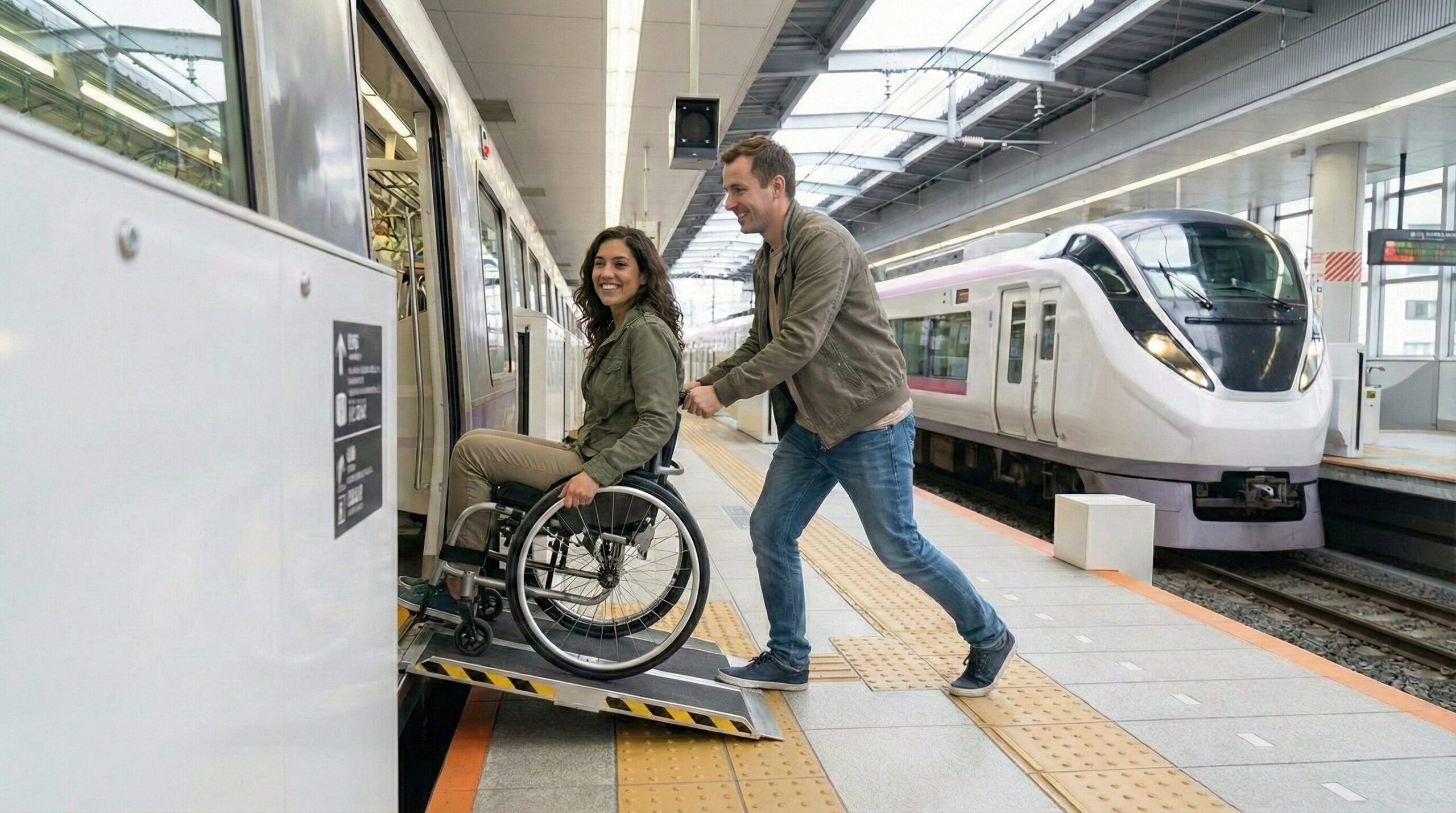
This is the hidden superpower of Japanese travel. In nearly every train station in Japan (JR, Metro, and private lines), there is a system in place for wheelchair users.
- How it works: When you arrive at the ticket gate, tell the station staff your destination.
- The Service: A staff member will escort you to the platform. They will radio ahead to your destination station and any transfer points.
- The Boarding: When the train arrives, they pull out a portable ramp (called a “slope”) to bridge the gap between the platform and the train. They guide you in.
- The Arrival: When you get to your destination, another staff member is already waiting on the platform with a ramp to help you off. You don’t need to worry about missing your stop; the system ensures you are met.
Note: This service is free. In major cities and staffed stations, usually no reservation is required; just show up and ask. However, for rural lines or unmanned stations (Mujin-eki), you must contact the railway company in advance to ensure a staff member meets you with a ramp.
The Shinkansen (Bullet Train)
The Shinkansen is incredibly spacious and smooth, but booking requires strategy.
- Wheelchair Spaces: Every Shinkansen has designated seats for wheelchair users. Some allow you to stay in your wheelchair; others are “transfer seats.”
- The Multipurpose Room: There is also a private room on the train for those who need privacy for medical care or breastfeeding, though it prioritizes passengers with disabilities.
- Booking is Vital: You cannot simply book these seats on a standard third-party travel site. You must book them:
- At a JR Ticket Office (Midori-no-madoguchi) in person.
- By phone (Japanese service mostly).
- Via the SmartEX App (available in English), which allows specific seat selection. Do not wait until the day of travel; these spots sell out.
Taxis: The “UD” Taxi
In cities like Tokyo, Kyoto, and Osaka, you will see boxy, tall taxis that look like black London cabs. These are Toyota JPN Taxis, also known as Universal Design (UD) Taxis.
- Feature: They have wide sliding doors and can accommodate a wheelchair (via a ramp stored in the trunk).
- Availability: They are everywhere in major cities. While you can technically hail them on the street, using a taxi app (like GO or Uber) is highly recommended. Drivers may hesitate to stop on busy streets due to the time required to safely set up the ramp.
Navigating the Streets and Sidewalks
Walking (or rolling) through a Japanese city is a unique sensory experience.
Tenji Blocks (Tactile Paving)
You will notice yellow textured blocks on almost every sidewalk, train platform, and pedestrian crossing in Japan. These are Tenji Blocks.
- Fun Fact: They were actually invented in Japan (in Okayama Prefecture) in 1965.
- The Code: Straight lines mean “Go / Safe to walk.” Dotted bumps mean “Stop / Danger / Junction.” For travelers with visual impairments, Japan offers a continuous tactile path from the station exit to major public buildings.
Traffic Signals
Japanese crosswalks are audible.
- Bird Songs: You will often hear bird sounds (chirping or cuckoo calls) to indicate when it is safe to cross. The sound indicates the direction of the green light (North-South vs. East-West).
Elevators vs. Escalators
- Elevators: Almost all train stations have elevators. However, they are sometimes located at the far end of the platform. Follow the yellow signs with the wheelchair icon.
- Priority: In Japan, locals are generally good about giving priority to wheelchair users and strollers for elevators, though during rush hour, you may have to wait for the second car.
Accommodation: The Challenge of the “Genkan”
Finding a hotel is where this Accessibility Guide for Japan Travelers urges the most caution. Traditional Japanese architecture is inherently hostile to wheels due to the Genkan (the entryway step).
The “Universal Room”
Modern Western-style hotels in Japan (major chains like Toyoko Inn, APA, Nikko, Prince) usually have specific “Universal Rooms” or “Barrier-Free Rooms.”
- Features: Wider doors, handrails in the bathroom, roll-in showers (no bathtub lip), and emergency pull cords.
- Availability: Hotels often only have one or two of these rooms. You must email the hotel directly to confirm availability, even if booking online.
The Ryokan Dilemma
Staying in a traditional Ryokan is a highlight of any trip, but tatami mats and wheelchairs do not mix. Wheelchairs damage the delicate straw mats.
- The Solution: Look for “Modern Ryokan” or hotels that offer “Western-Japanese style rooms” with beds.
- Wheelchair Covers: Some high-end ryokans provide wheel covers or separate “indoor wheelchairs” so you can enter the tatami rooms.
- Private Baths: If the public onsen is inaccessible, book a room with a private open-air bath (Rotenburo-tsuki kyaku-shitsu). This guarantees you can bathe safely and privately.
Recommendation: Keio Plaza Hotel (Tokyo): A pioneer in accessibility. They have “Universal Rooms” designed with adjustable furniture and lifts. Toyoko Inn (Nationwide): A budget business hotel chain. Almost every branch has a “Heartful Room” that is fully accessible and very affordable.
Restrooms: The Multipurpose Toilet
Japan has the best public toilets in the world, and this extends to accessibility. In train stations, department stores, and parks, look for the “Multipurpose Toilet” (Dare-demo Toire). These are massive, unisex, single-room restrooms.
Standard Features:
- Space: Enough room to rotate a large electric wheelchair.
- Ostomate Facilities: A sink and faucet designed for cleaning ostomy bags.
- Handrails: Drop-down rails on both sides of the toilet.
- Baby Keep: A chair to hold a baby while a parent uses the restroom.
- Adult Changing Board: A fold-down bed for changing clothes or adult diapers.
The Buttons: Be warned, Japanese toilets have many buttons.
- Flush: Often a sensor (wave hand) or a large silver lever.
- Emergency: There is usually a red button or a pull cord near the floor. Do not confuse the Flush button with the Emergency button. If you pull the cord, station staff will come running.
Sightseeing: Old Japan vs. New Japan
Historical sites are beautiful, but they were built centuries ago to defend against samurai, not to welcome wheelchairs. However, renovations are happening constantly.
The Accessible Friendly
- Senso-ji Temple (Asakusa, Tokyo): Surprisingly accessible. There is an elevator hidden on the side of the main hall that takes you up to the altar level.
- Kiyomizu-dera (Kyoto): The most famous temple in Kyoto is fully wheelchair accessible. They have built smooth ramps that wind up the mountain, allowing step-free access to the main stage.
- Tokyo Skytree / Abeno Harukas: Modern towers are 100% barrier-free.
- Nara Park: The deer park is mostly flat and paved. Todai-ji (the Great Buddha) has ramps.
The Challenging
- Castles (Himeji, Matsumoto): Original keeps are notoriously difficult. They have steep, ladder-like wooden stairs. Himeji Castle has no elevator to the top. You can enjoy the grounds, but entering the keep is impossible for wheelchair users.
- Alternative: Osaka Castle is a modern reconstruction (concrete inside) and has an elevator to the top floor.
- Golden Gai (Shinjuku): The tiny alleyways are navigable, but the bars themselves are often located up narrow stairs and are too small for a wheelchair to enter.
Museums and Gardens
- Shinjuku Gyoen / Kenrokuen: Major landscape gardens usually have designated “Wheelchair Courses” mapped out on brochures. Gravel paths can be tricky, but main routes are paved.
- TeamLab Planets: Fully accessible, though you may need to transfer to a rental wheelchair provided by the venue for certain water areas.
Practical Tips for the Accessible Traveler
Takkyubin (Luggage Delivery)
This is a game-changer. Do not drag your suitcases through the station.
- The Service: Send your luggage from the airport to your hotel, or from hotel to hotel.
- Why: Navigating a wheelchair or walking with a cane is infinitely easier without luggage. It costs about ¥2,500–¥4,000 per bag depending on size and distance, and usually arrives the next day. Ask your hotel front desk to arrange it.
Renting Equipment
If you can walk short distances but get tired easily, consider renting a wheelchair in Japan rather than bringing one.
- Providers: Companies like “Ido Support” can deliver rental wheelchairs (electric or manual) to your hotel or the airport.
- Tourist Spots: Many major temples and museums lend wheelchairs for free at the entrance.
The Magic Phrase
Japanese people are incredibly helpful but often shy about offering help because they don’t want to be intrusive. If you need help, you must signal it.
- Phrase: “Tetsudatte kudasai?” (Can you help me?)
- Phrase: “Erebēta wa doko desu ka?” (Where is the elevator?)
Apps and Resources
- Google Maps: Go to Settings > Transit > Accessibility > “Wheelchair accessible.” It will route you via elevators.
- Japan Accessible Tourism Center: An NPO with a fantastic website offering detailed accessibility logs for ryokans and tourist sites.
- Accessible Japan: A website run by Josh Grisdale, a Tokyo resident and power chair user. It is the bible of English-language accessibility info.
A Note on Hidden Disabilities
Japan uses a symbol called the “Help Mark” (Herupu-maku). It is a red tag with a white cross and heart.
- What it is: People with invisible disabilities (heart conditions, early pregnancy, prosthetic legs, etc.) wear this tag on their bags.
- What to do: If you see someone with this tag on the train, offer them your seat, even if they look healthy.
- For you: If you have an invisible disability, you may be able to pick up one of these tags at major subway stations in Tokyo, though availability can be limited.
Conclusion
Travel is the act of expanding one’s world. A physical limitation should not limit the size of that world. Japan has embraced the philosophy of Kyosei (living together in harmony). While the ancient stone paths of a zen garden or the steep stairs of a Shinto shrine may present physical barriers, the human element of Japan works tirelessly to remove them. When you visit, you will find that the station attendant running with a ramp, the hotel concierge measuring the door width for you, and the stranger holding the elevator door are all part of the “Real Japan” experience. Do not let fear of the unknown stop you. The ramps are ready. The elevators are working. And the hospitality is waiting.