
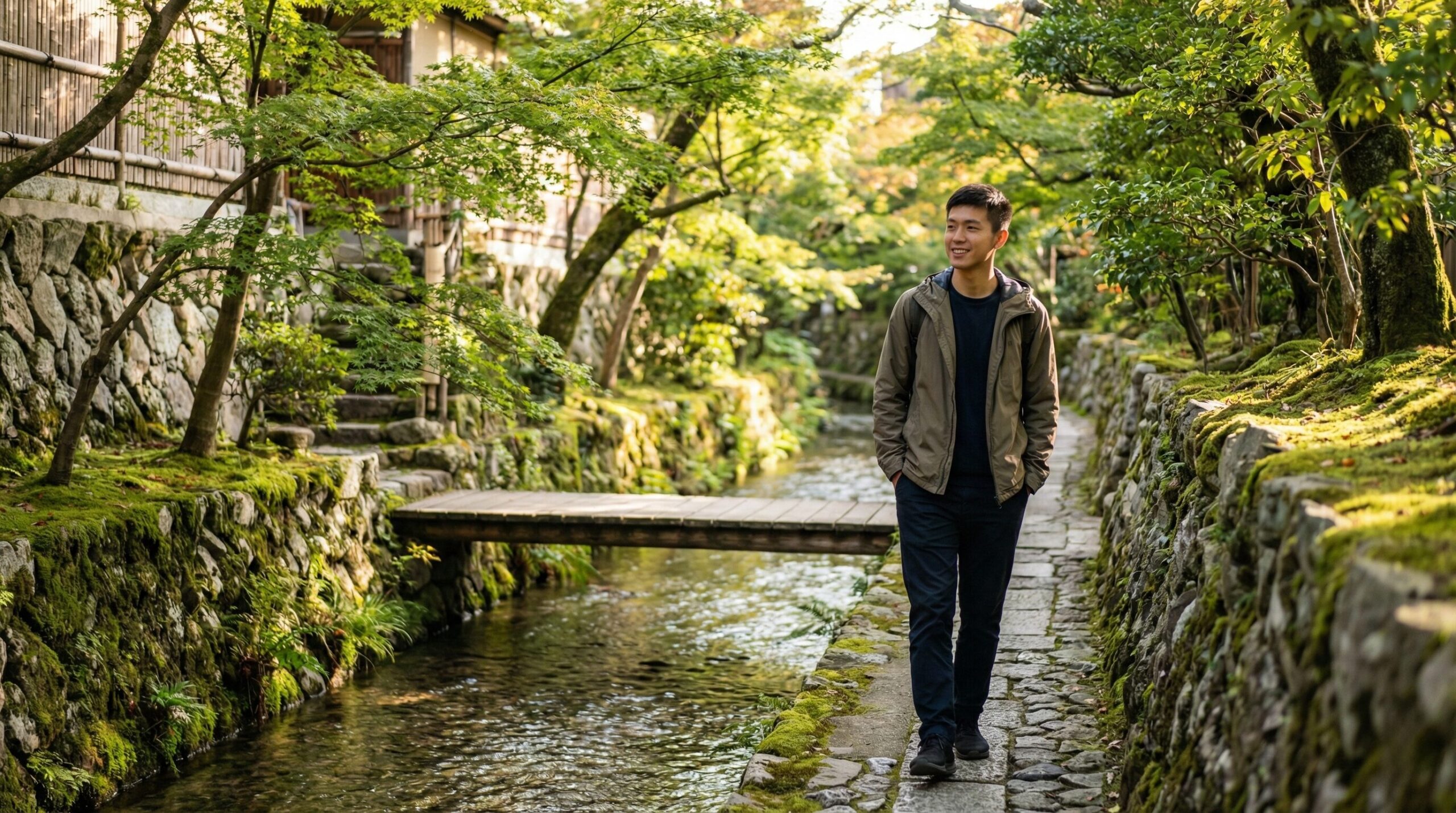
Kyoto is a city defined by water. Geographically, it is a basin, cradled by mountains on three sides. These mountains act as a natural sponge, collecting rain and sending it down into the city through a network of rivers, canals, and underground aquifers. While tourists flock to the static beauty of the temples—the Golden Pavilion, the Kiyomizu Stage—the true life of Kyoto is found in its moving waters.
However, most visitors only see one small section of one river: the crowded banks of the Kamo River near Shijo Bridge, often packed with couples sitting equidistant from each other (a phenomenon known as the “Kamo River Rule”) and buskers competing for attention.
But to go Beyond Nippon is to follow the water upstream. If you walk just a few kilometers north, or venture slightly east into the hills, the rivers transform. They become quiet, green corridors where herons stalk fish in the shallows, where university students practice the cello under bridges, and where the changing seasons are reflected not in ticketed gardens, but in the wild cherry trees lining the banks.
This guide to Kyoto’s Secret River Walks is an invitation to slow down. It is a guide to the paths less traveled, where the soundtrack of the city shifts from the rumble of buses to the murmur of running water. Here is where you find the breathing space in a breathless itinerary.
The Green Sanctuary: The Takano River (North of the Delta)
Most travelers know the Kamo River. Fewer know its wilder, greener sibling, the Takano.
The Kamo River is shaped like a ‘Y’. The confluence point is the Kamogawa Delta (Demachiyanagi). The left fork is the Kamo; the right fork is the Takano. While the Kamo side is paved and popular, the Takano side is where the locals go to escape.
The Route
Start at Demachiyanagi Station. Instead of heading south toward downtown, do not cross the bridge, but head north along the east bank of the Takano River.
Why It Is A “Secret”
- The Tunnel of Green: In spring, this riverbank is a tunnel of cherry blossoms (Sakura). Unlike the Philosopher’s Path, which is a shoulder-to-shoulder crush of tourists, the Takano is spacious. You will see grandfathers painting watercolors, families having picnics, and egrets flying low over the water.
- The Turtle Stones: At the Delta, you can cross the river by jumping on large stepping stones shaped like turtles and plovers (chidori). It is a moment of pure, childlike joy that breaks the solemnity of temple-hopping.
- The Mountain View: As you walk north, the view of Mt. Hiei (the sacred mountain protecting Kyoto from the northeast) dominates the skyline. It is a stunning backdrop that most tourists miss because they are looking down at their phones in Gion.
The Breakdown
- Start: Demachiyanagi Station (Kamogawa Delta).
- End: Matsugasaki Bridge.
- Distance: Approx. 2.5 km.
- Best Time: Early morning or late afternoon (Golden Hour).
- Look For: The massive black kites (hawks) circling above. Warning: Do not eat a sandwich openly while looking away. They will snatch it from your hand.
The Philosopher’s Path… At Dawn
Wait, isn’t the Philosopher’s Path (Tetsugaku-no-michi) the most famous walk in Kyoto? Yes. But it makes this list of Kyoto’s Secret River Walks because of when you visit. At 10:00 AM, it is a tourist trap. At 6:30 AM, it is a spiritual experience.
The Canal
The path follows a canal, not a natural river. This water comes from Lake Biwa, carried through a tunnel under the mountains to power Japan’s first hydroelectric plant. It flows gently, lined by hundreds of cherry trees.
The “Secret” Experience
If you walk this path at dawn, the only other people you will see are local monks sweeping the entrance to their sub-temples and cats stretching on the warm stones. The stillness of the water mirrors the leaves perfectly.
- The Hidden Coffee Shop: Keep an eye out for Pomme, a small coffee shop near the northern end. Or, simpler yet, bring a canned coffee from a vending machine and sit on a bench near Honen-in Temple.
- Honen-in: Speaking of which, step off the canal path to visit Honen-in. It has a thatched gate that looks like it grew out of the moss. It opens at 6:00 AM and is free. It is arguably the most atmospheric entrance in Kyoto.
The Breakdown
- Start: Nyakuoji Bridge (near Eikan-do).
- End: Ginkaku-ji Bridge.
- Distance: 2 km.
- Best Time: Sunrise. Strictly.
- Vibe: Meditative, silent, misty.
The Yamashina Canal: The Cherry Blossom Tunnel
For those who want the beauty of the Philosopher’s Path but refuse to wake up at dawn, there is a legitimate secret alternative: the Yamashina Canal (Yamashina Sosui). Located just one train stop away from Kyoto Station (on the JR or subway), Yamashina is a residential district that tourists rarely visit. Yet, the same Lake Biwa Canal flows through here, creating a spectacular walking path.
The Contrast
Here, the canal is elevated. You walk on a path with the water on one side and a view looking down over the town on the other.
- Nanohana (Rapeseed Flowers): What makes this walk unique is the color contrast. In spring, the banks are planted with bright yellow rapeseed flowers. The combination of the pink cherry blossoms above and the yellow flowers below creates a vivid, painting-like scene.
- Bishamondo Temple: The walk leads you towards Bishamondo, a temple famous for its “moving eyes” dragon painting and its stunning red maple leaves in autumn.
The Breakdown
- Start: JR Yamashina Station (walk north 10 mins to reach the canal).
- End: Near the tunnel entrance to Kyoto.
- Distance: 3–4 km.
- Best Time: Early April (Sakura season) or November (Autumn leaves).
- Crowd Level: Low. Mostly local dog walkers and photographers.
The Shirakawa: The Gion You Missed
Everyone walks Hanamikoji Street in Gion to spot geisha. It is crowded, paved, and often stressful. But just a block north runs the Shirakawa River. Most tourists see the western tip of it (near the Tatsumi Daimyojin shrine). But if you follow the Shirakawa east towards the mountains (near Chion-in Temple), it becomes a hidden, subterranean secret.
The Willow Walk
The section of the Shirakawa running along Shirakawa-minami-dori is preserved as a historical district. Willow trees drape their green branches into the water. The wooden backs of high-end Ryotei (restaurants) rest on stilts over the stream.
- The Heron: There is a famous grey heron that lives on this stretch of the river. He is often seen standing motionless on a rock, unfazed by the few tourists who find him. He is the unofficial guardian of Gion.
- The Morning Light: Visit this street at 8:00 AM. The restaurants are closed, the garbage trucks haven’t arrived, and the light filtering through the willow leaves onto the cobblestones is magical. It is the most photogenic spot in the city, but only before the world wakes up.
The Breakdown
- Start: Kawabata-dori (near Gion-Shijo station).
- End: The Chion-in Temple Gate.
- Distance: Short (800 meters), but dense with atmosphere.
- Highlight: The small stone bridges that cross the stream, leading to private entrances.
The Kamiyagawa: The “Paper River” of Kitano
This is a true deep cut. The Kamiyagawa (or Kamiya River) flows along the western edge of the Kitano Tenmangu Shrine. Historically, this river was used by paper makers (Kami-ya) to wash the pulp for traditional Washi paper. Today, it flows through a deep, concrete-reinforced ravine that, for one month a year, becomes the most beautiful place in Kyoto.
The Momiji-en (Maple Garden)
In November, the ravine is opened to the public as the Momiji-en. Hundreds of maple trees, some 400 years old, hang over the river.
- The Perspective: Because the river is in a ravine, you view the trees from above (on the bridge) and then walk down to the riverbed to look up. Being surrounded by a canopy of red and orange leaves, with the sound of the rushing river drowning out the city noise, is immersive.
- The Tea and Sweet: The entry ticket usually includes a cup of tea and a sweet served at a teahouse overlooking the river. Note: Even outside of autumn, the walk along the upper street overlooking the river offers a glimpse into a quiet, older Kyoto neighborhood (Nishijin district) famous for its textile weavers.
Practical Examples: The Perfect River Picnic
One of the great joys of Kyoto’s Secret River Walks is the ability to stop and eat. Kyoto has a strong “picnic culture.”
The “Depachika” Strategy
Do not buy a sandwich from a convenience store. Go to the basement of a department store (Depachika) like Takashimaya or Daimaru.
- Buy: A high-end Bento box (look for seasonal ones with bamboo shoots or chestnuts).
- Buy: A small bottle of sake or craft beer (Kizakura is a local Kyoto brewery).
- Go: Take the train to Demachiyanagi.
- Sit: Find a grassy spot on the Takano River bank.
- Enjoy: Watch the students jumping on the turtle stones. Eat your bento. This is the luxury of time.
The “Konbini” Strategy (Budget Friendly)
If you are on a budget:
- Buy: Onigiri (Rice balls) and Karaage (Fried chicken) from 7-Eleven.
- Buy: A hot tea from the vending machine.
- Go: The benches along the Yamashina Canal.
- Enjoy: A meal with a million-dollar view for under $5.
Tips for the River Traveler
Rent a Bicycle
Kyoto is flat. The rivers are the highways for bicycles.
- Rule: Stay on the left.
- Path: The Kamo River banks are technically for pedestrians, but there are dirt paths often used by cyclists. However, the streets parallel to the rivers (like Kawabata-dori) have bike lanes. Exploring the length of the Kamo River by bike (all the way to the Botanical Gardens) is a fantastic half-day trip.
The Bug Factor
Rivers mean water. Water means mosquitoes.
- Summer: If you are walking near the rivers in June–September, bring insect repellent. The humid Kyoto summer is legendary, and the mosquitoes are aggressive near dusk.
Footwear
These “secret” walks often involve unpaved paths, gravel, or stepping stones.
- Advice: Leave the heels or stiff dress shoes at the hotel. Wear comfortable sneakers. You might want to dip your feet in the water at the Delta on a hot day, so shoes that are easy to slip off are a bonus.
Respect the Residents
Many of these paths (especially Yamashina and Shirakawa) go through residential neighborhoods.
- Noise: Keep your voice down.
- Trash: There are very few trash cans in Japan. You must carry your trash back with you to your hotel or find a designated bin at a convenience store. Leaving a bento box on a riverbank is a cardinal sin.
Conclusion
The rivers of Kyoto are more than just water; they are the timeline of the city. The Kamo River has seen samurai duels, the washing of brilliant Yuzen silks, and the first dates of countless lovers. The Takano has watched over the quiet study of scholars. The Shirakawa has reflected the painted faces of geisha for centuries. When you engage in one of Kyoto’s Secret River Walks, you stop being a spectator rushing from one checkpoint to the next. You become part of the flow. You align your pace with the current. In a city that can often feel like a theme park of its own past, the rivers are undeniably, refreshingly present. They are real. They are moving. And they are waiting for you to walk alongside them.