
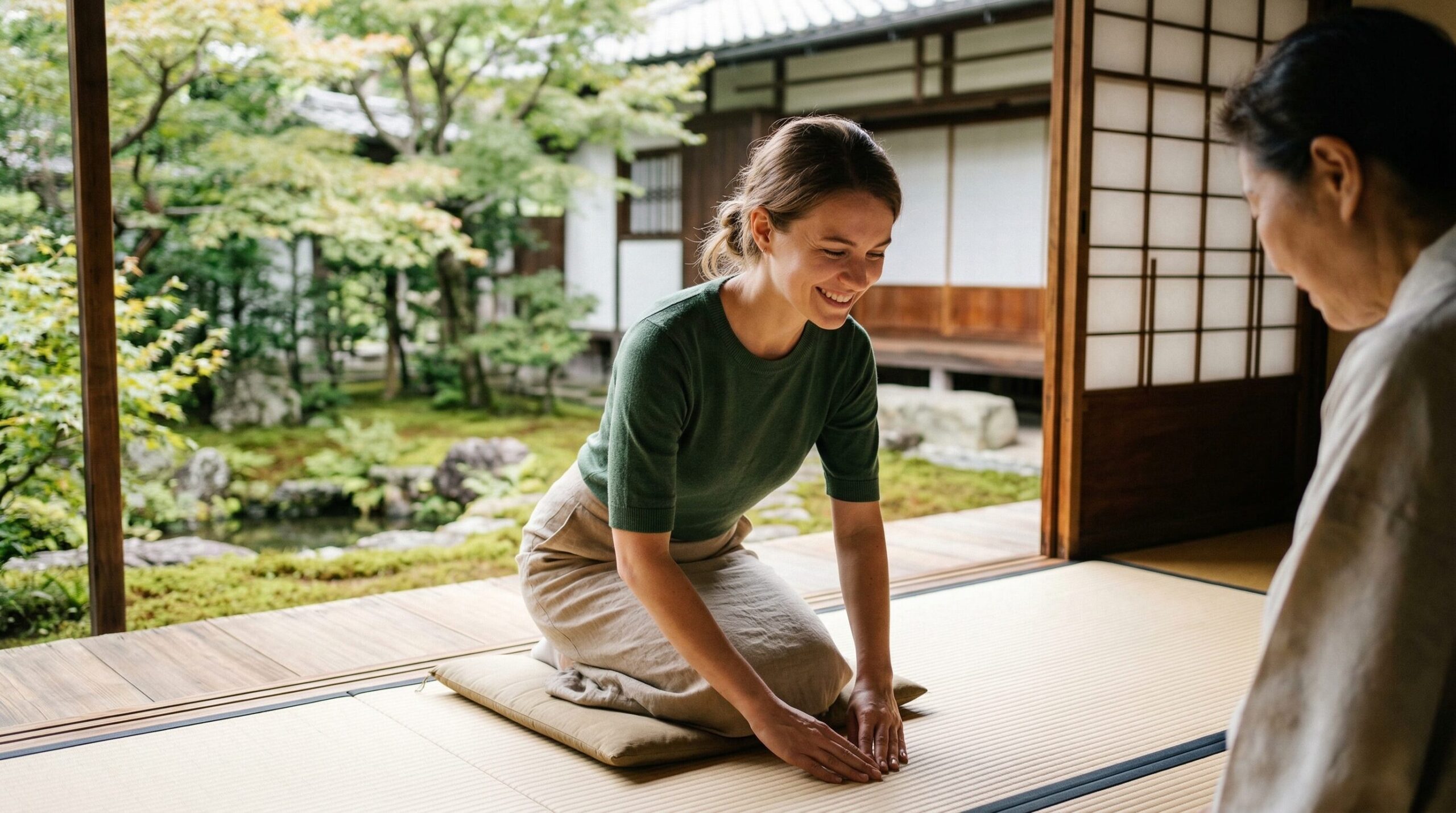
When you slide open the heavy wooden door of a traditional machiya or a rural inn, the first thing you notice is the immediate, profound shift in atmosphere. The chaotic noise of the modern street vanishes. It is replaced by the soft scent of woven rush grass, the subtle glow of paper lanterns, and a hushed, meticulous calm.
This sudden tranquility is not accidental. It is the direct result of centuries of shared social contracts, refined over generations. For the international visitor, navigating these unspoken rules can initially feel like walking through a minefield of potential faux pas. The fear of doing the wrong thing often keeps visitors tethered to heavily curated, English-speaking tourist bubbles. But to truly understand this country, you must step off the well-worn path and into the everyday spaces where locals live, eat, and bathe.
This is where a deeper understanding of cultural norms becomes your greatest asset. A comprehensive guide to Japanese etiquette for travelers is not a rigid list of restrictions designed to make you anxious. Rather, it is the master key that unlocks the real Japan. When you demonstrate a quiet understanding of local customs, invisible barriers fall away. The formal distance of a shopkeeper softens into a genuine smile.
The proprietor of a hidden neighborhood izakaya welcomes you into the fold. For the mindful traveler, mastering these subtle behaviors is the ultimate gateway to experiencing the authentic, unscripted beauty of the country.
The Anatomy of Harmony: Understanding the “Why”
To truly internalize the rules, one must first understand the philosophy that dictates them. Japanese etiquette is fundamentally rooted in the concept of Wa, or social harmony. In a geographically compact, mountainous island nation that has historically dealt with high population density and frequent natural disasters, communal cooperation has always been a matter of survival. Etiquette here is rarely about asserting individual status. It is entirely about minimizing friction and ensuring the comfort of the collective. When reviewing a guide to Japanese etiquette for travelers, you will notice these underlying principles in every interaction:
- Kuuki wo Yomu (Reading the Air): This is the high-context nature of Japanese communication. It involves anticipating the needs of others before they are spoken and recognizing subtle, non-verbal cues. If a restaurant is suddenly filled with quiet, rapid conversations and you are the only one laughing loudly, reading the air means lowering your volume immediately.
- Meiwaku (Avoiding Nuance): The ultimate social sin in Japan is causing meiwaku—being a nuisance or an inconvenience to others. This single concept explains why cell phones are silent on trains, why trash is carried home rather than left on a park bench, and why people patiently queue in perfectly straight lines.
- The Division of Uchi and Soto: Japanese society draws a sharp line between uchi (the inside, the clean, the private) and soto (the outside, the dirty, the public). This applies to physical spaces, like the interior of a home versus the street, as well as social circles. Moving gracefully between these spheres is the essence of good manners.
Navigating the Unspoken: Practical Examples and Recommendations
How do these broad philosophies translate into daily movement? When you leave the modern hotel chains and venture into the deep, traditional pockets of the country, you will encounter specific rituals. Here is how to navigate the most common scenarios with grace.
The Threshold: Mastering the Genkan
The physical manifestation of the uchi/soto divide is the genkan—the lowered entryway found in every Japanese home, traditional ryokan, and many historic temples. This is where the dirt of the outside world is left behind.
The Ritual:
- Step Up, Not Down: When you enter a genkan, remove your street shoes. Never let your bare feet or socks touch the lowered, stone or concrete floor of the entryway before stepping onto the raised wooden floor.
- Point the Toes Outward: Once on the raised floor, turn around and neatly align your shoes, pointing the toes toward the door you just entered. If you are at a high-end ryokan, the staff will do this for you, but it is a mark of deep respect to do it yourself in smaller establishments.
- The Slipper Shuffle: You will be provided with house slippers. Wear them in the wooden hallways, but take them off immediately before stepping onto any tatami (woven straw) mats. Tatami is sacred space; only socks or bare feet are allowed.
- The Toilet Slippers: Inside the restroom, you will find a separate pair of plastic slippers. Swap your house slippers for these. The crucial, oft-forgotten step: remember to swap them back when you leave. Wearing toilet slippers down the hallway is a classic traveler mistake.
The Art of the Shared Bath: Onsen Etiquette
Perhaps nowhere is Japanese etiquette more intimately observed than in the onsen (natural hot spring) or sento (public bath). In regions deeply defined by their geothermal activity—like the steaming, forested valleys of Oita Prefecture—the communal bath is a space of profound ritual purification and silent socialization.
The Ritual:
- Wash Before You Soak: The water in the large soaking tubs is for relaxing, not for cleaning. You must sit on a small stool at the washing stations, scrub yourself thoroughly with soap, and rinse completely before ever stepping into the communal bath.
- The Towel Rule: You will be given a small modesty towel. You may use it to cover yourself while walking, but it must never touch the bathwater. Most locals fold it and balance it on top of their heads while soaking, or leave it on the edge of the stone tub.
- Tattoos and Tradition: Despite slow modernization, many traditional baths still strictly prohibit tattoos due to historical associations. If you have ink, seek out ryokans with kashikiri-buro (private, reservable baths) to enjoy the waters without breaking local customs.
- The Shared Silence: An onsen overlooking an autumn maple grove is a place of deep meditation. Keep conversations to an absolute whisper, and avoid splashing or swimming. Allow the heat and the silence to perform their restorative work.
Dining at the Local Counter: Chopsticks and Oshibori
When you duck under the noren (fabric curtain) of a tiny, six-seat neighborhood izakaya, you are entering the chef’s domain. Dining here is highly interactive, but bound by subtle rules of respect.
The Ritual:
- The Oshibori: You will immediately be handed a wet towel (hot in winter, cold in summer). This is strictly for wiping your hands before the meal. Never use it to wipe your face, your neck, or the table.
- Chopstick Taboos: Chopsticks (hashi) are surrounded by spiritual symbolism. Never pass food directly from your chopsticks to someone else’s chopsticks; this mirrors a funeral ritual involving cremated bones. Never stick your chopsticks vertically into a bowl of rice; this resembles incense offered to the dead. When not eating, lay them flat on the provided hashi-oki (chopstick rest).
- Pouring for Others: In a communal dining setting, it is customary to pour drinks (beer or sake) for your companions, rather than filling your own glass. Keep an eye on your neighbor’s cup; when it is nearly empty, offer to refill it with both hands. They will likely return the favor.
Mindful Movement: Essential Tips for Travelers
Beyond specific locations, your general conduct as you move through the country dictates how you are received. A mindful traveler operates with a low physical and auditory footprint.
- Public Transportation is a Library: The Shinkansen (bullet train) and local subways are spaces of transit and rest. Switch your phone to “Manner Mode” (silent). Do not take voice or video calls on the train. If you must converse with your travel partner, use hushed tones. The quiet of a Japanese train is a carefully maintained public good.
- The Disappearing Trash Can: You will quickly notice a glaring lack of public waste bins on Japanese streets. Do not leave your empty coffee cup on a ledge or a vending machine. Carry a small plastic bag in your daypack, hold onto your trash, and dispose of it at your hotel or at designated bins inside convenience stores.
- Photography with Permission: In the age of social media, the urge to document everything is strong. However, photographing geisha in Kyoto’s alleyways without consent, or snapping pictures of locals going about their daily lives, is considered deeply invasive. Always ask for permission (“Shashin, ii desu ka?”) or stick to photographing landscapes, architecture, and the food on your own table.
- The Graceful Exchange: When paying for goods or receiving a receipt, use the small plastic tray provided at the register. Do not hand cash directly to the cashier. Furthermore, always offer and receive items—be it a credit card, a business card, or a bowl of matcha—using both hands. It is a subtle gesture that communicates undivided attention and respect.
Conclusion
Japan’s true beauty often hides in plain sight, far removed from the massive digital billboards and the crowded tourist thoroughfares. It is found in the meticulous sweep of a shop owner’s broom at dawn, the precise placement of a tea bowl on a lacquered tray, and the quiet nod of a train conductor as they exit a passenger car. By familiarizing yourself with this guide to Japanese etiquette for travelers, you do more than just avoid offending your hosts. You actively participate in the rhythm of the country. You trade the loud, demanding footprint of a tourist for the observant, respectful presence of a guest. It is time to go beyond the ordinary, slow your pace, and discover the deep, authentic, and profoundly welcoming Japan that the locals know best.