
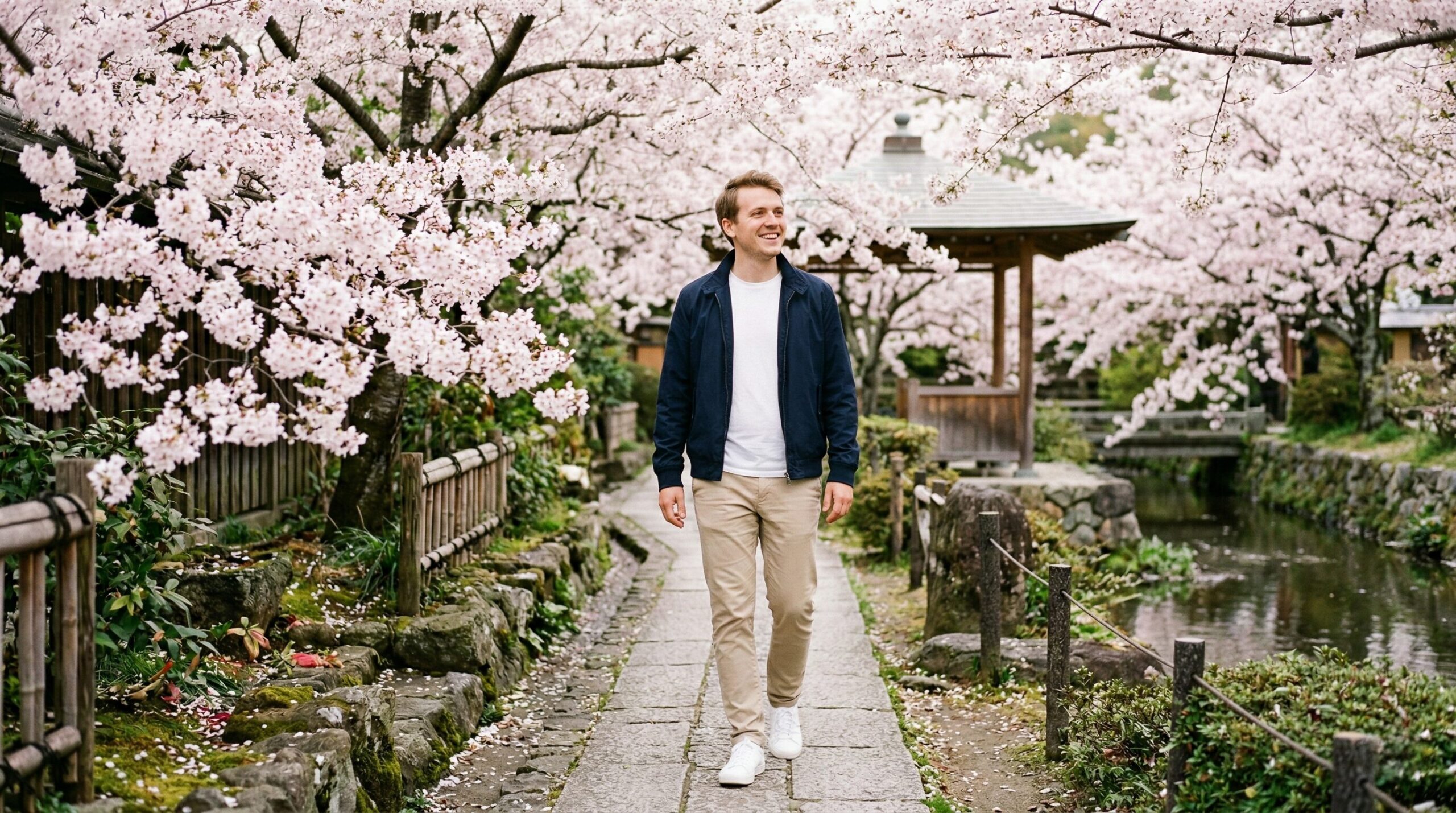
There is a highly specific image of Kyoto in spring that lives in the imagination of travelers worldwide. It is a photograph of the Philosopher’s Path, completely empty, bathed in the soft, pale pink light of blooming sakura. It is an image of profound tranquility, a visual representation of Japanese Zen. The reality of modern travel, however, is often starkly different. If you visit Kyoto’s most famous temples during the peak of spring, that tranquility is entirely absent.
The Philosopher’s Path becomes a slow-moving river of shoulder-to-shoulder foot traffic. The approach to Kiyomizu-dera Temple is gridlocked with tour buses and selfie sticks. The true, delicate poetry of the season is easily drowned out by the sheer volume of global tourism. For the traveler who seeks superficial sightseeing, this might be enough.
But if your goal is to travel deeper, you must adjust your compass. The authentic spirit of the season—the fleeting, melancholic beauty that the Japanese call mono no aware—cannot be found in a crowd.
It is found in the quiet corners of the ancient capital. It is found in residential neighborhoods, at the end of unmarked gravel paths, and in the courtyards of lesser-known sub-temples. Finding Kyoto’s secret cherry blossom spots is not just about avoiding lines; it is about reclaiming the soul of the season.
It is about sitting quietly on a wooden veranda, listening to the wind rustle through a weeping willow, and watching a single, pale petal drift to the moss below. Let us step away from the congested tourist corridors and explore the hidden geography of Kyoto’s true spring.
Key Details: The Science and Philosophy of Sakura
To successfully navigate Kyoto during this highly volatile season, you must first understand the rhythm of the blossoms and the cultural philosophy that surrounds them. The cherry blossom season is not a static event; it is a rapid, unpredictable wave.
The Phenomenon of the Sakura Zensen
The “cherry blossom front” (sakura zensen) is a meteorological phenomenon followed with near-religious devotion in Japan. As the weather warms, the blooming front sweeps from the southern islands of Kyushu all the way up to northern Hokkaido.
- The Window: In Kyoto, the window of mankai (full bloom) is notoriously short. From the moment the buds open to the moment the petals begin to fall, you generally have only about seven to ten days.
- The Vulnerability: This delicate window is entirely at the mercy of the weather. A single heavy spring rainstorm or a sudden gust of wind can strip the trees bare overnight, instantly turning peak bloom into a carpet of fallen petals.
The Cultivars: Beyond the Standard Pink
Not all cherry trees bloom at the same time. Understanding the different varieties is the key to finding Kyoto’s secret cherry blossom spots even if you arrive slightly early or slightly late.
- Somei Yoshino: This is the iconic Japanese cherry tree. It boasts five-petaled, pale pink (almost white) flowers. It makes up roughly 80% of all cherry trees in Japan. They all bloom and fall in unison, creating the famous massive canopies.
- Shidarezakura (Weeping Cherry): These ancient, cascading trees are often found inside temple courtyards. Their vibrant pink branches sweep toward the ground like a willow. They typically bloom a few days before the Somei Yoshino.
- Yaezakura (Double-Flowering Cherry): These trees produce large, heavy, pom-pom-like blossoms with multiple layers of deep pink petals. They typically bloom one to two weeks after the Somei Yoshino, offering a lifeline for late arrivals.
The Philosophy: Mono no Aware
The Japanese do not celebrate the cherry blossom because it is enduring; they celebrate it precisely because it dies so quickly. This is the concept of mono no aware—a gentle, wistful awareness of the impermanence of things. Seeking out quiet, hidden spots allows you to actually sit and reflect on this concept, rather than simply snapping a photo and moving on.
Practical Examples and Recommendations: The Hidden Sanctuaries
While the guidebooks point millions of people toward Maruyama Park and Arashiyama, the real magic of Kyoto lies in its peripheral wards. Here are the types of locations that represent the best of Kyoto’s secret cherry blossom spots.
Kurodani Temple (Konkai Komyoji): The Elevated Fortress
Located on a hill just east of the Kamo River, Konkai Komyoji is a massive temple complex that somehow remains entirely off the radar of mainstream tourism, despite being relatively close to the heavily trafficked Heian Shrine.
- The Vibe: Austere, vast, and breathtakingly quiet. This temple was historically used as the headquarters for the Aizu domain, who oversaw the Shinsengumi, during the late Edo period.
- The Visual: The approach features a towering, dark wooden Sanmon gate. Flanking the steep stone steps are massive, ancient Somei Yoshino trees. The visual contrast between the heavy, blackened wood of the gate and the incredibly delicate, pale pink blossoms is a photographer’s dream. You will likely share this space only with local dog walkers and practicing monks.
Takenaka Inari Shrine: The Hidden Tunnel
When travelers think of red torii gates, they immediately picture the endless, crowded tunnels of Fushimi Inari in the south. However, hidden on the slopes of Mount Yoshida in the eastern part of the city lies Takenaka Inari.
- The Vibe: Secluded, mystical, and deeply atmospheric. It requires a bit of a hike up a forested residential hill, which naturally filters out the casual tourists.
- The Visual: The shrine features a modest, curving path lined with perhaps two dozen weathered vermilion torii gates. During spring, the canopy above these gates erupts in white and pink cherry blossoms. The visual combination of the red gates, the white flowers, and the green forest floor is spectacular, and you can often experience it in total solitude.
Shoji-ji (The Flower Temple): The Poet’s Retreat
If you are willing to travel to the western outskirts of the city, into the Nishikyo Ward (past the bamboo groves of Arashiyama), you will find Shoji-ji.
- The Vibe: Rural, historic, and intentionally preserved. This temple is intrinsically linked to Saigyo, a famous 12th-century monk and poet who spent his life writing verses about the beauty of cherry blossoms.
- The Visual: The temple grounds are planted with dozens of cherry trees, but the centerpiece is the Saigyo-zakura, a magnificent weeping cherry tree said to have been planted by the poet himself. Because it requires a bus ride and a walk through a quiet suburban farming area, the crowds here are non-existent. It is the ultimate destination for slow, reflective travel.
The Yamashina Canal: The Symphony of Colors
Just one stop east of Kyoto Station on the JR Line lies the Yamashina district. It is a working-class residential area that tourists have no reason to visit—unless they know about the canal.
- The Vibe: A slice of everyday, local Japanese life. No souvenir shops, no matcha ice cream stands. Just neighborhood residents riding bicycles and walking home with groceries.
- The Visual: The Lake Biwa Canal runs right through this neighborhood. The banks of the canal are lined with hundreds of cherry trees. Beneath the trees, local volunteers plant brilliant yellow canola flowers (nanohana). The resulting landscape—a bright yellow carpet beneath a pale pink roof, reflecting in the flowing water—is one of the most vibrant, hidden color palettes in the entire Kansai region.
Tips for Travelers: The Art of the Quiet Hanami
Even when you know where to find Kyoto’s secret cherry blossom spots, executing your trip requires strategic thinking. Spring in the ancient capital is a logistical challenge. Here is how to navigate it smoothly.
The Rule of the Dawn
The single greatest tool in the traveler’s arsenal is the alarm clock. Kyoto wakes up late. Most temples do not open their gates until 8:30 or 9:00 AM, and the tourist crowds do not truly swell until 10:00 AM.
- The Strategy: If you want to photograph a famous spot (like the Philosopher’s Path or the Gion Shirakawa canal) without the crowds, you must be there at 6:00 AM. Use the crisp, early morning light for the famous areas, and then retreat to the hidden spots mentioned above when the city gets busy in the afternoon.
Bicycle Over Bus
In April, Kyoto’s bus system completely collapses under the weight of tourism. Buses run 45 minutes late, and they are often so packed that the driver will not open the doors at your stop.
- The Strategy: Rent an electric-assist bicycle (an e-bike). Kyoto is relatively flat in the center, and an e-bike allows you to glide effortlessly up the slight inclines toward the northern and eastern foothills. You bypass the gridlock entirely, and you will stumble upon dozens of unnamed neighborhood parks blooming with spectacular trees.
The Depachika Picnic
Hanami (flower viewing) is traditionally accompanied by a picnic. However, trying to get a table at a restaurant near any cherry blossom spot in April is an exercise in frustration.
- The Strategy: Head to the basement food halls (depachika) of major department stores like Takashimaya or Isetan. Here, you can purchase incredibly high-quality, beautifully packaged spring bento boxes featuring seasonal ingredients like bamboo shoots and sakura-flavored rice. Take your bento to the quiet grassy banks of the northern Takano River for a five-star, crowd-free meal under the trees.
The Etiquette of the Blossom
Japan operates on a strict code of respect for nature, and this is amplified during sakura season.
- The Rule: Never, under any circumstances, touch the cherry blossom branches. Do not pull a branch down to your face for a selfie. Do not shake the tree to create a petal shower. The trees are incredibly delicate and susceptible to disease. Observe with your eyes, not with your hands.
Embrace the Hazakura
Do not despair if you arrive a few days past peak bloom. The Japanese have a specific word—hazakura—for the period when the green leaves begin to sprout alongside the remaining blossoms.
- The Magic of Hanafubuki: This is also the time of the hanafubuki, the “cherry blossom blizzard.” Standing in a quiet temple courtyard when a gust of wind sends thousands of pale petals swirling through the air like warm snow is arguably more beautiful than seeing the trees in static full bloom.
Conclusion: The True Rhythm of Spring
Kyoto’s true beauty does not shout; it whispers. It is easily missed if you are rushing from one major landmark to the next, checking items off a predetermined itinerary.
To seek out Kyoto’s secret cherry blossom spots is to engage in a different kind of travel.
It is a conscious decision to slow down, to step away from the commercialized center, and to wander the quiet residential streets where the true rhythm of the ancient capital still beats.
It is the joy of turning a random corner and finding a single, magnificent weeping cherry tree sheltering a small stone shrine, with no one around but the wind. This spring, leave the selfie sticks and the crowded avenues behind.
Embrace the fleeting, delicate poetry of the season. It’s time to go beyond the ordinary, breathe in the crisp morning air, and see the Japan that locals know best.
Travel deeper. Explore the real Japan.