When exploring the relentless, neon-drenched avenues of Japan’s capital, it is remarkably easy to get caught up in the current of consumerism. Tokyo is undeniably a shopper’s paradise, offering everything from hyper-advanced electronics in Akihabara to luxury fashion in Ginza. Yet, for the mindful traveler looking to travel deeper and explore the real Japan, buying a mass-produced trinket from a crowded souvenir shop often feels hollow. A factory-made folding fan or a plastic keychain offers little connection to the people or the enduring history of the country. To truly understand the cultural heartbeat of this metropolis, you must look beyond the polished retail displays and seek out the quiet, dusty, and meticulously organized studios hidden in the city’s historic working-class wards. Engaging directly with local artisan workshops in Tokyo is a transformative experience. It shifts your role from a passive consumer to an active participant in centuries-old traditions. In a city racing toward the future, these workshops serve as anchors to the past. They offer a rare opportunity to sit beside a master craftsman (shokunin), learn the weight of traditional tools, and understand the profound philosophy that guides Japanese creation. Whether you are piecing together broken pottery with gold or carving intricate geometric patterns into colored glass, dedicating an afternoon to these crafts is the ultimate way to create a deeply personal, physical memory of your journey. This guide explores how to navigate Tokyo’s artisanal landscape, ensuring you bring home not just an object, but a profound new skill.
The Anatomy of Craftsmanship: Key Details and Breakdown
Before booking a session, it is essential to understand the cultural framework that surrounds local artisan workshops in Tokyo. The Japanese approach to craftsmanship is not merely about producing functional items; it is a spiritual and philosophical pursuit. When you enter these spaces, you are stepping into an ecosystem defined by extreme dedication and historical continuity. Here is a breakdown of the key elements that define the Tokyo artisan experience:
- The Spirit of the Shokunin: The term shokunin translates loosely to “craftsman” or “artisan,” but the English translation fails to capture the depth of the word. A shokunin feels a deep social obligation to their craft, striving for absolute perfection not for wealth, but for the honor of the work itself. When you take a workshop, you are observing this relentless dedication firsthand.
- The Geography of Craft: Tokyo’s artisans are not evenly distributed. Historically, during the Edo period, craftsmen were clustered in the shitamachi (the low city) along the Sumida River. Today, wards like Taito (Asakusa, Kuramae), Sumida, and Koto remain the epicenters of traditional trades. Navigating these specific neighborhoods is essential for finding authentic studios.
- Wabi-Sabi and Imperfection: Many Japanese crafts are deeply rooted in the philosophy of wabi-sabi—the aesthetic appreciation of the imperfect, impermanent, and incomplete. This is crucial for travelers to understand. Your handmade object will likely have flaws, an uneven glaze, or a slightly asymmetrical cut. In the context of Japanese art, these “flaws” are exactly what make the piece beautiful and entirely unique.
- Visual and Tactile Learning: Traditional apprenticeships in Japan involve very little verbal instruction. Apprentices learn by watching the master (minarai) and physically repeating the motions. Many tourist-friendly workshops retain this teaching style. You will learn by observing the master’s hands, feeling the tension of the materials, and listening to the sounds of the tools.
Hands-On Heritage: Practical Examples and Recommendations
Tokyo offers a staggering variety of traditional crafts, many of which have been designated as official “Traditional Crafts of Tokyo” by the metropolitan government. Here are four exceptional, hands-on experiences that reward the observant and patient traveler.
The Art of Repair – Kintsugi Workshops in Aoyama and Omotesando
Perhaps no craft embodies Japanese philosophy more perfectly than Kintsugi (golden joinery). It is the art of repairing broken pottery using a special lacquer (urushi) mixed with powdered gold, silver, or platinum. Rather than hiding the damage, Kintsugi illuminates the cracks, treating the breakage as a beautiful part of the object’s history rather than its end.
Highlights of a Kintsugi Workshop:
- The Accelerated Process: Traditional Kintsugi uses genuine urushi tree sap, which takes weeks to cure in a highly humid environment. Because travelers do not have months to wait, modern workshops in Tokyo offer a specialized “one-day” Kintsugi experience using modern resins and brass or synthetic gold powder, allowing you to complete and take home your piece on the same day.
- The Meditative Focus: The process is incredibly meditative. You will use a fine brush to carefully trace the fault lines of a broken ceramic bowl or plate, applying the adhesive and carefully dusting it with gold powder. The quiet concentration required silences the mind and forces you to be entirely present in the moment.
- A Sustainable Souvenir: Many studios allow you to bring your own chipped or broken ceramics from home. Repairing a beloved coffee mug or a family heirloom in Tokyo and returning home with it transformed is an incredibly profound travel experience. However, please note that ceramics repaired with modern resins in a one-day workshop are not food-safe and should be enjoyed strictly as beautiful decorative pieces.
Carving Light – Edo Kiriko Glass Cutting in Sumida Ward
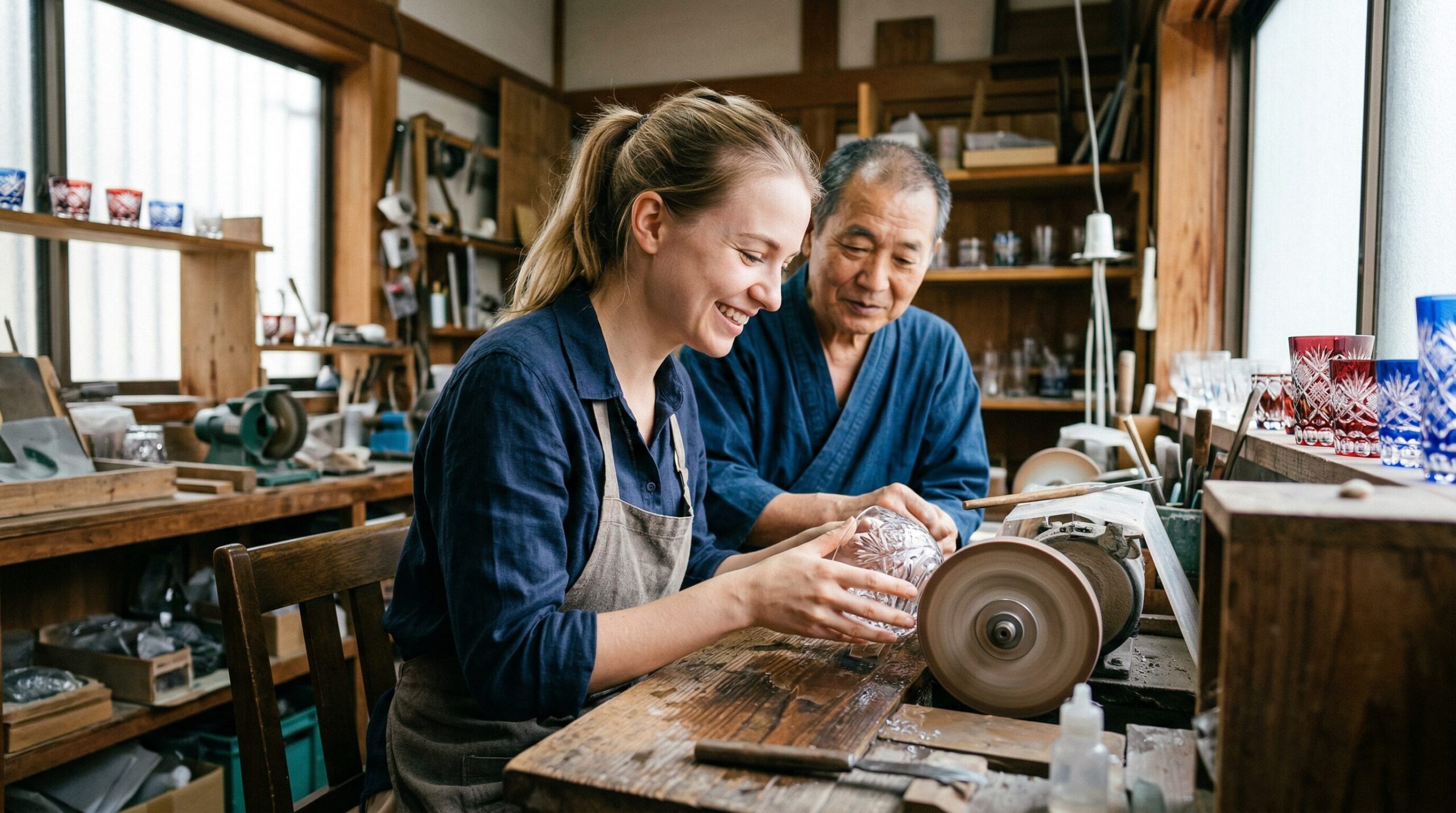
Edo Kiriko is a traditional glass-carving technique that originated in Tokyo in the 1830s. It involves cutting intricate, geometric patterns into the surface of double-layered, colored glass (usually deep blue or vibrant red). The result is a stunning vessel that refracts light brilliantly, traditionally used for drinking cold sake.
Highlights of an Edo Kiriko Workshop:
- The Weight of the Wheel: In a typical workshop, you are given a blank, colored glass tumbler and a marker to draft your pattern. You then sit at a diamond-grinding wheel. Pressing the fragile glass against the spinning wheel requires a delicate balance of firm pressure and extreme caution.
- Traditional Patterns: You will learn about the historical significance of the cuts. Common patterns include nanako (fish scales, symbolizing abundance) and kagome (basket weave, believed to ward off evil). Carving these precise lines is a masterclass in hand-eye coordination.
- The Reveal: The most satisfying moment of the workshop is wiping away the glass dust and holding the tumbler up to the light. The contrast between the deeply colored exterior and the brilliant, clear crystal exposed by your cuts is breathtaking.
The Deep Blue – Aizome (Indigo Dyeing) in Asakusa
Before synthetic dyes dominated the textile industry, Japan was known globally for its mastery of “Japan Blue”—a rich, deep, and highly durable indigo dye known as Aizome. Traditional workshops still operate in the historic neighborhoods near the Sumida River, using natural indigo leaves fermented in massive, in-ground vats.
Highlights of an Aizome Workshop:
- The Fermentation Aroma: When you enter an authentic Aizome studio, the first thing you notice is the smell. The natural indigo fermentation process produces an earthy, almost sweet aroma that is unmistakable and deeply historic.
- Shibori Techniques: You will learn shibori—the traditional Japanese tie-dye technique. By folding, twisting, and binding a plain white cotton cloth (like a tenugui hand towel or a tote bag) with wooden blocks and rubber bands, you create areas where the dye cannot penetrate, resulting in intricate, striking white patterns against the blue background.
- The Magic of Oxidation: The actual dyeing process feels like alchemy. When you pull your fabric out of the vat, it is a pale, sickly green color. However, as the natural indigo reacts with the oxygen in the air, the fabric dramatically shifts before your eyes, transforming into that iconic, brilliant “Japan Blue.”
The Sound of Summer – Edo Furin (Wind Chimes) in Edogawa
If you visit Tokyo in the humid, oppressive heat of summer, you will hear the delicate, high-pitched ringing of furin (wind chimes) hanging from the eaves of traditional homes. Edo Furin are unique glass wind chimes that have been crafted in Tokyo since the Edo period.
Highlights of an Edo Furin Workshop:
- Glass Blowing: Unlike factory-made chimes, true Edo Furin are blown freehand without a mold. In a workshop, you will stand near the blazing 1,300-degree furnace and use a long glass tube to blow a small, perfectly round glass bubble.
- The Jagged Edge: A defining characteristic of an authentic Edo Furin is its jagged, unpolished bottom edge. This rough edge creates friction against the internal clapper, producing a distinctly gentle, soothing sound that machine-polished glass cannot replicate.
- Inside-Out Painting: After the glass cools, you move to the painting station. Because the exterior of the chime needs to remain smooth and shiny, you must paint your design (like fireworks, goldfish, or morning glories) on the inside of the glass sphere. This requires painting in reverse, challenging your perspective and artistic skills.
Mindful Participation: Tips for Travelers
Booking one of the many local artisan workshops in Tokyo is only the first step. To ensure your experience is respectful, seamless, and deeply enriching, you must approach the studio with the right mindset and preparation. Keep these practical tips in mind:
- Advance Reservations are Non-Negotiable: These are not massive tourist attractions with a continuous flow of ticket sales. They are working studios run by a handful of artisans. Class sizes are often capped at four to six people per day. You must secure your booking weeks, if not months, in advance, particularly for popular English-speaking Kintsugi or Edo Kiriko classes.
- Navigate the Language Barrier: While an increasing number of workshops cater to international visitors with English-speaking staff or translated instruction sheets, many of the most authentic, neighborhood studios operate solely in Japanese. Do not let this deter you. As mentioned earlier, Japanese crafts are largely visual and tactile. Watch the master closely, smile, and rely on body language. A simple “Arigatou gozaimasu” (Thank you very much) goes a long way.
- Dress for the Mess: While almost all workshops will provide you with a heavy canvas apron, accidents happen. You will be dealing with flying glass dust, permanent indigo dye, and sticky resins. Do not wear your best clothes or expensive shoes to an artisan studio. Dress comfortably, roll up your sleeves, and tie back long hair.
- Punctuality is a Sign of Respect: In Japanese culture, arriving exactly on time is considered late. Aim to arrive at the studio at least ten to fifteen minutes before your scheduled workshop begins. This allows you time to take off your shoes, stow your bags, put on your apron, and settle your mind before the master begins the instruction. Rushing in sweating and breathless disrupts the quiet, focused atmosphere of the studio.
- Handle Tools with Reverence: The tools in an artisan’s workshop—whether they are delicate bamboo brushes, heavy iron scissors, or diamond grinding wheels—are incredibly expensive and often custom-made. Treat every tool handed to you with the utmost respect. Never toss them onto the table, and always return them exactly as you found them.
Conclusion
Japan’s true beauty rarely exists in the things you can simply point at and buy. It does not live inside the plastic wrapping of a duty-free shop at Narita Airport, nor is it found on the crowded, neon-lit floors of a massive electronics retailer. The profound, enduring soul of Japan is found in the physical act of creation. It is found in the dirt beneath a potter’s fingernails, the heat of a glass-blowing furnace, and the quiet, rhythmic focus required to paint a golden line across a broken bowl. By seeking out local artisan workshops in Tokyo, you actively reject the superficial layers of modern tourism. You choose to travel deeper, trading your time and focus for a genuine connection to the country’s heritage. The object you carry home—be it a jagged glass wind chime, a deeply dyed indigo cloth, or a brilliantly cut tumbler—will not be perfect. It will carry the slight wobble of your hand and the hesitation of a beginner. But it is within those very imperfections that your memory lives. It is time to go beyond the ordinary, sit at the workbench, and discover the deep, resonant pride of crafting the real Japan with your own two hands.