The sliding doors of the local train open with a soft hiss, revealing an unmanned station deep in the mountains of Shikoku. The air is sharp with the scent of cedar, and the only sound is the rush of a nearby river. There are no English signs. The ticket machine accepts only coins, and the timetable is a weathered piece of paper pinned to a wooden bulletin board.
For the intrepid traveler, this is exactly the kind of deep, immersive experience they crossed oceans to find. It is the Japan that exists far beyond the neon-soaked intersections of Shibuya or the crowded temple paths of Kyoto.
Yet, arriving in these quiet, profoundly beautiful corners of the country presents a unique set of modern challenges. Japan is a country of beautiful contradictions. It is a society that engineers the world’s most advanced bullet trains, yet still relies heavily on cash, fax machines, and handwritten ledgers in its rural heartlands.
To bridge this gap—to comfortably navigate the space between the high-tech infrastructure and the deeply analog traditional culture—you need the right tools. This is not about remaining glued to a screen. It is about utilizing the best apps for traveling in Japan: unlock authentic experiences that would otherwise be obscured by a language barrier or complex logistics.
The right digital toolkit acts as a silent interpreter, a local guide, and a logistical master. It removes the friction of daily travel, allowing you to lift your eyes from your guidebook and fully engage with the subtle, enduring magic of the real Japan.
Key Details and Breakdown: The Digital Bridge to the Analog World
To understand why specific applications are necessary, one must first observe how travel in Japan actually functions. The challenges you face here are rarely about safety or unreliability; they are about profound complexity and linguistic isolation.
The Linguistic Reality Outside of major hotels and primary tourist hubs, English is not widely spoken. This is not a reluctance to help; it is simply the reality of a largely homogenous island nation. The most authentic experiences—the multi-generational udon shops, the local ceramic studios, the hidden Shinto shrines—operate entirely in Japanese. To access them, you need digital translation that grasps the nuanced context of the language.
The Logistical Labyrinth Japan’s public transportation is famously punctual, but it is also a dizzying web of competing private railway companies, municipal subways, and rural bus routes. A single journey from Tokyo to a hidden hot spring (onsen) in Nagano might require three different train systems and a final, infrequent local bus. Navigating this without real-time, algorithmic assistance is an exercise in unnecessary frustration.
The Philosophy of Mindful Technology When compiling the best apps for traveling in Japan: unlock authentic experiences, the goal is digital minimalism. The objective is to use the app to solve an immediate problem—translating a menu, finding the correct train platform, locating a luggage locker—and then immediately return the phone to your pocket. Technology should be the quiet facilitator of your journey, not the focus of it.
Practical Examples and Recommendations: The Essential Toolkit
To truly move off the beaten path and engage with local culture, your smartphone needs to be equipped with specific, highly functional tools. Here is a curated breakdown of the essential applications.
Breaking the Language Barrier: DeepL and Google Translate
Communication is the cornerstone of authentic travel. While Google Translate is famous, for Japan, you need a nuanced approach.
- DeepL (The Conversationalist): When it comes to translating Japanese to English (and vice versa), DeepL is widely considered vastly superior in capturing natural syntax and nuance.
- The Authentic Angle: Imagine sitting at a small, six-seat izakaya in Takayama. The elderly chef wants to explain that tonight’s special is wild boar hunted in the nearby mountains. Using DeepL allows for a much more natural, respectful conversation than the robotic, often grammatically incorrect output of other translators. It turns a transactional encounter into a genuine human connection.
- Google Translate (The Visual Decoder): Keep this app strictly for its camera function.
- The Authentic Angle: Rural ryokans and local restaurants often feature handwritten menus brushed on Japanese paper (washi). Google Translate’s real-time camera translation is an absolute necessity for deciphering these beautiful but illegible documents, allowing you to order regional delicacies rather than pointing blindly at pictures.
Mastering the Labyrinth: Navitime and Japan Official Travel App
Google Maps is excellent for walking directions, but for the complex web of Japanese transit, local apps provide crucial, granular data.
- Japan Travel by Navitime: This is the undisputed champion of Japanese transit routing.
- The Authentic Angle: Navitime allows you to filter your routes based on which specific Japan Rail (JR) pass you hold. More importantly, it provides the platform number for your departure. When you have three minutes to transfer at a massive station like Shinjuku, knowing you need to go directly to Platform 12 is the difference between catching your limited express train to the countryside and being stranded.
- Japan Official Travel App (by JNTO): Backed by the government, this app is incredibly reliable for rural bus schedules and sudden service disruptions due to weather (like typhoons or heavy snow).
Dining Like a Local: Tabelog
Yelp and Google Reviews are heavily skewed by foreign tourists in Japan. If you want to eat where the locals eat, you must use local metrics.
- Tabelog: This is Japan’s premier restaurant review site and app. It is notorious for its incredibly harsh grading curve.
- The Authentic Angle: On Western apps, a 3.5-star restaurant is considered mediocre. On Tabelog, a 3.5-star rating is a mark of absolute culinary excellence. Restaurants with a 4.0 or higher are often Michelin-level. By using Tabelog, you bypass the flashy, English-menu tourist traps on the main streets and discover the quiet, smoke-filled yakitori joints tucked into narrow alleyways that the local neighborhood fiercely protects.
Frictionless Movement: Digital IC Cards and Ecbo Cloak
The physical act of moving through Japan should be as smooth as possible. Eliminating paper tickets and heavy bags frees you to explore deeply.
- Mobile Suica / Pasmo (Apple Wallet): If you use an iPhone (iPhone 8 or later), you can easily load a digital Suica or Pasmo card directly into your Apple Wallet instead of buying a physical card. (Note: Most Android smartphones purchased outside of Japan lack the necessary hardware to support digital Japanese transit cards. Android users should plan to purchase a physical Welcome Suica or standard IC card upon arrival.)
- The Authentic Angle: You simply tap your phone against the ticket gate reader as you walk through. It works seamlessly across major cities, national transit networks, and many convenience stores. However, remember to carry cash (especially coins) when venturing into deeply rural areas, as many local trains and regional buses still do not accept IC cards.
- Ecbo Cloak: Japan is a country best explored on foot, but dragging luggage over cobblestones destroys the experience.
- The Authentic Angle: Train station coin lockers fill up incredibly fast. Ecbo Cloak allows you to find and reserve luggage storage space in local businesses—cafes, post offices, and kimono rental shops. It allows you to step off the train in a historic town like Kurashiki, drop your bags at a nearby cafe, and wander the canal district unburdened.
Tips for Travelers: Navigating the Digital Landscape
Equipping yourself with the best apps for traveling in Japan: unlock authentic experiences is only half the preparation. You must also ensure your device can reliably connect to the network without breaking local etiquette.
- Secure Uninterrupted Connectivity: Do not rely on public Wi-Fi in Japan. It is often slow, requires complex registrations, and is virtually non-existent in rural areas. Before you arrive, purchase an eSIM (like Ubigi or Airalo) or rent a physical Pocket Wi-Fi router. Consistent internet access is non-negotiable for using transit and translation apps on the fly.
- Carry a Power Bank: Navigating with GPS, scanning menus, and taking photos will drain your battery rapidly. Carrying a high-capacity power bank is essential. Finding a public outlet to charge your phone in a Japanese cafe is often not permitted unless explicitly stated.
- Observe “Manner Mode”: Japanese society highly values public harmony. It is considered extremely rude to have your phone ring or make notification sounds on public transportation. Always keep your phone on silent (referred to locally as manner mode) and never take phone calls on local trains or buses.
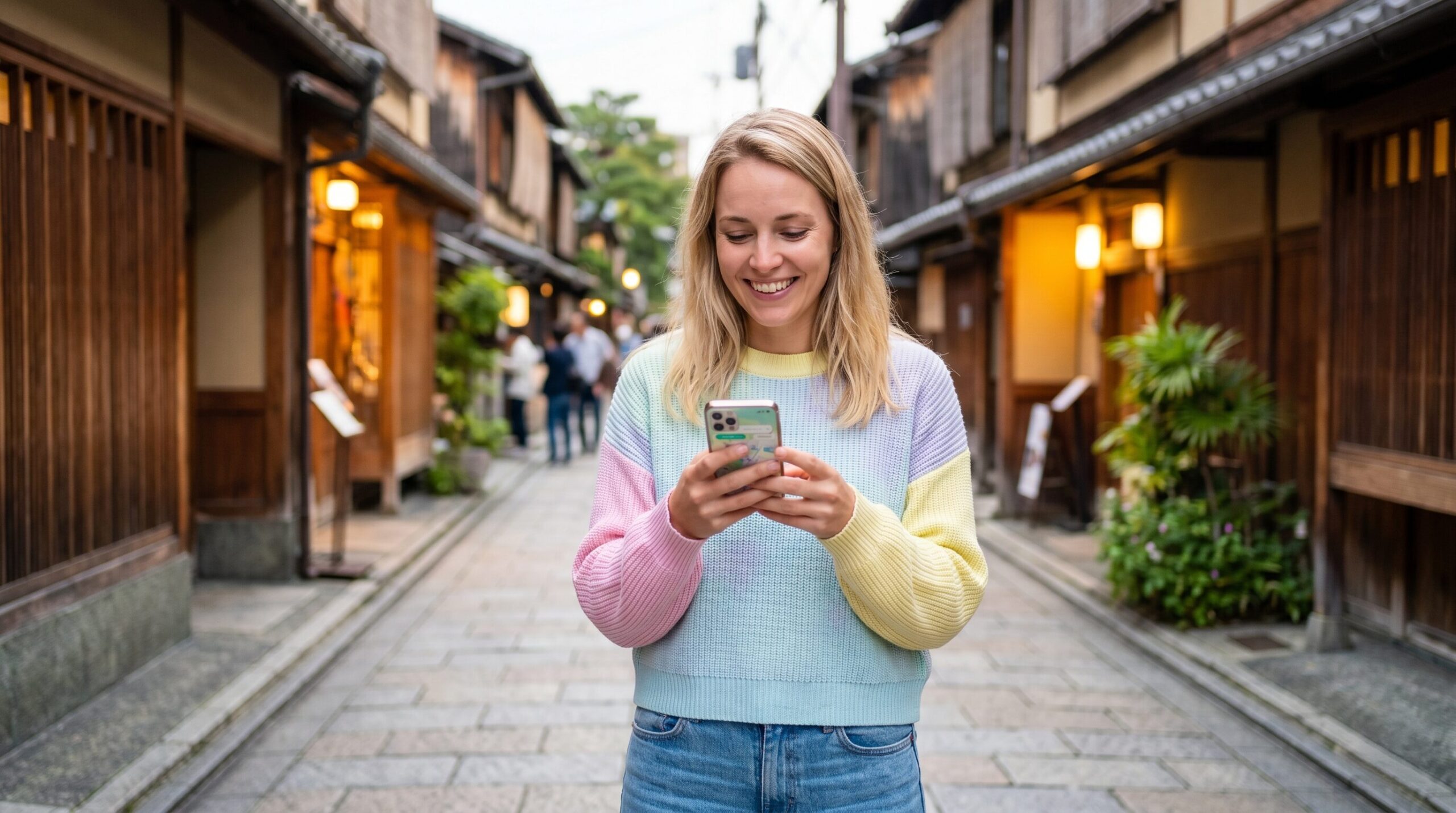
- Step Aside to Scroll: If you are walking down a street in Kyoto and need to check your map, do not stop abruptly in the middle of the sidewalk. Step to the side, place your back against a wall, and look at your screen. This simple act of situational awareness goes a long way in showing respect for the local flow of foot traffic.
- Know When to Put It Away: The most important tip regarding technology in Japan is knowing when to ignore it. Once Navitime has brought you to the entrance of the temple, and DeepL has helped you understand the history on the wooden plaque, put the phone away. The scent of the incense, the sound of the gravel under your shoes, and the shifting light in the garden cannot be digitized.
Conclusion
Traveling deeply requires a delicate balance. It asks you to be vulnerable, to step out of your comfort zone, and to embrace the unknown. Yet, true immersion does not mean you must struggle unnecessarily.
By curating your smartphone with the best apps for traveling in Japan: unlock authentic experiences, you are not building a wall between yourself and the culture. You are forging a key. You are empowering yourself to confidently board a rural, one-car train. You are giving yourself the voice to thank an artisan for their centuries-old craft. You are stripping away the logistical anxieties that tie most tourists to the familiar, crowded paths.
Japan is a masterpiece of hidden details, waiting patiently in the quiet valleys and lantern-lit backstreets. Equip yourself wisely, step off the main avenues, and allow technology to guide you toward the profound, enduring beauty of the Japan locals know best.