If you walk down the sloping, stone-paved streets of Higashiyama on a busy spring afternoon, you will see a sea of green.
You will see tourists holding towering soft-serve ice cream cones, bright green lattes topped with whipped cream, and artificially colored parfaits.
The matcha craze has swept the globe, and Kyoto, as the undisputed capital of Japanese tea culture, has happily obliged the demand.
But there is a sharp divide between commercialized matcha and the authentic, centuries-old tradition.
The bright, sugary drinks sold on the main tourist thoroughfares are a modern invention.
They are designed for quick consumption and rapid sightseeing.
However, true matcha—the kind that was slowly milled by stone and whisked by Zen monks for centuries—was never meant to be consumed in a rush. It is a beverage that demands stillness.
It requires an environment that matches the profound, earthy complexity of the tea itself.
To find this experience, you have to look past the main avenues. You have to seek out the secret matcha cafés in Kyoto.
These hidden sanctuaries are not advertised on massive billboards.
They do not have long lines snaking out the door.
They are tucked away in the residential backstreets of Nishijin, hidden within the sprawling complexes of Zen sub-temples, or concealed behind the unmarked sliding wooden doors of historic machiya townhouses.
Searching for secret matcha cafés in Kyoto is a deliberate act of slowing down.
It is an invitation to leave the noise behind, travel deeper, and taste the profound, quiet history of the real Japan.
Let us explore the philosophy, the architecture, and the etiquette of the ancient capital’s most treasured hidden spaces.
Key Details and Breakdown: The Anatomy of Authentic Matcha
To truly appreciate the secret matcha cafés in Kyoto, you must first understand what makes the tea itself so remarkable. Authentic matcha is not merely an ingredient; it is the culmination of meticulous agricultural and artistic processes.
The Origin: The Shaded Valleys of Uji
Almost all of the high-grade matcha served in Kyoto’s finest hidden cafés originates just a few miles south of the city, in the misty, rolling hills of Uji.
- The Process: Several weeks before the spring harvest, the tea bushes (Camellia sinensis) are entirely shaded from direct sunlight using bamboo mats or dark tarps.
- The Science: This forced shade causes the plant to overproduce chlorophyll and L-theanine, an amino acid responsible for the tea’s brilliant, vibrant green color and its deeply savory, umami flavor profile.
- The Result: The leaves are hand-picked, steamed to halt fermentation, dried, stripped of their stems and veins, and then painstakingly ground into a microscopic powder using heavy granite stone mills. A single mill takes an hour to produce just 30 grams of ceremonial-grade matcha.
The Philosophy: Wabi-Sabi in a Teacup
The spaces that serve this tea are designed around the aesthetic philosophy of wabi-sabi—the appreciation of beauty that is imperfect, impermanent, and incomplete.
- The Environment: The secret matcha cafés in Kyoto intentionally avoid flashy decor. The walls are often made of textured earth and clay. The wooden beams are aged and darkened by decades of soot.
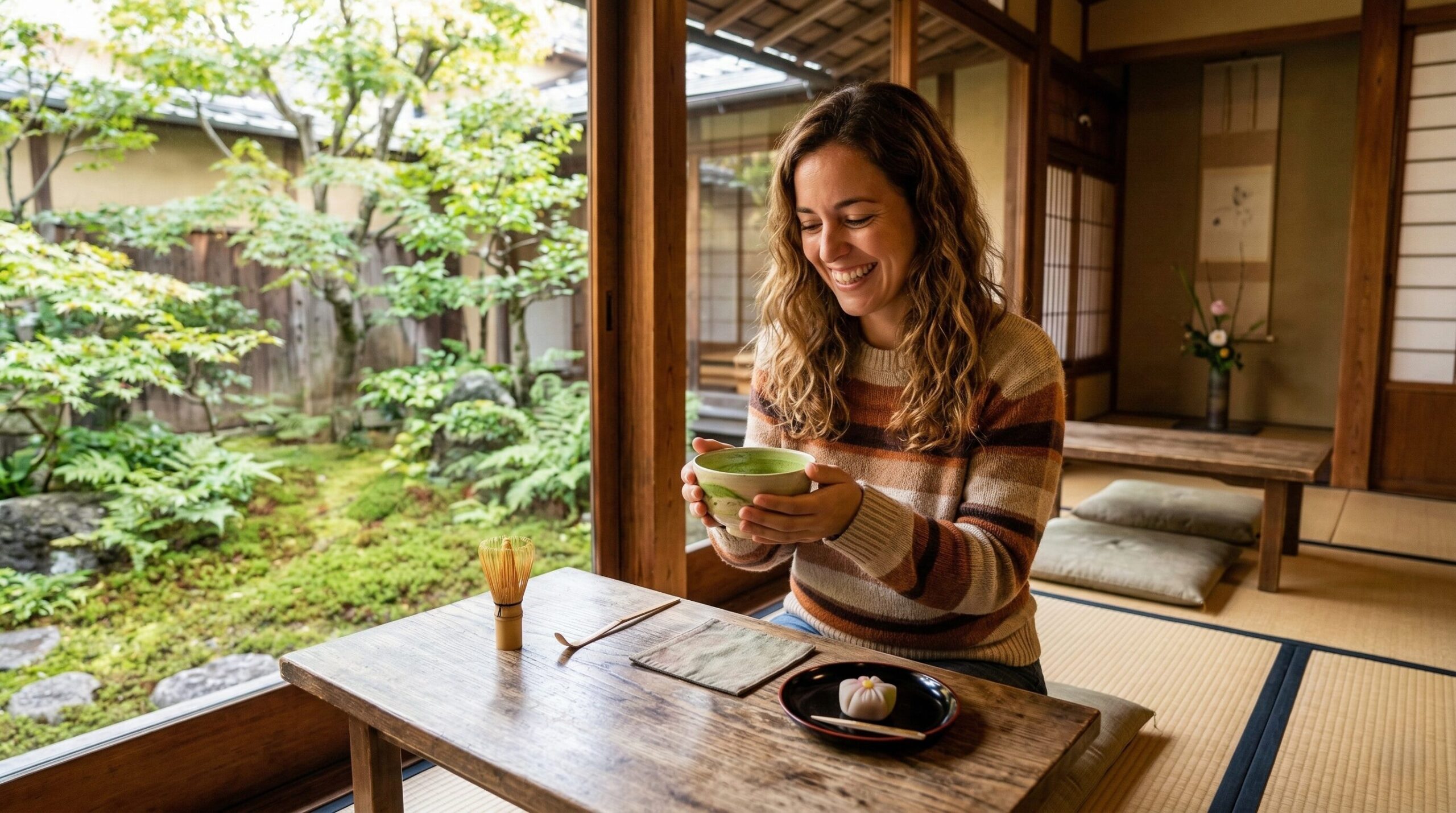
- The Vessel: The tea is never served in a flawless, mass-produced mug. It is presented in a chawan (tea bowl). These ceramic bowls are often handmade, featuring irregular shapes, uneven glazes, and sometimes even a visible, repaired crack filled with gold (kintsugi). The imperfection of the bowl forces you to pay attention to the present moment.
The Pairing: The Necessity of Wagashi
You cannot fully understand matcha without its counterpart: wagashi (traditional Japanese sweets).
- The Balance: Ceremonial-grade matcha is intensely rich, naturally sweet, and deeply vegetal. To balance this, it is almost always served alongside a small, seasonal sweet.
- The Artistry: Wagashi are edible poetry. In autumn, your sweet might be shaped like a maple leaf and flavored with roasted chestnut. In spring, it might be a delicate pink mochi filled with sweet white bean paste, resembling a cherry blossom petal. The visual and culinary harmony between the bitter tea and the seasonal sweet is the cornerstone of the authentic café experience.
Practical Examples and Recommendations: Finding the Sanctuaries
The best secret matcha cafés in Kyoto are the ones you stumble upon by accident, but a little geographical guidance is necessary. Here are the types of hidden establishments that offer the most profound, uncrowded tea experiences.
The Sub-Temple Retreat: Daitoku-ji and Myoshin-ji
Kyoto is home to massive Zen temple complexes that operate almost like walled cities. Within these walls are dozens of smaller “sub-temples,” many of which are completely ignored by the guidebooks.
- The Atmosphere: These sub-temples often feature spectacular, centuries-old dry landscape gardens (karesansui) or lush moss gardens.
- The Experience: Some of these temples open their doors to the public and offer matcha on the veranda (engawa). You pay a small entrance fee, which includes a bowl of tea. You sit formally (seiza) on the wooden floor, sip your tea, and gaze out over a raked gravel garden in absolute silence. You are sharing the exact view and the exact beverage that Zen monks have enjoyed for over five hundred years. It is the ultimate antidote to the crowded city streets.
The Repurposed Machiya: The Nishijin District
The Nishijin neighborhood, historically the center of Kyoto’s textile weaving industry, is a labyrinth of narrow alleys and beautifully preserved wooden townhouses (machiya).
- The Atmosphere: As the textile industry shrank, many of these historic homes were left empty. Today, a new generation of artisans has transformed them into deeply atmospheric, secret matcha cafés in Kyoto.
- The Experience: You look for a small, unadorned white linen curtain (noren) hanging over a dark wooden door. Inside, you pass through a dimly lit corridor into a pristine tatami room. The sliding shoji screens are pulled back to reveal a tiny, immaculate courtyard garden (tsuboniwa) designed to catch the afternoon light. The tea here is often sourced directly from independent farmers in Uji, offering flavor profiles you cannot find in the large department stores.
The Riverside Hideaway: North of the Kamo Delta
While the southern banks of the Kamo River (near Gion and Pontocho) are packed with tourists taking photos, the far northern stretches of the river offer a completely different pace of life.
- The Atmosphere: Rent a bicycle and ride north toward the Kamigamo Shrine. The city falls away, replaced by open skies, wide grassy riverbanks, and local families flying kites.
- The Experience: Tucked into the residential neighborhoods bordering the river, you can find small, modern, independent tea houses. They blend traditional tea preparation with minimalist, contemporary Japanese architecture. Sitting at a smooth cypress counter, watching a master whisk your tea with precise, rhythmic motions, while the northern mountains loom in the distance, is an incredibly grounding experience.
Tips for Travelers: The Etiquette of the Tea
When you step off the busy street and enter one of the secret matcha cafés in Kyoto, you are entering a space that demands a certain level of respect. The etiquette is not meant to be intimidating; it is designed to enhance your focus and your appreciation of the craft.
The Sweet Comes First
This is the most common mistake travelers make when served traditional tea and wagashi.
- The Rule: Do not alternate between eating the sweet and drinking the tea. You must eat the entire sweet first.
- The Reason: The sugar from the wagashi coats your palate. When you subsequently take a sip of the warm, bitter matcha, the contrast creates a brilliant, balanced explosion of flavor. Cut the sweet into small, manageable pieces using the provided wooden pick (kuromoji), finish it, and then lift your tea bowl.
Handling the Chawan (Tea Bowl)
There is a specific, respectful way to handle the handmade ceramic bowl your tea is served in.
- The Practice: When the bowl is placed in front of you, the “front” of the bowl (usually featuring the most beautiful part of the glaze or design) will be facing you. Pick the bowl up with your right hand and rest it in the palm of your left hand.
- The Turn: Before you drink, use your right hand to turn the bowl clockwise by about 90 degrees. You do this to avoid drinking from the “face” of the bowl, which is considered a sign of humility and respect to the potter and the host.
The Volume of the Space
Secret matcha cafés in Kyoto are acoustic environments. They are built from wood, earth, and paper.
- The Rule: Keep your voice to a hushed whisper. The soundtrack of these cafés should be the sound of water boiling in an iron kettle (kama), the vigorous whisking of the bamboo chasen, and the wind moving through the courtyard garden. Loud conversations instantly shatter the carefully cultivated wabi-sabi atmosphere.
Photography with Restraint
While it is natural to want to capture the profound beauty of your tea and the garden, you must do so with extreme discretion.
- The Practice: Never stand up and walk around the room to find the perfect angle. Never use a flash. Most importantly, turn off your phone’s artificial shutter sound if possible. Snap one or two quick photos from your seated position, put the phone away, and allow yourself to actually experience the moment rather than just documenting it.
Embracing the Bitterness
Do not ask for milk or sugar.
- The Mindset: Authentic, high-grade matcha is not a dessert; it is an experience of umami and complex vegetal notes. It might taste shockingly rich with umami on your first sip. Let it sit on your palate. Notice the long, sweet finish that lingers in the back of your throat. Trust the centuries of cultivation that went into that single bowl.
Conclusion: The Quiet Luxury of Time
In a modern world that prioritizes speed, convenience, and instant gratification, the traditional Japanese tea experience feels like a radical act of rebellion. It demands your time. It demands your attention.
The secret matcha cafés in Kyoto are not just places to grab a caffeine boost. They are architectural and culinary sanctuaries. They are surviving fragments of an ancient philosophy that teaches us to find immense, profound beauty in simplicity, in shadow, and in the bitter, earthy taste of ground leaves. When you slide that wooden door shut behind you, leaving the noise of the modern city outside, and wrap your hands around a warm, imperfect ceramic bowl, you finally connect with the true pulse of the ancient capital. It’s time to go beyond the ordinary, escape the curated tourist corridors, and let the quiet, enduring traditions of the city steep. Travel deeper. Explore the real Japan.