When travelers visualize the culinary landscape of Kyoto, the mind immediately drifts to the vibrant green of powdered matcha, the delicate precision of a kaiseki dinner, or the steaming bowls of thick, rich ramen.
But beneath the cobblestone streets and the ancient temple grounds flows a different kind of lifeblood.
It is the invisible element that has shaped the city’s fortunes for over a millennium: water.
Kyoto rests on a massive, natural underground basin.
This aquifer holds water of astonishing purity and softness.
And where there is pristine water and high-quality rice, there is sake.
Most visitors who venture into the world of Japanese rice wine head straight to the Fushimi district.
They walk the willow-lined canals, take photos of the iconic wooden transport boats, and visit the massive, museum-like facilities of global brewing giants.
These experiences are educational, but they are undeniably commercial. The tour buses idle outside, and the tasting rooms are built for volume.
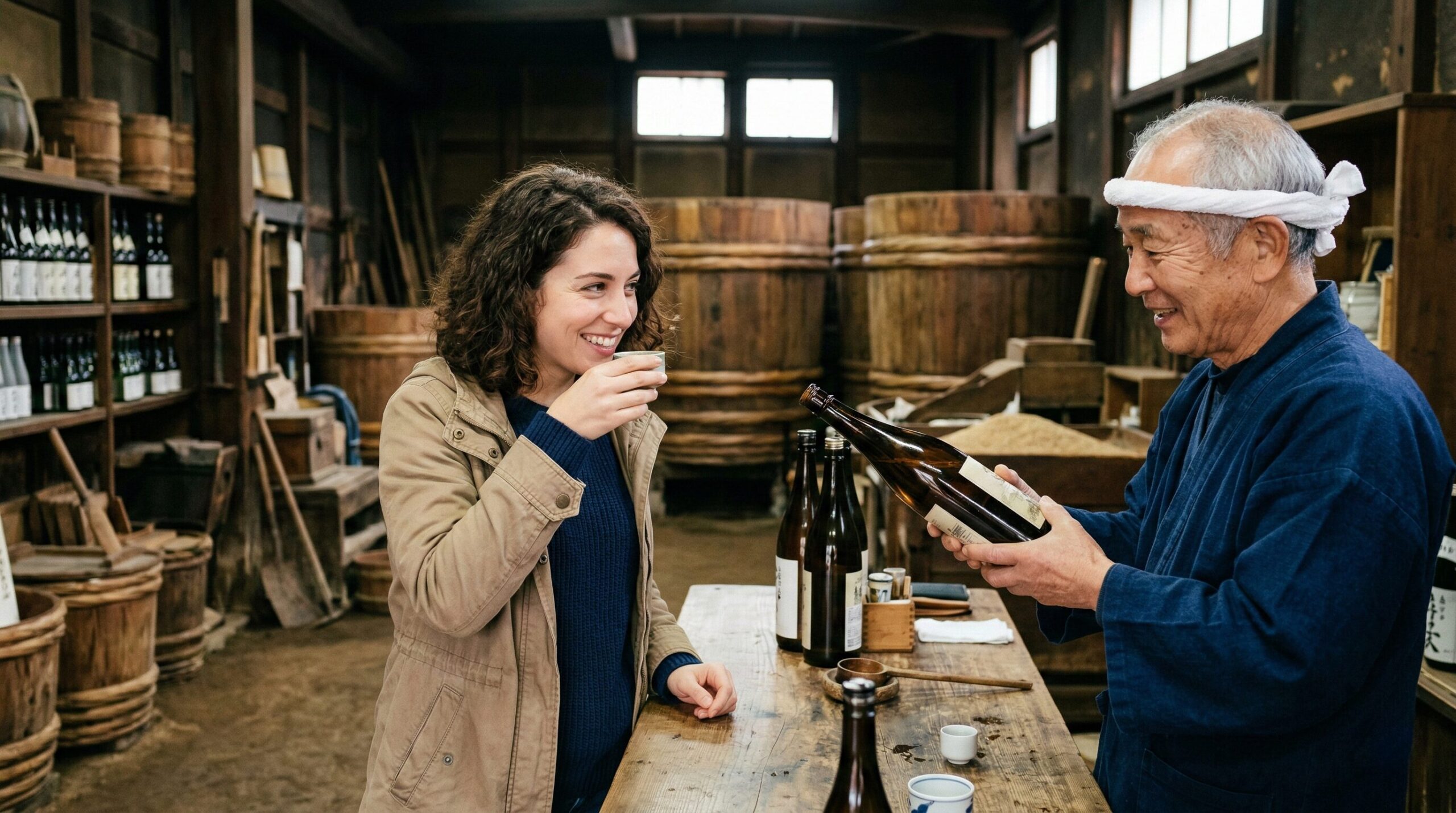
But if you are willing to leave the main avenues and navigate the quieter residential grids, a different world awaits. You will find the hidden sake breweries in Kyoto. These are small, family-run operations. They do not export their bottles globally.
They do not have multi-lingual audio guides. Instead, they offer an intimate look at a grueling, beautiful, centuries-old craft.
Exploring the hidden sake breweries in Kyoto is about witnessing alchemy.
It is about smelling the sweet, melon-like fermentation of yeast in the crisp winter air.
It is about understanding the dedication of the toji (master brewer) who sleeps next to the fermentation tanks.
Let us step away from the crowded tasting counters and dive into the quiet, intoxicating heart of Kyoto’s authentic brewing culture.
Key Details and Breakdown: The Anatomy of Kyoto Sake
To truly appreciate the hidden sake breweries in Kyoto, you must first understand what makes the local product so distinct. Sake is brewed across the entire Japanese archipelago, from the freezing coasts of Hokkaido to the humid valleys of Kyushu. However, Kyoto sake possesses a highly specific, geographically determined character.
The Magic of Fushimizu (Hidden Water)
The most critical ingredient in sake is water, making up roughly 80% of the final product.
- The Fushimi Aquifer: The water drawn from the deep wells in southern Kyoto is historically known as Fushimizu, meaning “hidden water.” One of its most famous springs is Gokosui (“fragrant spring water”) at Gokonomiya Shrine.
- Soft vs. Hard: Unlike the mineral-heavy, hard water found in the famous Nada brewing district of neighboring Kobe, Kyoto’s water is incredibly soft (nansui). It is low in iron and manganese.
- The Result: This soft water drastically slows down the fermentation process. The resulting sake is famously smooth, elegant, and subtly sweet. Historically, experts have contrasted the sharp, dry “masculine sake” (otoko-zake) of Kobe with the gentle, rounded “feminine sake” (onna-zake) of Kyoto.
The Rhythm of Kanzukuri (Cold Brewing)
True artisanal sake is not made year-round. It is a seasonal pursuit tied intimately to the rhythm of the Japanese winter.
- The Season: The traditional brewing method is called kanzukuri (cold weather brewing). It begins in late autumn, after the rice harvest, and finishes in early spring.
- The Reason: The freezing temperatures naturally suppress unwanted airborne bacteria, allowing the delicate sake yeast (kobo) to ferment slowly and cleanly. When you walk past the hidden sake breweries in Kyoto in January or February, the air in the alleys smells intensely sweet and fruity—the unmistakable scent of active fermentation.
The Role of the Toji
The technology of brewing has advanced, but in the hidden, small-scale breweries, the human element remains paramount.
- The Master: The toji is the master brewer. Historically, these were farmers who migrated to the breweries during the snowy off-season.
- The Dedication: During the peak brewing months, the toji and their team (kurabito) rarely sleep for more than a few hours at a time. They must constantly monitor the temperature of the koji (the mold-inoculated rice that drives fermentation) by hand and by smell. It is a labor of absolute, uncompromising dedication.
Practical Examples and Recommendations: The Secret Cellars
While Fushimi is the undisputed capital of Kyoto sake, there are magnificent, isolated breweries surviving in other parts of the city. Finding them requires intentional travel. Here are prime examples of the hidden sake breweries in Kyoto that offer an unforgettable, authentic experience.
Sasaki Shuzo: The Last Survivor of Rakuchu
Hundreds of years ago, the central district of Kyoto (known historically as Rakuchu) was packed with over 300 active sake breweries. As the city modernized, the breweries were paved over or pushed to the outskirts. Today, only one remains.
- The Location: Sasaki Shuzo is tucked away in a quiet residential neighborhood in the Kamigyo Ward, not far from the imposing stone walls of Nijo Castle.
- The Vibe: It is fiercely independent and deeply historical. The brewery sits on the exact site where the famous warlord Toyotomi Hideyoshi built a legendary mansion known as the Jurakudai.
- The Experience: Sasaki Shuzo draws its water from the same underground vein that Hideyoshi used for his tea ceremonies. Their signature sake, named Jurakudai, is an elegant, highly fragrant brew. Visiting their modest, street-level shop feels like stepping into a living museum. You are tasting the literal history of central Kyoto.
Fujioka Shuzo: The Micro-Brewery Revival
If you return to the Fushimi district, skip the massive, block-long factories and look for a much smaller, unassuming wooden facade. Fujioka Shuzo represents the resilience of the artisanal spirit.
- The History: This family brewery tragically closed its doors in 1997 following the sudden death of its previous master the year prior.
- The Vibe: Because they produce an incredibly small volume of sake, they focus intensely on quality over quantity. Their signature brand, Sookuu, is renowned for its clean, modern profile.
- The Experience: What makes Fujioka Shuzo one of the best hidden sake breweries in Kyoto is its tasting room, En. It is a beautiful, minimalist wooden bar. The best part? The back wall is a massive pane of glass looking directly into the brewing room. You can sit, sip a glass of unpasteurized namazake, and watch the brewers working silently just a few feet away.
Matsui Shuzo: The Riverbank Alchemists
Located far to the northeast, near the banks of the Kamo River in the Sakyo Ward, Matsui Shuzo is an architectural and culinary gem.
- The Location: Nestled in an area known for quiet temples and university students, this brewery operates out of a beautifully renovated, modern-meets-traditional facility.
- The Vibe: They masterfully blend ancient techniques with modern precision. Despite their sleek tasting room, their brewing process remains incredibly labor-intensive.
- The Experience: They are famous for using Iwai rice, a notoriously difficult-to-grow strain that is entirely native to Kyoto Prefecture. Tasting a sake made from Kyoto water, Kyoto rice, and Kyoto yeast, while standing in a quiet corner of the Sakyo ward, is the ultimate expression of terroir—the taste of the place.
Tips for Travelers: The Etiquette of the Pour
Visiting the hidden sake breweries in Kyoto is not like visiting a loud, rowdy pub. These are places of craftsmanship. Navigating them requires a specific set of manners and a bit of practical knowledge.
Read the Sugidama (The Cedar Ball)
You do not need to read Japanese to know what is happening inside a brewery; you just need to look up.
- The Symbol: Outside almost every traditional brewery hangs a sugidama—a large sphere made of tightly bound cedar branches.
- The Meaning: In November or December, a fresh, vibrant green sugidama is hung. This signals to the neighborhood that the first batch of the new sake (shinshu) has been pressed and is ready to drink. As the months pass, the cedar needles turn dry and brown. When the ball is completely brown, it signals that the sake has aged properly and is ready to drink. It is a beautiful, natural clock.
The Golden Rule: No Perfume
This is perhaps the most critical rule of visiting a sake brewery or a high-end tasting room.
- The Reason: Sake is judged heavily on its delicate aroma (ginjoka), which can smell like green apple, white peach, or steamed rice.
- The Rule: If you wear strong perfume, cologne, or highly scented hair products, you will destroy the olfactory experience not only for yourself but for everyone else in the tasting room. Go completely scent-free on the day you plan to visit.
Namazake and the Cold Chain
If you buy a bottle directly from a small brewery, you will likely encounter namazake (unpasteurized sake).
- The Flavor: Most commercial sake is pasteurized twice to make it shelf-stable. Namazake skips this process. It is wild, vibrant, and incredibly fresh, often with a slight, natural effervescence.
- The Logistics: Because the yeast is still technically alive, namazake must be kept strictly refrigerated. Do not buy a bottle of namazake if you plan to carry it in your backpack all day in the spring sun, or if your hotel room does not have a mini-fridge. It will spoil.
Tasting, Not Shooting
Sake has unfortunately earned a reputation in some Western countries as a cheap shot to be thrown back with a beer. This is a tragic misunderstanding of the beverage.
- The Practice: Premium sake (like Ginjo or Daiginjo) is brewed to the same standard as a fine wine. It should be sipped slowly from a small ceramic cup (ochoko) or a glass. Swirl it gently, inhale the aroma, and let it wash over your palate.
Cash and Communication
The hidden sake breweries in Kyoto are not built for mass tourism.
- The Reality: The staff behind the counter are often the brewers themselves, or their family members. They may not speak fluent English.
- The Strategy: Bring cash, as small operations may not accept foreign credit cards. Learn a few key phrases: “Karakuchi” means dry, and “Amakuchi” means sweet. Point to a bottle, say “Kore o shiin deki masu ka?” (Can I taste this?), and approach the interaction with a smile and a quiet sense of respect.
Conclusion: The Taste of Time
To drink a glass of mass-produced sake in a loud chain restaurant is to consume a beverage.
To stand in a quiet, timber-framed tasting room, sipping a limited-batch brew drawn from the same aquifer that sustained samurai and emperors, is to consume history.
The hidden sake breweries in Kyoto offer a rare window into the soul of Japanese craftsmanship.
They are stubborn holdouts against a rapidly accelerating world. They remind us that the best things cannot be rushed.
They require cold winters, sleepless nights, clean water, and the quiet dedication of human hands.
When you leave the neon lights behind and walk down a silent alley in Fushimi or Rakuchu, guided only by the faint, sweet smell of fermenting rice and the sight of a brown cedar ball hanging in the eaves, you have finally arrived. It’s time to go beyond the ordinary, taste the true essence of the ancient capital, and see the Japan locals know best.
Travel deeper. Explore the real Japan.